Showing posts with label Tennessee. Show all posts

Saturday, December 17, 2022

Acts of Kindness Encourage the Wounded after the Battle of Chickamauga -- Sept.18-20, 1863

    In difficult and distressful situations of pain and suffering, how much do "little things" really matter?  Consider the following account of a USCC delegate working among wounded soldiers as you answer the question about the value of "little things".

    The battle of Chickamauga took place in northwest Georgia along the Chickamauga Creek between the Union Army of the Cumberland commanded by Maj Gen William Rosecrans and the Confederate Army of Tennessee commanded by Gen Braxton Bragg. The Confederate forces were attempting to stop Union forces from entering deeper into Georgia and instead retake Chattanooga TN back from Union control.  The small city of Chattanooga, with 2,500 inhabitants, lay on the banks of the Tennessee River where it cut through the Appalachian Mountains.  It was the crossroads for four major railroads.  Capturing it allowed Union forces to cut off vital Confederate supply lines.  The Battle of Chickamauga was a costly Confederate victory in stopping the Union army from advancing into Georgia.  In fact, its casualty rate was second only to Gettysburg.  Of the 60,000 Union forces, 1657 were killed, 9756 were wounded, and 4757 were missing or captured.  Of the 65,000 Confederate forces, 2312 were killed, 14674 wounded, and 1468 missing or captured.  The Union army withdrew from Chickamauga, GA area back to Chattanooga, TN to regroup.  Gen. Bragg’s Confederate forces then besieged the Union forces occupying Chattanooga, but were later driven back when more Union reinforcements arrive. 

Wounded in the Hospital

The following is a description of a U.S. Christian Commission delegate creatively doing whatever he can to encourage the wounded men after the battle:

Rev. Edward Hawes recalls these scenes of his service as a USCC delegate working among the wounded in Chattanooga after the battle of Chickamauga:  
    Pushing aside the canvas, I enter a hospital tent.  In one corner lies a wounded man: “Can I do anything for you, my friend?”
    “Yes, sir, if you please.  I have lost my Testament, and would like to get one.”  I give him one.
    On the next cot is a man who lies quiet, seemingly without pain.  All save his face is covered: “You are not much injured, I suppose, my dear fellow?”
    He looks up with a faint smile, “Not much, sir,” -- but he has been hit in nine places by a bursting shell!
    I pass along and the steward says “Chaplain, won’t you come here?  We think this man is dying.  Can’t you say something to him?”
    I bend over him; the cold sweat is already upon his brow; his eyes are fixed, fastening themselves in death, but they grow brilliant, and he mutters something: “See! A star!  Oh, how bright!  It’s the star--,” and his voice dies away in death.  Perhaps he is thinking of the Star of Bethlehem.  We hope so, and that it will light him through the dark valley.
    I go to another man in the next tent, and with the Surgeon’s permission give him a single swallow of wine; he looks such a beam of gratitude from those brightened eyes!
    “O sir, that’s good.  What is your name?  I shall always remember you.”
    “How are you getting along, my brother?” I say to the next.
    “Oh, very well, thank you.”
    “Have you a family?”
    “Yes, a wife and two little children in Ohio.”
    “Have you written to them since the battle?” – It is a foolish question, for I see in a moment that his right arm is shattered; “Sha’n’t I write for you?”
    He hesitated; why don’t he say gladly “Oh, yes, sire, if you please?”  I repeat, perhaps he does not understand.  He looks at me with a queer air:
    “How much do you charge, sir?”
    Oh, how that cuts the Delegate’s sensitive heart: -- “My dear brother soldier, that is what I am here for, -- to write for you, or to do anything for you.  I will thank you for the privilege.”
    “Oh, thank you!  Thank you!  I will be so glad.”
    We get paper and pen ready: “What shall I write?”
    He begins with expressions of Christian trust, and then briefly describes his condition.  We read what is written, but the man is not there, -- his eyes are shut, the big tears are rolling down from the beneath closed lids, and he makes no effort to wipe them away, -- ah! The shattered arm perhaps; but no, that is not the reason; he is in Ohio, with his dear wife and children; we will not disturb his dreams.  After a pause he opens his eyes, and we tell him the letter is finished, -- “Will it do?”  With a look of overflowing gratitude he answers –
    “Oh, yes, sir; yes, sir; thank you!”
    In the corner lies a man burdened with a sense of his guilt.  After talking some time, I ask him “My dear friend, can’t you trust Jesus now?”
    “Oh! If I only could!  It would be the happiest day of my life.  Won’t you pray for me?”
    I kneel at his side; -- there may be card-playing in the opposite corner, -- no matter, God’s Spirit is with us and prayer ascends, and God hears us, for I leave the soldier with a trembling hope in Jesus.
    Passing out, I come to a little shelter-tent, under which a man is lying.  I bend over and ask – “You have the Christian’s hope, I trust?”
    “Oh, yes, sir.”
    I see no Testament by him, -- “Have you no Testament?”
    “No, sir.”
    “Well, you must have one”, and I begin opening my haversack; but he tells me he cannot read.
    “You cannot read?  Then I shall read for you.”
    We begin at the precious words, “For we know that if our earthly house of this tabernacle were dissolved, we have a building of God, an house not made with hands, eternal in the heaves.” [2Cor.5:1] We read through the chapter, and then leave him peering up through the rent in the canvas covering into the deep blue beyond, longing after the country above, where his spirit must soon be with the multitude of the redeemed.
                Incidents of the U.S. Christian Commission by Edward P. Smith 1869. P.224-26.

    “Little things” make a big difference -- USCC delegates were civilian volunteers who helped the soldiers in any way they could during the Civil War.  This account shows the delegate creatively doing whatever he can to encourage the wounded men in a variety of situations.  Sometimes it is giving them something he has that they need, like a New Testament, a sip of wine, or an envelope set to write home.  Other times it is engaging in conversation about their situation and sharing encouragement and most importantly pointing them to Jesus.
    The account of the letter writing for the wounded Ohio soldier shows the heart of the USCC: “God’s love is free, so is this soldier.”  It was a “small thing” in the “big picture” of history, yet to that man far from home it was indeed a most precious gift to help him connect with his loved ones.
    I can understand Rev. Hawes’ reaction to the Ohio soldier’s hesitancy to accept his offer of help by asking “how much?”  Our family has reenacted the USCC for almost 30 years.  At our tent we have offered something to drink and goodies to eat as encouragement to the reenactors at events.  From time to time someone would look in at the mix of goodies (cookies, pumpkin bread slices, brownies, lemon bars etc), pause, and ask “how much”?  So over the years we started saying to anyone who hesitated “God’s love is free, so is this soldier!  Come on in!”  To the spectators we would explain that we were reenacting an organization that did whatever they could to help and encourage the soldiers of the Civil War era.  (And also explain that the USCC would not have served goodies like we put out, but more basic food to supplement the army “good old hardtack” rations.)  My point, Rev. Hawes was not offended by the soldier’s question.  Rather he was saddened that his offer to freely help the man was being wrongly rejected “because everyone knows nothing is free in this world.”  And you can sense his joy when the soldier accepts his offer of help.
    I believe "little things" in difficulty make a difference.  To the one who is struggling with sad distressing difficulty such actions can be an encouragement to enable them to better face the challenge.  And to the giver of the "little thing" it brings a smile of joy just knowing that you helped someone else.

Examples of U.S. Christian Commission Envelopes
These are reproductions of original envelopes that I have in my collection.  The USCC gave the soldiers envelopes and stationery for free so they wouldn't have to buy writing sets from the sutlers at high prices.  This helped out the men who didn't have money to buy stationery and helped those who did have money to be able to use their money to buy other things they needed or to send back home to support their family.  In the spirit of the USCC doing little things to encourage, I have handed out many of these reproductions at the tent and in camp walk throughs over the years.  Additional USCC designs are shown on the website Roweclan Haversack.

Children’s Project:
Read through this account with your child.  Talk about how the USCC delegate creatively did his best to meet the need of each wounded soldier.  Talk about how we need to be creative in helping others.  Explore about how your child can help their friends in little ways, especially in sharing with their friends about Jesus’ love for them.


Saturday, July 30, 2022

Challenges & Joys of an Ohio Soldier Tramping Through Tennessee 1862

  Of course, being out on campaign in the fall of 1862 is fun!  Well, maybe better described as a mix of challenges and surprises.  This letter is from George Washington Fawcett (1837 – 1912).  He had volunteered for three month service in the 19th Ohio when the call first went out from President Lincoln.  Then he reenlisted for three year service in Co.I 1st Ohio Infantry.  His commitment to the Union cause shows up in this letter, written to his friend Clara Strieby living in Kansas.  His unit, involved in the Western Theater campaign, is encamped in Franklin Country TN just north of the Alabama boarder.  Having fought at Shiloh (April 1862) and the Corinth Campaign, they are awaiting further orders.  His letter is an interesting mix of how he is handling challenges such as 'marching into enemy territory' and finding 'creative' ways to get food, along with enjoyable surprises such as getting mail from home and exploring interesting local sights.  He has some interesting insights into the change of attitude about this being a "short war" and about how his attitude toward the secessionists is changing.  Enjoy a bit of “history” from the ranks:

Written to Miss Clara L Streby
Council Grove, Morris County, Kansas
Postmarked Nashville, Tn

Camp Boiling Fork, Franklin county, Tennessee
August 5, 1862
Friend Clara,
Yours of July 11th was received the other day and you may rest assured that it was perused with much interest. For a long while we had been—as it were—shut out from the balance of the world without either a mail, newspaper, or any news whatever save camp rumors which are as a general thing very ridiculous and not much to be depended upon. But the other day a train did finally get through from Nashville and the glad tidings was revealed to us that this railroad was open through from Nashville to Stephenson—a distance of 120 miles. But this was not all the joy. A large mail for Company I produced some smiling countenances and your humble servant was the recipient of no less than four letters and several papers, one of which was from your good self. So you may judge that I felt right good and that night I slept sound and had pleasant dreams of friends in the far distant west & of dear ones at home—a sister whom I so dearly love and who expected or hoped that the war would be over before this, was disappointed in not having me home by the 4th of July. Why Clara, if I get home by the next fourth of July, I shall feel thankful. I do not see as there is any prospect of the war ending yet. Indeed, things look more gloomy to me now than they did 10 months ago. We have gained a great amount of territory, but we have got as much or more than we can hold.
The rebels are now all around us and if they should make a dash into our camp today, I would not be a bit surprised. We are looking for them and more than half of our regiment are now out building fortifications. If they do come, we will give them a warm reception and they will get the best we have got in our cartridge boxes. We are encamped in a very pleasant grove near Boiling Fork—a small creek which supplies our camp with an abundance of the best of water. We are guarding a bridge which we have rebuilt across the creek since we came here. We arrived here on the 8th of July. Came by way of railroad from Huntsville. Our train was the first one on the road for over 5 miles as the rebels destroyed all the bridges on the road last spring when they retreated from Nashville. We have now go the road in running order.
        We are distant from Nashville about 87 miles south and 30 north of Stephenson and about 35 or 40 from Chattanooga. We are only a few miles north of the line between Alabama and Tennessee. There is a range of the Cumberland Mountains here through which the railroad crosses by way of a long tunnel. We are encamped at the foot of the mountain about 2 miles from the tunnel.
When I last wrote you we were at Florence which is over 150 miles from here. We had some hard marches after that beneath the rays of a hot Alabama sun. And you better believe we felt glad when we arrived at Huntsville and were favored with a ride on the cars. The balance of the division were not thus favored as they had to walk through to Stephenson. Since we have been here, we have been rather short of rations for a long while. We were one-fourth rations and some of the time without any at all from Uncle Sam. But we made it a point to visit some of the neighborhood plantations very frequently and the potato patches, hen roosts, orchards and such like had to yield to our wants.
I have been in the service over one year but I have never taken anything of much importance without paying for it—till of late. But lately since the rebs have been playing the mischief so and trying to cut off our supplies, I have just come to the conclusion there is no harm in making the prominent secessionist in the neighborhood respond to our wants. This rather a rich part of the country and there are quite a number of very good plantations near our camp. I have been out several times after provisions. I first go and ask for what I want and if they do not give it, I sometimes take it anyhow. We were out of bread for several days and we were bound to have something to eat or else starve so 8 of our mess went out after potatoes. We found an old planter who gave us enough to fill our haversacks and while 6 of us were in the garden digging, then two others of our mess were skylarking around the premises to see if they could find another patch and they engaged the old planter in conversation while the other two boys filled a 2-bushel bag.
Since our arrival here I have had several tramps up on the mountains and have visited quite a number of very wild and dangerous places. But I am always in my element while clambering over rocks, penetrating caverns, and visiting such wild places. But I must now tell you about what a beautiful cave there is on the mountain side about 1½ miles from our camp. We heard of this cave shortly after our arrival here. Also heard that there was a band of bushwhackers concealed in the cave. So our captain with our entire company went out on a scout to the cave. After a long search, we found it but would not if we had not went and got a negro slave to show us the place. There is no road or even a path leading to it. The entrance of the cave is very small—not more than large enough to crawl in at. We did not see any outward signs of rebels so we had no fears on entering. We left a strong guard on the outside while about 20 of us provided ourselves with hickory torches and entered. After crawling on our hands and knees for several hundred feet, we came out into a large room which was at least 60 feet from floor to ceiling and several hundred feet in length and width. I was perfectly enraptured with awe at its beauty and grandeur. The ceiling and walls resembled the most magnificent fresco painting, which reminded me of the audience room of the M. E. Church in Salem—only it was far more grand. The ceiling was covered with formations which resembled icicles in shape. Those were of various sizes from 3 inches to 3 and 4 feet in length—the points of which are covered with a white substance resembling snow. This reflecting in the torchlight was magnificently grand. We found several springs of the purest crystal water. There were many side caverns that we did not enter but doubtless the cave is miles in extent. I have made two visits to the cave and am now ready for the third visit. I was there one day with our chaplain. He says it exceeds the Mammoth Cath in beauty.
We have captured several bushwhackers since we have been here. One boy belonging to our company was shot at the other day while on picket. I like our present camp very much, it being so near the mountains. The weather as a general thing is very pleasant. There is an abundance of apples & peaches which are now ripe.  The health of our regiment is remarkably good. Two of our company there were wounded at Shiloh have again rejoined us in camp nearly as sound as ever. One of them will be a little lame probably for life yet he is of the right grit and he wants to get a chance at them again. Steph. Talcott has again rejoined us after being home on furlough about 3 months. My right hand man, Joe T., is all right. Him and I have got us a very nice bough house made with a good bed in it and everything fixed to suit our fancy. Call around and see us.
Well, Car, I have not told you half as much as I thought I would when I commenced but I will have to close. We are all enjoying camp life hugely. My health was never better. Soldiering is a luxury while we are laying in camp as we are at present.
So it is the white Injins you are afraid of now? I should judge from what you say that they need civilizing—a portion of them at least. Your letter was full of interest and just such a one as a soldier loves to receive. You need have no fears about not interesting me. I remember our friend Alex Taylor. I trust he is not badly wounded.
The late call for 300,000 more troops [Lincoln’s Proclamation July 1, 1862] will either bring out a good many cowards or else they will be drafted. There is considerable of talk about drafting now about home.  I have not seen or heard from Br. Hale since I wrote you before but I learn that Woods’ Division is on the railroad between us and Nashville. Talcott saw Br. Hudson on the train the other day as the cars passed but he did not get to speak to him. We still have some very spiritual prayer meetings. I could appreciate a good class meeting once more. I trust that my heart will remain fixed and that my faith may never waiver.
Write me soon as you can. I remain as ever your friend truly, — G. W. Fawcett
    Direct On the line of the Nashville and Chattanooga Railroad, Cowan Station, Tennessee
    Stephen sends his respects & says he is a going to emigrate to Kansas after the war is over and Fawcett is a going along.

[This letter transcript is from the WordPress site: Billy Yank & Johnny Reb Letters. Transcribed by Will Griffing, in the Ohio letters section]

Children Projects:
    1) In his letter’s first paragraph explore why his unit might be very glad to get “mail from home”.  Explain to them what “letters” and “newspapers” are.  Maybe show them some of your artifacts if you still have them.  And remind them that this letter they are reading was written in 1862 and has survived over 150 years.  He wrote this letter on Aug. 5th.  The cancelation date on the envelope in Nashville is Aug. 9th.  And it looks like someone wrote on the envelope that the letter was "received" on Aug. 15th.  So it appears that sometimes mail delivery was good and sometimes not so good, which makes sense in a war situation.  Staying connected with loved ones back home was always something the men looked forward to, both to get news from home and as Fawcett shows here to share perspectives from the field about what's going on in his life.  
    2)  Supplementing short rations means taking what's needed:  Explore his attitude change about getting food needed to survive.  They are now in “enemy” territory and sometimes are not getting the supplies needed from the army quartermaster.  Initially Union commanders tried to uphold Lincoln’s policy of not pillaging from the locals as the armies moved through secessionist territory.  The hope was to avoid pushing locals toward loyalty of the Southern cause.  But as the Union troops began pushing into the South in 1862, attitudes began to change as it became evident that Southern loyalty was indeed generally stronger than national loyalty. Attitudes from the men in the ranks on up to higher commanders became “we must conquer” by punishing the disloyal and gaining supplies for our conquest.  Fawcett is reflecting this shift in this letter as he describes the reaction to how his unit is supplementing their shortages of army rations. For a more detailed summary of this shift of attitude check out Nothing But Victory – The Army of the Tennessee by S.E Woodworth p.210-13.
    3)  Trace through the letter his comments that point to a shift in his understanding that this will not be a “short war” as he had once hoped in early 1861.  Remember he had signed up for the first call to action of 3 months.  Now reality is setting in.  Discuss if his attitude is one of defeat or determination.

Wednesday, April 6, 2022

Songs on the Civil War Battlefield -- Shiloh 1862

 An account from a soldier who fought and died there:
    The sanguinary battle of Shiloh was fought on the sixth and the seventh of April, 1862.  The ordinary scene which presents itself, after the strife of arms has ceased, is familiar to everyone.  Heaps of the slain, where friend and foe lie by the side of each other; bodies mangled and bleeding; shrieks of the wounded and dying, are things which we always associate with the victories and defeats of war.  But seldom do we read that voices of prayer, that hymns of exultant faith and thanksgiving, have been heard at such times and in such places.
    The following account was received from the lips of a brave and pious captain in one of the Western regiments, as some friends who visited Shiloh on the morning after the battle were conveying him to the hospital.
    The man had been shot through both thighs with a rifle bullet; it was a wound from which he could not recover.  While lying on the field, he suffered intense agony from thirst.  He supported his head upon his hand, and the rain from heaven was falling around him.  In a short time, a little pool of water collected near his elbow and he thought if he could only reach that spot he might allay his raging thirst.  He tried to get into a position which would enable him to obtain a mouthful, at least, of the muddy water; but in vain, and he must suffer the torture of seeing the means of relief within sight, while all his efforts were unavailing.  “Never” said he,  “did I feel so much the loss of any earthly blessing.  By and by the shades of night fell around us, and the stars shone out clear and beautiful above the dark field, where so many had sunk down in death, and so many others lay wounded, writhing in pain, or faint with the loss of blood.  Thus situated, I began to think of the great God who had given his Son to die a death of agony for me, and that he was in the heavens to which my eyes were turned, -- That he was there, above that scene of suffering, and above those glorious stars; and I felt that I was hastening home to meet him, and praise him there; and I felt that I ought to praise him then, even wounded as I was, on the battlefield.  I could not help singing that beautiful hymn:
When I can read my title clear
To mansions in the skies,
I’ll bid farewell to every fear,
And wipe my weeping eyes.
And though I was not aware of it till then,” he said, “it proved there was a Christian brother in the thicket near me.  I could not see him, but was near enough to hear him.  He took up the strain from me; and beyond him another, and then another, caught the words, and made them resound far and wide over the terrible battlefield of Shiloh.  There was a peculiar echo in the place, and that added to the effect, as we made the night vocal with our hymns of praise to God.
    It is certain that men animated by such faith have the consciousness of serving God in serving their country, and that their presence in the army adds to it some of its most important elements of strength and success.
From Christian Memorial of the War:  Scenes and Incidents Illustrative of Religious Faith and Principle, Patriotism and Bravery in Our Army by Horatio B. Hackett 1864 page 18-20.

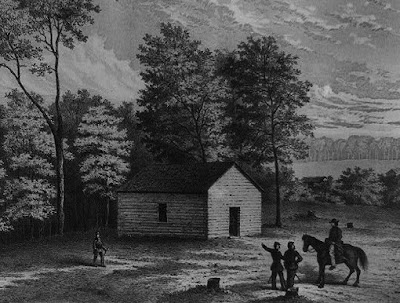
Shiloh Church

Summary historical perspective on the battle

    The intensity of the Battle of Shiloh in southwestern Tennessee on April 6-7, 1862, also known as the Battle of Pittsburg Landing, changed public expectations in both the North and the South that this would be a short-lived war because of the intensity of the battle and the high rate of casualties for both sides:
            Union losses out of 62,000 troops: 13,047
                        Killed 1,754
                        Wounded 8,408
                        Missing or captured 2,885
            Confederate losses out of 45,000 troops: 10,669
                        Killed 1,728
                        Wounded 8,012
                        Missing or captured 959
    In his memoirs in chapter 25 “Remarks on Shiloh” Grant writes “Up to the battle of Shiloh, I, as well as thousands of other citizens, believed that the rebellion against the Government would collapse suddenly and soon, if a decisive victory could be gained over its armies….” But the intensity and cost in man-power changed his perspective:  “I gave up all idea of saving the Union except by complete conquest.”
    Though the Union losses were greater than the Confederate, the Union victory would allow for him to push deeper into Southern territory to divide the Confederacy in two.  Victory came at a high cost.
 
Reflections on the “soldier in the ranks” perspective on dealing with the cost of battle
    In the midst of such pain and suffering what should one do?  The above account which Horatio Hackett recounts shows some dealt with the harshness of their suffering through the lens of faith.  The hymn “When I can Read My Title Clear” by Isaac Watts was first published under the heading "The Hopes of Heaven our Support under Trials on Earth" in his 1707 Hymns and Spiritual Songs:

When I can read my title clear
To mansions in the skies,
I’ll bid farewell to every fear,
And wipe my weeping eyes.
 
Should earth against my soul engage,
And hellish darts be hurled,
Then I can smile at Satan’s rage,
And face a frowning world.
 
Let cares, like a wild deluge come,
And storms of sorrow fall!
May I but safely reach my home,
My God, my heav’n, my All.
 
There shall I bathe my weary soul
In seas of heavn’ly rest,
And not a wave of trouble roll
Across my peaceful breast.
 
    “Clear title” means “undisputed ownership”.  Isaac Watts’ original title -- "The Hopes of Heaven our Support under Trials on Earth" -- gives us insight into his meaning of this song.  In a world of fear and sorrow, Watts challenges us to put our trust in Jesus’ promise in John 14:1-3: “Let not your heart be troubled: ye believe in God, believe also in me.  In my Father's house are many mansions: if it were not so, I would have told you. I go to prepare a place for you. And if I go and prepare a place for you, I will come again, and receive you unto myself; that where I am, there ye may be also” (King James Version wording clearly is the basis for the song).  Through faith in Jesus, Watts says we can put in perspective the troubles of this world as we look to the place of joy Jesus is preparing for those who trust in Him as Savior.
    So there on the Shiloh battlefield where death, pain and sorrow were abundant, for many of the men this well-known hymn became a call to look to Jesus’ promise as a way of dealing with the “storms of sorrow” that night and yet also an offering of praise to Jesus for His willingness to “die a death of agony for me”.
    In the Old Testament, the town of Shiloh ("place of peace") became the place where the Tent of Meeting was located after the land was conquered and the people would come to worship God during the time of Joshua and the days of the Judges (Josh.18:1-10).  The Shiloh Meeting House on the battle site was built in 1853, and Union forces encamped along the ridge the church was built on.  The battlefield took its name from the church.  The church was damaged in the fighting, then used as a hospital after the battle, and finally torn down by Union soldiers for the lumber to build a bridge.

    In Nothing But Victory -- The Army of the Tennessee 1861-1865 by Steven Woodworth (2005) pages189-191 is a detailed description of the night of April 6.  After intense twelve hours of fighting came the darkness with the wounded between the lines "calling for mother, sister, wife, sweetheart, but the most piteous plea was for water". Then came the rain and thunder mixing with the ongoing artillery fire between the lines.  Woodworth cites that on one part of the battlefield was heard the singing of Charles Wesley's "Jesus, Lover of My Soul" hymn among the wounded.  And elsewhere was the singing of the hymn of this account.  I cite this as evidence that the above account recorded by H. Hackett is in fact a description of something that actually happened that night.

Children’s project questions:
            1) Talk about the shift from early war “optimism” that the conflict would be brief and end soon to the “reality” that it was going to be a “long hard road to Richmond”.  Explore why human nature often “presumes” desired outcomes more often than realistically thinking through what might happen and exploring ways to overcome the difficulties to accomplish the goal.
            2) Would there be many who would join in today if someone started singing a Christian song on a battlefield filled with wounded & dying soldiers?  What does that say about our culture today?  Does that make you glad or sad?