Showing posts with label Letter writing helps. Show all posts

Friday, March 25, 2022

Letters Are Important to Civil War Soldiers

 What is the proof that letters were important to Civil War Soldiers?
We often hear that letters were important to soldiers serving on the field. The following excepts are from letters George P. Jarvis wrote to his sister Leonora Jarvis during the war when he served in the 3d Ohio.  The complete transcripts of all eight of his letters are in Billy Yank & Johnny Reb Letters under the Ohio section.  The complete letters are interesting reads.  I am only citing excepts from various letters that illustrate how much he treasured staying in contact with family back home through letters.  I hope you find this first hand evidence of "letters being important" enjoyable and informative.
George P. Jarvis (1842-1920). Raised in in Athens County, Ohio where his father had a mercantile business in the unincorporated town of New England. (No, not the region in the North Eastern US.)  He enlisted for three months in the 3d Ohio, then reenlisted June 1862. Wounded Oct. 1862 in the Battle of Perrysville Kentucky, he returned to his unit in late Dec. 1862 when stationed at Murfreesboro Tennessee.

Letters from home are considered a good source of news; also he mentions that he has enclosed a letter from a confederate soldier that was left behind when then they skedaddled. Letter #1:

Huntsville, Alabama
May 13th 1862
Dear Sister,
Having nothing else to do this morning, I thought I would drop you a few lines. The weather is very hot here now although it is only May and the Devil only knows how hot it will be next month. I think, however, that six or eight months will close this thing up [the war]   . . . I wrote to Charlie Collier some time since but as yet have received no reply. Haven’t had a mail for three weeks and can’t tell what is going on. About all the news we get is from a Nashville paper — a kind of a would-be Secesh if it dared to sort of a paper — and one don’t have much comfort in reading it. . . The enclosed letter is one that I picked up. The writer, it seems, was a member of Hindman’s Legion [CS Arkansas units led by Thomas Hindman that Jarvis’ unit routed] — the same we shelled at Bowling Green. It seems from his letter that they were not whipped, they only ran to prevent such a catastrophe. He is wrong as regards the number killed as there was not a person killed during the whole cannonade. It will give you a pretty good idea of Southern intellect. But I have been stretching this out longer than I at first intended and will have to close. So good bye all with kind regards to everyone. 
I remain as ever your affectionate brother, — Geo. P. Jarvis

    Letters allow “news” to flow both ways. Unfortunately, there is no copy of the captured confederate letter that Jarvis sent home.  But you can see he wants to keep his family informed of what’s going on in his life on the field.  At the same time, he relies on them to keep him updated on news, both family and national.   His letters show there is give and take between him and his family, which is an encouragement to him as he does his duty.


    This plain envelope is what he sent Letter #1 in to his sister.  Note that is it marked "Soldier's Letter" in the upper right corner.  So that is why the "due 3" is written in the lower left below the address. His sister had to pay three cents to redeem the letter.  In the upper left corned it looks like the letter was sent through the Chaplain of the 3d Ohio, who also wrote the tag Soldiers Letter.  Remember, there was no "free mail" for soldiers at this time in history.

Circumstances sometimes make writing a bit difficult Letter #2:

Murfreesboro, Tennessee  September 4th 1862
Dear ones at home,
It has been some time since I wrote home but be assured that it was not a lack of interest on my part that caused the delay, but we have been on the move almost all the time and it has been impossible for me to send a letter even if I had written one. I will give you a brief account of our march and troubles. . . My postage stamps were all stolen from me by some rascal night before last and I would like some more if you can send them just as well as not. I would say something about our movements and force but are not allowed to do so. I will write again soon. Give my love to all.
As ever, your affectionate son & brother, — G. P. Jarvis

    Being on the march can make it difficult to keep them up to date with what he is experiencing.  And that his postage stamps were stolen also doesn’t help.  Remember, postage stamps functioned as small change during the war, so the thief was likely stealing them for the money value.  But For Jarvis the frustration is that it hinders his ability to stay in touch with his family.  For more information on this see my post “Letter Writing and Postage Stamps Importance to the Civil War Soldier” May 9, 2020 in the blog archive, where I discuss the need to use stamps as money because of the coin shortage during the war.

Mail Delivery is not always the best – grumbling about delays Letters #4 & #5:

Corinth, Mississippi
May 18th 1863
Dear ones at home,
Not as yet have I heard from you, but if I don’t get a letter tonight, I shall be disappointed, and I’ll give Uncle Sam’s mail carriers thunder for I think they have had sufficient time to have forwarded a letter to me since I wrote you last. But it will come some time and if it does not come tonight, I shall not despair. Suppose I should be at home soon. Would it not surprise you? . . . Now do not make up your minds to see me for this is only my opinion, but just consider me as absent till my time is out and then if I get home before, why! you will be disappointed, that’s all.

Murfreesboro, Tennessee
June 22d 1863
Dear Ones at P. G. C.
I take upon myself the duty of answering your kind letter of the 4th and 7th ulto. received yesterday. You can’t guess how much pleasure they afforded me, they being the first of a late date I had received from home since I left Murfreesboro to go on that confounded trip into the bowels of “Dixie.” I had you — when I was at Nashville — direct to that place without reference to Company or Regiment from the fact that I did not know what moment I would leave there nor where I would go, and I thought by so doing I could get the letters sooner and it has proved I was right. The letters remaining in the office are advertised each morning and as soon as I saw my name in the advertisements I wrote to the postmaster where to forward them to. Don’t you think I was rather cute?

    Jarvis has some interesting comments in these two letters about delivery issues.  You can’t blame him for grumbling about delays since he really values the letters from home.  Yet circumstances on the field often made mail delivery to the soldiers difficult.  The second letter shows an interesting point that evidently a list was put out to units about letters that the army mail service wasn’t sure where the addresses was located.  Interesting, as I had not heard about this approach to letter delivery, but it does make sense.
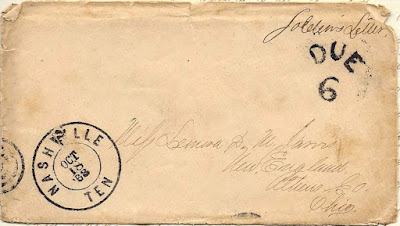
    This plain envelope is from Letter #6 which I have not cited anything from, but I have included the envelope picture here because of the "Due 6" cents stamp on it.  The cost of getting letters home for the soldiers varied at times due to factors such as a long distance or the need to be sent on a ship to get delivered.  I do not know what was the cause of the additional cost in this case.  Again, notice that this time George Jarvis wrote "Soldiers Letter" himself in the upper corner.  The postmark shows the letter clearly went through Nashville, TN to be delivered to Ohio.

Constantly changing circumstances sometimes mean rewriting is necessary Letter #7:

Chattanooga, Tennessee
October 3d 1863
Dear Sister,
Your kind note of 14 Sept. came duly to hand last evening about ten o’clock. You have no idea how glad I was to hear from you for I had not heard a word for nearly a month. I have written just as often as I could send letters and even oftener. Two or three letters I have written and kept a few days and then burned them up because I had no opportunity to send them. And by the time I would get an opportunity, they would be stale and I would write again. I have not written much account of the fight [Battle of Chickamauga] because you will get it in the papers much sooner and more correctly than I could give it to you, and I have not been on the field at all, but have been in the rear all the time where we get nothing but exaggerated reports till we ourselves get a paper containing an account of the battle. And even if I had been there, I could only have described first what came beneath my immediate notice.

    Jarvis takes keeping the family updated seriously, so as things are often changing, he updates letters if he can’t send them out.  And evidently, he doesn’t want his discarded letters to be found and read by someone other than his family.  Yet he is also honest in that he realizes his perspective is often limited and may not be the total truth of what has taken place.
    As I said at the beginning, I've only cited excerpts focused on illustrating his high value of staying connected with family through the letters.  I appreciate his sense of humor and also his humility.  He is sharing what he is experiencing so they can continue to be involved in his life even though separated by hundreds of miles.  Mail Call for him was a good thing to look forward to.  And because his letters have been preserved, we also get to see into his joy of keeping connected with his loved ones back home.

Children Projects:
1)  Do you think Jarvis’ action in letter #7 in getting rid of old letters that he didn’t get sent out and so had to update by rewriting is in part due to his finding that confederate soldier’s letter he mentions in letter #1?  He doesn’t want his feelings, concerns and perspectives being read by someone other than his intended readers, his family.
2)  Explore the issue of stamps being worth money by also reading the blog I mentioned in comments on letter #2.  Today if you took in a stamp to a store would they accept it as change?  No.  Especially the “forever stamp” which has a constantly changing value.
3) Look at the envelope pictures.  They are marked “soldier’s letter”, but they were not "free".  The family had to pay the money due to redeem them at the hometown post office.  And remember “3 cents” back then was of much greater value then 3 cents is today.


Saturday, May 9, 2020

Letter Writing and Postage Stamps Importance to the Civil War Soldier

     John D. Billings' recollections of his time served in the Army of the Potomac have many interesting insights into life in the army during the Civil War.  In 1887 he published them in his book Hard Tack & Coffee -- Soldier's Life in the Civil War.  I hope you will find Billings' brief description of letter writing and dealing with postage stamps in the chapter "Life in Tents" as interesting as I have.  [page 62-63].

Letter writing was important
"The manner in which the time was spent in these tents [Sibley style] and, for that matter, in all tents varied with the disposition of the inmates.  It was not practicable for men of kindred tastes to band themselves under the same canvas, and so just as they differed in their avocations as citizens, they differed in their social life, and many kinds of pastimes went on simultaneously.  Of course, all wrote letters more or less, but there were a few men who seemed to spend the most of their spare time in this occupation.  Especially was this so in the earlier part of a man's war experience.  The side or end strip of a hardtack box on the knees, constituted the writing-desk on which this operation was performed." 
                                                  
     I've always appreciated the fact that the many letters written during that time have given us greater insight into "what was going on" than the historical headlines about "date and location and armies fought here" could ever do alone.  Sadly our modern means of communications (which are very helpful and enjoyable) will not do the same for future generations looking back on us.  Oh well, life moves on.  For reenactors who wish to portray letter writing at an event, using a wood board as a writing desk might communicate to spectators better the creativity of the soldier-in-the-ranks  overcoming obstacles.  "Let the officers have their fancy writing desks.  We men in the ranks can get the job done even without the advantages of privilege."  The picture here is from the book.  I have seen it before but didn't know where it originally came from.

Postage Stamps were a necessary Challenge
     Then Billings gives insight into why and how postage stamps became important to the soldier, as well as the challenges of keeping the stamps usable:

"It will be remembered that in the early months of the war silver money disappeared, as it commanded a premium, so that, change being scarce, postage stamps were used instead.  This was before scrip was issued by the government to take the place of silver; and although the use of stamps as change was not authorized by the government, yet everybody took them, and the soldiers in particular just about to leave for war carried large quantities away with them -- not all in the best of condition.  This could hardly be expected when they had been through so many hands.  They were passed about in little envelopes, containing twenty-five and fifty cents in value.
Many an old soldier can recall his disgust on finding what a mess his stamps were in either from rain, perspiration, or compression, as he attempted, after a hot march, to get one for a letter.  If he could split off one from a welded mass of perhaps a hundred or more, he counted himself fortunate.  Of course they could be soaked out after a while, but he would need to dry them on a griddle afterwards, they were so sticky."

     One time a few years ago I had a reenactor ask me for an assortment of my reproduction stamps so that he and his fellow comrades could use them as "money" as they played card games at events as the spectators walked by.  In spite of my not wanting to encourage gambling (after all, I do portray the U. S. Christian Commission), I did share some with him because I agreed that it would allow them to portray more accurately to the spectators what the soldiers did back then.
      Billings' description about the stamps getting wet and stuck together is an interesting insight into the many challenges soldiers faced as they lived on the march. When the war broke out the uncertainty over what was going on and people's distrust over the value of the Greenback paper money being issued led to the hoarding of coins made of copper & silver & gold.  But people still needed to give or get back small change in making purchases such as a 3 cent loaf of bread or a 5 cent quart of milk.  During the first few years of the war stamps became by common acceptance and out of necessity "money".  In July 1862 Congress attempted to address the coin shortage by passing a law which allowed postage stamps to satisfy debts owed to the government of up to $5.  People incorrectly presumed that this officially approved stamps as usable for any type of debt or purchase.  In 1862 John Gault came up with the creative encased postage stamp coin solution.  Using button making machines he enclosed postage stamps in silver or brass buttons with a thin mica layer on one side which allowed you to see the stamp's denomination -- this helped preserve the actual stamp better.  He would later add on the back of the encasement button advertisements for various company about their products or services.  His invention was short lived as in 1863 the U.S government issued official script factional currency to over come the coin shortage.  Also during this time various vendors issued "private issue tokens" that they gave out as change when sales were made.
     All this shows the creativity of the people back then as they faced the challenges arising from society being torn apart.  I've often marveled at the fact that postage stamps back then could be cut in half and still used to mail out letters.  For example, you could take a 2 cent Black Jack, and cut one stamp in half, put it on the envelope next to a complete 2 cent stamp and that would total up to the 3 cents needed to mail the letter.  Can you imagine trying to do that today?  The US Postal Service would probably call the police and have you arrested!  Times have certainly changed as the bureaucrats have gotten greater power to control us with "the official regulations and procedures".
     When we forget history, we lose examples of how people before us have risen to the challenge of "changing times".  We should never be herded into the socialist mentality that "the government" or "the experts" will solve what's wrong.  We as individuals need to always be experimenting with options to overcome the difficulties.  It may be having to use a board for a desk or having to soak apart stamps and then dry them on a griddle.  Creativity needs to come from each of us.  That makes us better and stronger, and will also make for good stories later on we can tell around the campfire.


Wednesday, August 17, 2016

Captured Yankee Envelope Used for a Confederate Letter Home

     I have heard of Southern Soldiers using "captured" Union stationery to write letters home.  I recently ran across a reference to an actual historical incident of a confederate soldier doing this.  I pass along this anecdote to give you "support" for doing this in your living history presentations:

When the sun came up the next day, Hotchkiss could see more clearly what had happened at the Battle of McDowell.  "The Yankees abandoned a large quantity of stores here, baggage, etc -- I got quite a number of things and enjoyed plundering them, retaliating for Rich Mtn," he wrote Sara in a letter mailed in a captured "Yankee envelope."  Despite the victory, Hotchkiss admitted that "this country is a scene of desolation.  Living scarce."  
             [pp.262-263 In the Presence of Mine Enemies:  War in the Heart of America, 1859-1863 by Edward Ayers 2003]

     The letter writer is Jedediah "Jed" Hotchkiss, cartographer for Stonewall Jackson in the Valley Campaign of 1862. Ayers cites the above quote coming from a letter Hotchkiss wrote to his wife dated May 10, 1862. Ayers lists the letter as being part of the  "Jedediah Hotchkiss Papers" collection in the "Library of Congress, Manuscripts Division, Washington DC." 
     I wish I had a picture of the captured Yankee cover, but Ayers does not supply it.  But the citation of Hotchkiss' letter to his wife at least gives a specific instance backing up what I've heard happening from time to time.  Such use of captured stationery makes perfect sense -- "you use what you have" to write home on.  Plus in this instance you can sense the satisfaction Hotchkiss has in sending home some evidence of victory over the invading Yankees.

Some suggested teaching points for integrating this historical practice into your Southern living history presentation:
     1) Shows the frugality of the times:  Soldier's used what they had.  Letters -- staying connected with loved ones back home -- was very important.  You can also share how especially in the South as shortages became more severe, they would reuse envelopes by turning them inside out;  use wall paper to make them, use any sort of paper they could find to make up an envelope.  So obviously using a captured stationery set just makes sense.
     2) Sent home as a Trophy:  Yes, it's a Yankee cover, but hey, they ran leaving spoils of war behind for us.  Using it to write home brings a bit of satisfaction to show our folks back home that we beat them Yanks!
    3) Write over/ change the Northern political message to reflect Southern Pride like I've done on this reproduction cover:

Illustration of how to use a captured Yankee cover
to show Southern Pride
Remember that patriotic envelopes were used to reflect political opinions.  I like to tell people to look at them as "1860s bumper stickers".  So have some fun being creative taking a captured Yankee cover and reversing the message to reflect Southern perspectives like I did with this 1861 Union cover.  By letting family see the Union message being "reversed" it serves as both a trophy and an encouragement for "our southern cause".  At the very least, you could cross out the Northern message to show victory over their aggression.  I trust you can see how you can have some fun with this practice and also help your listeners learn more about Civil War history.  Keep teaching history by making it interesting to your listeners.

     Brief biography of Jedediah Hotchkiss:  born Windsor, NY Nov.30, 1828; died Jan.17, 1899 Staunton, VA.  Was a teacher in Lykens Valley, PA.  Then relocated to the Shenandoah Valley/ Virginia area. He signed on as a Confederate teamster, then as a map maker for various campaigns.  His map making skills helped Stonewall Jackson immensely in defending the Valley.  He continued to serve on various command staffs, including General Lee's Army of Northern Virginia, throughout the remainder of the war.  Almost all of the Confederate maps in the Official Records by the US War Department were his.
   

Thursday, February 20, 2014

Portraying a Confederate Regimental Postmaster

    Meet a reenactor who enjoys portraying a Confederate Regimental Postmaster.  Darwin Roseman's interest in postmasters and mail arises from his family history.  His great great grandfather became postmaster of his hometown after serving in the Confederate army during the war.  So it's natural that along with his involvement with the N.C. Cummins Cape Fear Artillery (Longstreets Corp)  he mixes in Postmaster duties with Alexander's Battalion Field Hospital and Gen. A.P.Hill's staff.  He has presented his portrayal to a wide range of children and adult groups such as schools, Scouts, SCV and UDC camps.  Though he is often surprised at how little most people know of the topic, he enjoys making it come alive through discussion, questions and hands on learning.  He finds people receptive.  He lives in Cary, North Carolina.  Here's Darwin's description of his postmaster impression:

    "Here are some of my experiences with the kids and scouts at living histories.  The parents are also very interested in the topic of the Confederate Postal System.
1861
I have a picture of the first postmaster general John H. Reagon which I show the kids as well as give them quick history of who President Jefferson Davis was.  Then I show them the green 5 cent 1861 stamp with his picture on it.  I explain the 500 and over 500 mile rule of mailing with the showing of the 10cent stamp.  Parents are very interested in this aspect.  I ask the kids who Thomas Jefferson is when I show them the 1861/62 10 cent stamp.  I show patriotic and plain writing paper (I call it writing paper and ask the kids what they call it today -- stationery), I show them patriotic and plain covers (I call them covers and ask the kids what they call it today -- envelopes).  I ask them why they are called covers -- they cover the letter.
    I ask the kids why it was important to write letters during the war -- (only means of communications with family and loved ones; no cell phones, computers, etc;  this limitation on communications is often hard for some to understand).  I ask them what happens if they do not know how to read and write -- I tell them my duties as postmaster of the regiment is to assist soldiers in reading and writing letters especially if the soldier came from the farm and had no education.  They find all this fascinating.  They really like the wall paper covers and the range of cover sizes.  I show the stamps in a sheet and ask them how the stamps stay on the covers.  Many answer "by licking them".  I have them feel the back and they discover there is no glue!  Also there are no holes for perforation so I explain about having to cut them apart with a knife or scissors.  To those who say "glue" I explain that early in the war I had glue which was scarce, but as the war progressed and glue wasn't available I was forced to use something else.  That is when I pull out my bottle of molasses.  They really go nuts over this!  Amazingly some don't even know what molasses is so I have to explain that too.  I have a lot of fun attaching a stamp to a cover using molasses and passing it around for them to see how it holds the stamp on.  This usually surprises even the parents.  I also show them a cover where I have sewn the stamp on because I've run out of molasses.  This really gets the kids interested!  When a group is really with me I take the time to show them some of the late war stamps.  I also explain the use of 2 cent stamps for periodicals and drop letters.  Most have no idea what a drop letter is.
1862
    I get a lot of volunteers when I offer them a stamp for helping out.  Parents appreciate how much the kids are learning as they get involved.  Young and old come away with a better understanding of the Confederate Postal system and the importance of letter writing during the war.  I get questions from both kids and parents on a variety of things as I make my presentation.  To help me better make the facts come alive I set up my period tent (I am in period uniform of course), a table with two chairs, stamps, covers, writing paper, a post office sign hanging from my tent, various pictures for distribution during my talk and my hand laptop desk.  Two chairs -- I tell kids one is for the soldier who come to me for help in reading or writing a letter and I want to make him comfortable.  This sounds like a long presentation but really it's not.  Of course each presentation is different and might include or exclude items based on mixture of the group."
(This article is reprinted from the print edition of The Civil War Stationery Journal, Fall 2004 Vol.1, No.2)

    Reenacting as "sharing" is a lot more fun than doggedly pursuing "what's in this for me!"  Over the years I found that reenactors who enjoy sharing 'knowledge, experience and laughter' with others seem to find the joy they need with an event goes bad.  Joy comes from the good times of discovering details which make "history" come alive, from watching a child's eyes light up as you help them discover something they never imagined about history, or from the inner satisfaction of helping a friend improve by encouragement.  Hey, God made us to enjoy helping others.  Let the curmudgeons grumble about unit politics and rations and campsites.  Discover the fun of "gaining" by "giving".
    For me, experimenting with making accurate stationery has opened up a spring of personal satisfaction and enjoyable friendships.  We don't have to all do living history to the same degree.  But consider the possibilities of doing what you normally do in a way that helps others learn -- other reenactors and EVEN spectators.  Yeh, I have dealt with the obnoxious kid coming to our tent and assuming everything on display is for taking or breaking.  But there have been dozens of other kids who honestly get interested in learning why I'm there and what I'm doing.  So take a mental inventory of what you know and enjoy.  You might be surprised how much you have to share with others.  And you will be surprised how much "giving out" brings in "gains' of joy and satisfaction.

Saturday, November 2, 2013

Civil War "Soldier's Letter" Envelope Pictures Showing Various Postage Costs

After writing the post for October 26, 2013 on the Soldier's Letter 3d Maine Envelope, I did a search on the web for other pictures of "Soldier's Letter" envelopes.  Here are a few that I found that show some of the various ways postage costs were indicated:

Examples of envelopes without stamps, marked "Due 3":


United State Christian Commission Envelope
"Soldier's Letter"  Due 3

This envelope has the Soldier's Letter tag hand written with the name of the soldier, a chaplain. 


United States Sanitary Commission Envelope
"Soldier's Letter"  Due 3
This second example does not have the name of the soldier written on it, just the written tag Soldier's Letter, with the additional tag "please forward".  I've seen this sort of request tag in variations of wording written on other Soldier's Letter envelopes.  

Example of Envelope marked Due 6:

U.S. Army Hospital Envelope
Soldier's Letter  Due 6
This third example has the "Due 6" hand written in on it.  There is a name written in under the printed "soldier's letter" line, but it was still evidently penalized.  Why was this letter penalized when it has a name written on it?  Maybe it only has the name of the Chaplain and not that of the soldier.  I'm not sure. 

Example of Envelope with two Three cent stamps:
United States Christian Commission
6 cents postage paid
This fourth cover has only the printed tag, not a hand written one of Soldier's Letter, and no name of the soldier written on it.  The two stamps show six cents was paid to receive the letter.
 
    These examples are not presented as "definitive", but only as "illustrative" and "interesting".  As I said, I pulled these four examples off the web from sites that were selling them, so I do not have additional information to add beyond what we see on the covers.  There was a "standard practice" that was supposed to be followed . . . then real life brought variations.  I hope my grouping them together for you might be helpful in giving you some options to use in building your living history displays.  Any comment or additional information will be appreciated.


Saturday, October 26, 2013

Soldier's Letter 3d Maine Volunteer Infantry Envelope

    Was there free mail for the Civil War soldier to write home?  The simple answer is "no".  I remember thinking how sad that was for the soldiers back then not to have that simple privilege extended to them as they faced life and death fighting for their cause & country.  Letter writing was an important part of the typical soldier's life.  Far from home, letters were the only way to stay connected with family & friends.  They would never get enough letters from home.  They stayed connected with home through the letters they sent back.  
    I recently picked up the Union Soldier's Letter Cover shown here.  I admit its not an impressive envelope and there was no letter inside to give additional details about the soldier who sent it.  It does have the basic notation in the upper right corner of "Soldier's letter" along with the unit designation (3d Maine Regiment Volunteers, possibly company H in the third line down).  The cover is stamped with an Alexandria VA cancellation.  The 3d Maine fought at first Bull Run July 1861, the Peninsular Campaign of 1862 and through the rest of the war.   As beat up as the cover is, I bought it because its an interesting reminder of an unknown soldier's attempt to stay connected to "normal" in the midst of "uncertainty".
Civil War "Soldier's Letter" Envelope
3d Maine Reg. Vols.
Addressed to Mrs Mr J Greenleaf? Bath, Maine
  The designation "Soldier's letter" recognized the reality that often the active duty soldier might not have access to a 3 cent stamp or have the money on hand to buy one even if stamps were available.  Though the letter would be delivered to the addressee, they would have to pay the 3 cents postage due to get the letter.  If the soldier did not tag the envelope with "Soldier's letter" along with his unit designation, then the family would have to pay 3 cents for the letter and 3 cents additional penalty for a total of 6 cents to redeem the letter.  This particular envelope is not stamped "DUE 3" but the Alexandria VA cancellation mark shows it went via the postal system, so maybe the postal clerk knew the family member who picked it up in Bath, Maine?  Don't know.  Like I said its not a perfect example with all the "expected" details of a Union "Soldier's letter".  This envelope's conformity with deviations shows we need to be careful in making broad statements of "this is how they did it. . ." 
    Harry K. Charles, Jr. wrote an informative paper on "American Civil War Postage Due:  North and South" for the Postal History Symposium, Nov. 2012 which has a good section on Soldier's letters.  Both Union and Confederate soldiers could send letters home, postage due (the family needed to pay to redeem them).  Charles says the proper designation needed to be "Soldier's letter" with his rank and unit designation, and possibly unit commander's signature.  The above cover does not have the soldier's name and rank listed; only his unit designation.  As with all things, there was some flex in how things were designated.  The Confederate soldier's letter would have "Due 5" or "Due 10" depending on what the rate was at that time in the war.
    Since letters to home were so important to the soldiers, they came up with various ways outside of the postal system to send letters back to their family.  Anyone going back on furlough was given letters and notes to take with them.  United States Christian Commission delegates would collect letters and carry them back home whenever they could.  The USCC handed out free envelopes and stationery because they realized the importance of keeping the soldiers connected with family.
    So how might knowing some of these details help us do better living history?  Those representing civilians at home could have covers showing an envelope marked "Soldier's letter" with the details of your soldier on it as part of your living history display.  Again, you could mark it PAID 3/ or PAID 5 or 10 to help you explain to spectators what you have to do to keep in touch with your soldier.  For a soldier impression, you could have a letter written up with the envelope labeled correctly that you are "planning on mailing out as soon as possible" to explain to spectators the details and the importance of keeping connected with your family.  You can use patriotic or plain covers.  You can use a USCC or USSC cover which has "Soldier's Letter" printed on it.  Just remember that you as a soldier would not have a Soldier's letter mailed to you from the folks back home.
    At the tent I hand out  to the reenactors who visit us a gift of a USCC or a Plain cover stationery set.  If you are a reenactor, and if you place a regular order just tell me what you portray (US or CS and unit type) and I'll include with your order a gift of  a stationery Mail Kit that you can use for your impression.


Saturday, September 28, 2013

Civil War Letter Writing Reenacting

     Why not explore history through Civil War letter writing? We reenact Civil War history for a variety of reasons.  But whatever our personal motivation, when its no longer "fun" we lose heart.  One helpful way to keep it fun is to constantly be putting ourselves back into "their time".  By wearing brogans we realize the valor of a long march.  By wearing wool we discover the reality of being too hot . . . then enjoy the warmth as the day cools down.  Discovering for ourselves -- putting ourselves back into their time in practical ways creates the "fun" of discovering history.  And its this discovery which takes us beyond 'camping out' into 'reenacting'.
     During the Civil War letter writing blossomed.  Never before had so many people been uprooted from home, experiencing the mixture of the excitement of travel and the pain of homesickness.  Their letters were their way of sharing the wonder of discovery, the grief of being apart, the laughter over the craziness of their situation.  Letter writing was their way to stay connected with loved ones so far away. 
    And for us today letter writing is an excellent way of making their history become "real".  Experimenting in letter writing is sitting beside the fire wondering "what would I say?"  One woman shared with me how writing a letter to her son on her home state stationery as she waited for the various groups to come through at the living history event really helped her 'become' the person she was portraying.  "I imagined proudly using the stationery to write home" she said.  "I was both writing back then, yet writing to my son now, sharing what is happening."  Another reenactor at the 150th anniversary of Fort Sumter shared how writing letters while being there made the event come alive for himself and for the spectators who talked to him about what he was doing.
     I have known several reenactors who enjoy using letter writing to share the experience with family and friends who can't be present.  Others use letter writing to enhance the experience for fellow reenactors at the event.  Such letters are an enjoyable mixture of reality and imagination.  And its imagination which enables us to better explore for ourselves and explain to spectators the history we are trying to honor.
     In your letter writing, give yourself the freedom to mix what's going on with the broader landscape of history.  For example grumbling about the food and the offices can be both historic fun and present day therapy.  I have friends who think I'm a little crazy to send them one of my letters from the front, but they enjoy getting the note and sometimes even learn a little history in spite of themselves.
     Yes, we should use good envelopes and stationery to make accurate living history props for people to see.  But why shouldn't we also use letters to help us explore the fun of reenacting?