Showing posts with label Civil War Humor. Show all posts

Friday, October 6, 2023

Hardtack in the Petersburg trenches -- A Soldier’s “Explanation”

 What might be a creative way to point out the deficiency of army rations to a superior?  Here is one interesting account:
    While before Petersburg, doing siege work in the summer of 1864, our men had wormy “hardtack,” or ship’s biscuit, served out to them for a time.  It was a severe trial, and it taxed the temper of the men.  Breaking open the biscuit, and finding live worms in them, they would throw the pieces in the trenches where they were doing duty day by day, although the orders were to keep the trenches clean, for sanitary reasons.
    A brigade officer of the day, seeing some of these scraps along our front, called out sharply to our men: “Throw that hardtack out of the trenches.”  Then, as the men promptly gathered it up as directed, he added: “Don’t you know that you’ve no business to throw hardtack in the trenches?  Haven’t you been told that often enough?”  Out from the injured soldier heart there came the reasonable explanation: “We’ve thrown it out two or three times, sir, but it crawls back.” 
            [H. C. Trumbull War Memories of an Army Chaplain
                (Charles Scribner’s Sons, New York 1898) p.52-53]

Troops in the trenches
Library of Congress/ Getty Images
(Location is debated. Some sites tag this as picturing men in trenches at Petersburg.
But other sites say the location is unknown or at Fredericksburg.)

    I heard this joke about hardtack early on when we started reenacting many years ago, and have often used it myself over the years to explain to spectators, especially kids, about the “glories” of hardtack.  No one I talked to knew the source, even though they had heard the joke.  Some years later I finally learned the source of the story is from Henry Clay Trumbull, who served as a Chaplain in the 10th Regt. Connecticut Volunteers.  Was glad that I confirmed to myself that it had historical background instead of being just a modern reenacting joke.
    But what was Trumbull source?  Was it his personal slam on hardtack he would tell in a fictional story to make it sound good?  The joke about hardtack appears in his book in Chapter 3 entitled “Disclosures of the Soldier Heart”.  In this chapter Trumbull uses several incidents which he witnessed to give insight into attitudes and motivation of the soldiers he served with.  He cites various incidents of soldiers enduring hardship while still showing great dedication and fortitude in their service to their unit and their country.  Then he makes the following summary statement:
     “There was no show of heroism on the part of the average soldier, any more than there was a show of sentiment.  He simply was a loving-hearted hero, without saying anything about it, or making a demonstration of his feelings.  Indeed, a soldier tried to cover up his emotion; and in this effort he would frequently act as if he were ready to laugh, when he felt a good deal more like crying.  A joke, indeed, often took the place of an oath, starting a laugh instead of a groan or a sob, as the feelings must find vent in some way.” [p.50]
    Trumbull is saying the men he served with were not focused on being famous.  Their focus was on diligently doing their duty to comrades and county.  Trumbull follows the introductory summary with some examples of how humor helped the men handle the tedium or difficulty of their circumstances.  The Petersburg hardtack joke cited above is one of the examples he gives of humor being a vent for frustration.
    He then shares a second hardtack joke from the same Petersburg situation:
    About the same time, I was accompanying our brigade commander in a tour of observation along our front.  As he stopped in the trenches where the men were keeping up a sharp fire, he saw them opening a fresh box of ammunition, of which they constantly needed a new supply.  Noting the careful wrapping of the cartridges in their neat packages of a dozen each, he said pleasantly to the soldier who was taking them out:
    “’Uncle Sam’ is very careful that his boys shall have good cartridges while in his service.”
    “Yes, sir; I wish he was half as careful of their hardtack,” was the keen and respectful reply.
    This dry humor in the expression of strong feeling showed itself in the ordinary soldier in every phase of his service.”  [p.53]

    Trumbull then moves on from examples of humor giving vent to frustration over poor rations to explaining how general humorous contempt toward cowards helped the man in the ranks resist the temptation to shirk his own duty in the next few pages. 

    Trumbull does not tell how the officers reacted to the hardtack jokes.  Possibly his being silent on that aspect might mean the officer in each situation caught the point, knew it was an honest challenge about the poor quality of rations, and chose not to seek punishment on the man who said it.  Can’t say for certain.
    I do not present this information as being some profound historical discovery to impress you, the reader.  I just appreciate knowing the historical background of a joke I’ve often told.  And when I tell it to spectators now, I can add the insight which Trumbull gives about humor being a relief for the struggle to deal with difficult challenges like poor quality rations.  I have often thought reenacting the incident in front of a crowd of spectators would be ‘humorously educational’.

    Henry Clay Trumbull (1830 to 1903) was Chaplain of the 10th Connecticut Infantry starting in 1862.  The troops enjoyed his eloquent sermons, his dedication to helping and encouraging them, and his personal courage.  He was captured at the battle of Fort Wagner on July 19,1863 while searching for wounded Union soldiers, and held as a prisoner of war until exchanged on Nov.24, 1863, when he then rejoined the 10th Conn., serving with them until they mustered out in Aug. 1865.
    After the war, Trumbull became a prominent lecturer, an advocate for Sunday School being incorporated into the American church, and a scholar who wrote many books.  Among them was The Knightly Soldier (1865 biography of his friend, Adjutant Henry Ward Camp, who was KIA Darbytown Road, Oct 13, 1865), and War Memories of an Army Chaplain (1898).

Chaplain Henry Clay Trumbull
Picture from Connecticut Historical Society collection.
Rustic pulpit built by Army Engineers
below Richmond Va. in the winter of 1864-65.

    The 10th Connecticut Infantry Regiment was one of Connecticut’s most exemplary units, having fought in twenty-three battles and many smaller skirmishes.  It was formed in the summer of 1861, serving in the early war coastal campaign from the battle for Roanoke Island to the assault on Fort Wagner, then on to fight in the trench as the Union Army pressed in on Petersburg and Richmond.  They were present at Appomattox when Lee surrendered to Grant.  The Tenth was one of the top 300 Union regiments in the Civil War (out of over 1,700), according to historian William F. Fox.

Children Projects:  
    Might be an interesting opportunity to discuss options of handling frustrations.  Also, how humor could be better than outright anger, but can also lead to punishment if the superior gets angry.  Might look at Proverbs 15:1ff.
    For hardtack projects check out my other posts tagged with “hardtack” such as Oct.22, 2022 “Why was hardtack so disdained by the Civil War troops?”

Saturday, October 22, 2022

Why Was Hardtack So Disdained by the Civil War Troops?

  Complaining about army rations has been a soldier’s task from time immemorial.  But is there really any basis for the Civil War soldier to grumble about the army provisions?  Well, John D. Billings (Hard Tack and Coffee. Soldier’s life in the Civil War 1887  p.113-16) has an interesting description of this ‘beloved’ government issued army ration which I’d like to serve up for your enjoyment, then you decide if you would sing it’s praises:

“I will speak of the rations more in detail, beginning with the hard bread, or, to use the name by which it was known in the Army of the Potomac, Hardtack.  What was hardtack?  It was a plain flour-and-water biscuit.  Two of which I have in my possession as mementos measure three and one-eighth by two and seven-eithers inches, and are nearly half an inch thick.  Although these biscuits were furnished to organizations by weight, they were dealt out to the men by number, nine constituting a ration in some regiments, and ten in others; but there were usually enough for those who wanted more, as some men would not draw them.  While hardtack was nutritious, yet a hungry man could eat his ten in a short time and still be hungry.  When they were poor and fit objects for the soldiers’ wrath, it was due to one of three conditions:  
First, they may have been so hard that they could not be bitten; it then required a very strong blow of the fist to break them.  The cause of this hardness it would be difficult for one not an expert to determine.  This variety certainly well deserved their name.  They could not be soaked soft, but after a time took on the elasticity of gutta-percha. 
[During the Civil War “gum blankets” (water-proof flexible ponchos/ground clothes) were issued to the troops made with either India rubber or gutta percha coated muslin cloth. According to an on-line video by Mike Woshner, author of India-Rubber and Gutta-Percha in the Civil War, only 4% were made with the gutta-percha latex, the rest with India rubber.  It seems the term “gutta percha” became the popular ‘slang term’ for everything that was black rubbery looking even though it was made with India rubber.  So, in this context John Billings is saying that even if you soaked them, at best it is still just like eating your gum blanket.]
The second condition was when they were mouldy [sic] or wet, as sometimes happened, and should not have been given to the soldiers.  I think this condition was often due to their having been boxed up too soon after baking.  It certainly was frequently to exposure to the weather.  It was no uncommon sight to see thousands of boxes of hard bread piled up at some railway station or other places used as a base of supplies, where they were only imperfectly sheltered from the weather, and too often not sheltered at all.  The failure of inspectors to do their full duty was one reason that so many of this sort reached the rank and file of the service.
The third condition was when from storage they had become infested with maggots and weevils.  These weevils were, in my experience, more abundant than the maggots.  They were a little, slim, brown bug an eight of an inch in length, and were great bores on a small scale, having the ability to completely riddle the hardtack.  I believe they never interfered with the hardest variety.
When the bread was mouldy [sic] or moist, it was thrown away and made good at the next drawing, so that the men were not the losers; but in the case of its being infested with the weevils, they had to stand it as a rule; for the biscuits had to be pretty thoroughly alive, and well covered with the webs which these creatures left, to insure condemnation.  An exception occurs to me.  Two cargoes of hard bread came to City Point, and on being examined by an inspector were found to be with weevils.  This fact was brought to Grant’s attention, who would not allow it landed, greatly to the discomfiture of the contractor, who had been attempting to bulldoze the inspector to pass it.
The quartermasters did not always take as active an interest in righting such matters as they should have done; and when the men growled at them, of course they were virtuously indignant and prompt to shift the responsibility to the next higher person, and so it passed on until the real culprit could not be found.
But hardtack was not so bad an article of food, even when traversed by insects, as may be supposed.  Eaten in the dark, no one could tell the difference between it and hardtack that was untenanted.  It was not uncommon occurrence for a man to find the surface of his pot of coffee swimming with weevils, after breaking up hardtack in it, which had come out of the fragments only to drown; but they were easily skimmed off, and left no distinctive flavor behind.  If a solider cared to do so, he could expel the weevils by heating the bread at the fire.  The maggots did not budge in that way.  The most of the hard bread was made in Baltimore, and put up on boxes of sixty pounds gross, fifty pounds net; and it is said that some of the storehouses in which it was kept would swarm with weevils in an incredibly short time after the first box was infested with them, so rapidly did these pests multiply.”

As disdained as hardtack was by the soldier, it was a staple of army rations long before the Civil War, having variations of its production back to ancient times for various army and naval units.  So, its use in the Civil War time period is not a “new thing”.  William Davis writes “as many as three or four million hardtack [were] being consumed every day [by 1864], clearly too big a demand for any one baker to supply, and thus companies all across the North received contracts that kept their ovens at baking heat around the clock.” (A Taste for War: Culinary History of the Blue and the Gray  2003, p.42)  That is a lot of crates of hardtack being shipped to Union troops.
The South, not having as much access to wheat flour which was grown mostly in Virginia and Georgia, used other things like corn or rice to make something similar to hardtack known as “corn dodgers” or “Johnny cakes”.  This was a mixture of cornmeal, salt, and water cooked until it was just as dry and hard as the Union hardtack.
Given the challenges of the time period of limited preservation options combined with the large quantity needed and the transportation challenges, we have to give the soldiers back then much credit for making due with what they had, even if they grumbled and mocked it in songs like “Hard Crackers Come Again No More” (see the March 5, 2022 post about this humous song).  They made due with what they had in order to accomplish the task before them.  We can also see why the army sutlers enjoyed good business in offering expensive options of food variety to the soldiers.

        An example from the Vicksburg campaign of soldiers valuing this army ration is cited in Nothing But Victory; The Army of the Tennessee 1861 -- 1865 (p405-06) by Steven Woodworth.  "The [Union] army spent May 20 and 21 [1863] making preparations, improving its position and its supply situation.  Though the process of hauling up material from the river had begun on the nineteenth, it was taking time to get the new rations into the hands of the soldiers.  Riding his line on May 21, Grant heard one of the soldiers say, quietly, but just loud enough for the general to hear him, 'Hard tack.'  That was all it took, and within moments hundreds of men had taken up the chant of  'Hard tack!  Hard tack!' and it spread rapidly along the line in both directions.  Grant assured the soldiers nearby that the food was one the way, and shouts of 'Hard tack!' changed to cheers.  By the evening the army was able to issue full rations to all of its troops around Vicksburg."

Children’s projects:
1. Given the resources of the times, can your children understand that it was an honest attempt to have food available to eat that could be stored, transported and handed out to keep the men fed?  Remind your children this is before refrigeration and plastic packaging etc we take for granted today.
2. Which one of the three options would your children find most horrible if their rations were contaminated in one of the ways Billings lists.  Extra hard?  Moldy?  Weevil infested?
3. Do some on-line research about weevils.  Would they make nice pets?  What might be the rationale behind not rejecting weevil infested crackers?  Look at Billings description of how such biscuits were used by the men.

Saturday, March 5, 2022

Hard Crackers, Come Again No More! A Song Celebrating a Beloved Civil War Army Ration!

    Yes, the title above is being sarcastic.  John D. Billings shares his memory of a famous Civil War song that captures the “man in the ranks joy” over the army’s provisions (Hard Tack and Coffee.  Soldier’s life in the Civil War 1887).  This song that Billings remembers is a Civil War parody of a popular song from 1854 “Hard Times Come Again No More” by Stephen Foster that
challenged the fortunate to remember the struggles of the less fortunate.  The Civil War song is a satirical mocking of a staple of army rations that went by a variety of names: the hard cracker, hardtack, hard bread, army crackers, worm castles, sheet-iron crackers, tooth dullers.  Billings writes:

    “For some weeks before the battle of Wilson’s Creek, Mo., where the lamented [General Nathaniel] Lyon fell, the First Iowa Regiment had been supplied with a very poor quality of hard bread (they were not then -- 1861 -- called hardtack).  During this period of hardship to the regiment, so the story goes, one of its members was inspired to produce the following touching lamentation:

Let us close our game of poker,
Take our tin cups in our hand,
While we gather round the cook’s tent door,
Where dry mummies of hard crackers
Are given to each man;
O hard crackers, come again no more!
Chorus:  ‘Tis the song and sigh of the hungry,
“Hard crackers, hard crackers, come again no more!
Many days have you lingered upon our stomachs sore,
O hard crackers, come again no more!”

There’s a hungry, thirsty soldier
Who wears his life away,
With torn clothes, whose better days are o’er;
He is sighing now for whiskey,
And, with throat as dry as hay,
Sings, “Hard crackers, come again no more!”  -- Chorus

‘Tis the song that is uttered
In camp by night and day,
‘Tis the wail that is mingled with each snore,
‘Tis the sighing of the soul
For spring chickens far away,
“O hard crackers, come again no more!”  -- Chorus

When General Lyon heard the men singing these stanzas in their tents, he is said to have been moved by them to the extent of ordering the cook to serve up corn-meal mush, for a change, when the song received the following alteration:

But to groans and to murmurs
There has come a sudden hush,
Our frail forms are fainting at the door;
We are starving now on horse-feed
That the cooks call mush,
O hard crackers, come again once more!
Chorus:  It is the dying wail of the starving,
Hard crackers, hard crackers, come again once more;
You were old and very wormy, but we pass your failings o’er,
O hard crackers, come again once more!

The name hardtack seems not to have been in general use among the men of the Western armies.”  (p.118-19)

    In sharing this memory, Billings is reminding us that he and others did their duty even though it meant having to be “creative” with less than ideal food rations as well as with finding humor in what they were dealt.  Now certainly down through the centuries it has always been the habit, and the right, of the ranks to complain about the rations provided.  You have to enjoy the creativity of this song in lamenting what was a part of life for the soldier during the Civil War.

Children’s project:
1) Make some hardtack (there are various recipes on line; this one from the site:  Emerging Civil War – “Civil War Cookin’: Hard Tack Come Again No More”.  No, haven’t personally tried to use this recipe.  Others on line have differing measurements, salt added, and cooking times etc.
    3 cups flour (can use all-purpose, but whole wheat is more authentic)
Water (1 cup)
Add enough water to Flour so the mixture is soft, but not sticky, then knead for 8 minutes to make the dough elastic.  Roll the dough out and cut into 3”x 3” squares ½” thick.  Use a nail or something to prick four holes across in four rows down into the dough, then turn over and do this again -- (this prevents the cracker from “rising” as it bakes).  Bake at 450 degrees for 7 minutes, then reduce oven to 350 and bake for additional 7 – 10 minutes. They will be hard, and get harder as they cool and dry.  Bake them for looks, not for eating as they will be hard.  Don’t put them in a sealed container because they will mold, but let them dry out completely.  Add weevils for additional flavor and realism.  What?!? Just joking.  My family has a couple of hardtack pieces that we use for living history display that were given to us almost 30 years ago.  That should tell you how “durable” hardtack is.

2) Look up the words to the song “Hard Times Come Again No More” and compare them to this Civil War song parody.  (Parody: an imitation of the style of a particular writer, artist, or genre with deliberate exaggeration for comic effect).  Explore how parody works by looking at Foster’s song which calls on the favored in society to see the distressed struggling people around them and realize their plight.  Some say Foster’s song was his way of calling on the privileged to realize the needs of “the less fortunate” around themselves.  Others see his song as expressing his personal feelings as he descended into loss in his own life.  It most likely is a mix of both.  As culture continued to divide and the Civil War came, his song was indeed a challenge needed by society to look compassionately on others in their struggles.  Now obviously the parody Civil War song “Hard Crackers Come Again No More” is making the challenge for the “privileged” well-fed officers to see the plight of the “down-trodden” man-in-the-ranks.  Some eat well in the army, while many others must make do with poor quality rations as they obey the orders of the privileged to march and fight.   The “effectiveness” (= popularity) of the Hard Crackers song is in a great degree based upon the popularity of the Hard Times song in the culture of that time.  Maybe come up with a project where your child does a parody on something that is popular to them.

Saturday, January 22, 2022

On a Muddy Path You have to Laugh -- Burnside's Mud March January 1863

    General Ambrose Burnside, who replaced George McClellan as commander of the Army of the Potomac in Nov.1862 hoped that his plans in January 1863 to march on Richmond would go better than the disastrous assault on Fredericksburg he had commanded in December 1862 had gone.  This time he planned for his army to outflank Lee’s defensive position at Fredericksburg by crossing the river upstream and drawing Lee’s men out of their defensive positions.  That was the plan. 

           On January 20, 1863 in unseasonably mild weather the Union Army started its march to cross the Rappahannock.  But during the night a violent storm began pouring down rain which continued coming over the next two days.  The torrential downpour turned the dirt roads into a muddy quagmire.  One solider wrote “The whole country was a river of mud, the roads were rivers of deep mire.”  Wagons sank to their wheel hubs in mud.  At times artillery became so hopelessly stuck that even a team of 12 horses and 150 men couldn’t pull one cannon out of the mud.  Soldiers slipped repeatedly, many losing their shoes in the thick mud.  The rain ended on the 22nd, but the unusual above freezing temperatures kept the roads sticky mud paths where horses and mules died of exhaustion.  To help raise his soldier’s spirits Burnside issued a whiskey ration, but instead it led to drunken troops brawling with one another.  Across the river, Confederate pickets watched the struggling Union troops with amusement.  Some put up a large sign on the riverbank that said “Burnside’s Army Stuck in the Mud” and another sign “This way to Richmond”.

    On the fourth day, Burnside cancelled the order for the advance and ordered his troops to return to their encampments.  Many in the ranks were totally demoralized.  A Massachusetts soldier, Charles E. Davis Jr. wrote, “It is not an exaggeration to say, that before or after, there was seen no such state of demoralization as possessed a large part of the Army of the Potomac at the end of this foolish undertaking.”  Lincoln replaced Burnside with Joseph Hooker as commander of the Army of the Potomac on Jan.26th. 

    All this historical background gives an interesting twist to a “revised prayer of the soldier while on the celebrated Burnside Mud March” that John Billings shares in his book of Civil War memories  (Page 72 Hard Tack and Coffee 1887):

"Now I lay me down to sleep
In mud that's many fathoms deep
If I'm not here when you wake, 
Just hunt me up with an oyster rake"

    You have to smile at the humor of whoever came up with this revision of a prayer meant to comfort.  Sometimes things in life are so bad, the only thing left is to find something to laugh over.  Yes, this is not a “significant historical notation”, but Billings gives us insight into one way the men in the ranks struggling through the muddy quagmire got a brief moment of relief.  And evidently one solider remembered it long after and shared it with Billings.  Good night and watch where you sleep.


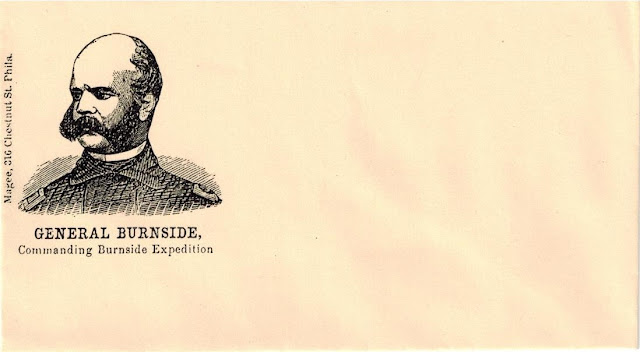
General Burnside Civil War Patriotic Envelope US48
celebrating his attacks on Confederate forces along the North Carolina coast
from February through June 1862.
Wonder how popular this one was among the soldiers after the mud march?

Children's Project:  Explore how both the Confederate signs and the Union revised prayer are both "sarcastic humor" using irony (intended meaning is the opposite of what's expressed).  Explore how what is humorous to one is not so funny to the other (am sure neither the Union soldiers seeing the CS signs nor General Burnside were pleased to be mocked).  This might be an interesting way to discuss different types of humor and the challenges of "cancel culture" with your children.  For example, should they share a joke mocking their teacher with the teacher?  And obviously jokes about you as a parent are always off limits.