Showing posts with label Music & Songs. Show all posts

Friday, April 7, 2023

Rock of Ages -- A Hymn Treasured by Civil War Soldiers Both North and South

The hymn “Rock of Ages” opened soldiers hearts to Jesus’ mercy and grace during the war. 
    Rev. George Bringhurst of Philadelphia, one of the first Delegates of the U.S Christian Commission serving the soldiers in the spring of 1862, shares how he saw this well-known hymn bring positive change in some who heard it being sung [Incidents of the U.S. Christian Commission by Edward P. Smith 1869. Pages 24-26]:

    In how many instances was the precious Gospel brought to the soldiers, in the strains of music set to Psalms and Hymns.  In camp and hospital, on march and field, the sweet songs of Zion wooed many a prodigal back to the Father’s loving embrace.  None possibly were more effectual than that familiar hymn, “Rock of Ages.”  We heard it sung for the first time in the army, on the beach at Fortress Monroe, by some Delegates of the Christian Commission, just beneath the “Lincoln Gun”.  Its grateful truth, borne by the winds, fell upon the ear of a soldier on the parapet; not only so, but touched his heart, and in time led him to build on the “Rock of Ages.”
    Again, we heard the same hymn at Yorktown, sung by some of the same Delegates.  After its singing, as we were returning to our quarters, one of the Delegates was overtaken by a soldier, who belonged to the “Lost Children” – (the name of a New York Regiment, “Enfans Perdus”).  He asked “Won’t you please tell me how I may build on the ‘Rock’ you sang about?  I was thinking of it while on guard the other day.”  He told his story in brief: he was from New York City, had received his mother’s dying blessing.  Before she breathed her last, she sang this hymn, and said “George, my son, I would not feel so badly about your enlisting, if you were only built upon that ‘Rock.’”
    These sacred memories were revived by the singing of the hymn; and as the Delegate and the soldier knelt on the dusty roadside, beneath the stars, the wanderer lost his weariness and thirst for sin, in the shadow of the “Rock of Ages.”
    Eighteen months after this incident, the same Delegate, going to Fortress Monroe, on a boat which had as part of her passengers a gay and happy company of the Signal Corps, conversed, sang and prayed with them.  He related to them the foregoing incidents, sang “Rock of Ages,” and retired to his state-room.  Soon after, a gentle tap called him to the door, where he found a tall graceful Lieutenant, who, with tears streaming down his face, said “O sir! I could not let you go to bed tonight until I had told you what you have done.  As I sat, with my head leaning against a spar, and listened to your words and to that hymn, you brought back my dead mother with all her prayers and love.  I have been a wanderer until this night, now by God’s grace I want to hide myself in that Rock of Ages.”

“Rock of Ages” was the song JEB Stuart requested to be sung as he was dying.  
    At 7 p.m., everyone in the house gathered around Stuart’s bed. Rev. Joshua Peterkin, an Episcopal minister, led them in prayers and the singing of “Rock of Ages,” Stuart’s favorite hymn. Stuart made a feeble effort to sing along, then turned to Brewer, and said, “I am going fast now. I am resigned; God’s will be done.” He then drifted into unconsciousness.  On May 12th, 1864 at 7:38, James Ewell Brown Stuart passed into the hands of his God.

Exploration of the Hymn “Rock of Ages” 
Written by the Reformed Anglican minister, Rev. Augustus Toplady in 1763 and first published in The Gospel Magazine in 1775.

Rock of Ages, cleft for me,
Let me hide myself in Thee;
Let the water and the blood,
From Thy riven side which flowed,
Be of sin the double cure,
Cleanse me from its guilt and power.

Not the labor of my hands
Can fulfill Thy law's demands;
Could my zeal no respite know,
Could my tears forever flow,
All for sin could not atone;
Thou must save, and Thou alone.

Nothing in my hand I bring,
Simply to Thy cross I cling;
Naked, come to Thee for dress;
Helpless, look to Thee for grace;
Foul, I to the fountain fly;
Wash me, Savior, or I die!

While I draw this fleeting breath,
When mine eyes shall close in death,
When I soar to worlds unknown,
See Thee on Thy judgement throne,
Rock of Ages, cleft for me,
Let me hide myself in Thee.

    Though there is some debate about Toplady writing the first verse of the hymn as he took refuge in a rock cleft himself during a strong storm, the Biblical Background for the hymn is likely the incident recorded in Exodus 33:12-34:9 where Moses is hidden in a cleft of the rock so that he is protected as he witnesses the Lord’s glory passing by and hears the Lord’s proclamation.  Psalm 18:2 also declares: “The Lord is my rock, and my fortress, and my deliverer; my God, my strength, in whom I will trust; my buckler, and the horn of my salvation, and my high tower [KJV]” from which Toplady may have also drawn inspiration.
    In the Dictionary of Hymnology, John Julian cites the 1775 article “Life a Journey” (printed in the Gospel Magazine) in which Toplady published the first stanza of his hymn “Rock of Ages.” As introduction to the first stanza’s words Toplady wrote: “Yes, if you fall, be humbled, but do not despair. Pray afresh to God, who is able to raise you up, and set you on your feet again. Look to the blood of the covenant; and say to the Lord from the depths of your heart” the prayer which Toplady lays out in his hymn.
    This gives insight into Toplady’s heart in writing this hymn of praise to Jesus.  Toplady points us to Jesus’ sacrifice on the cross as our only hope in this life of struggle with sin and our only protection when we come before Him on the judgment day.  Toplady correctly points out in verse 2 our own “goodness” cannot protect us on that day of judgement as the Apostle Paul teaches us in Ephesians 2:8-9.  Just as God placed the sinner Moses in a protective place, so in the day of judgment Jesus will be the protective place for those who have put their trust in Him alone for grace and mercy.  Toplady’s song calls on hearts to realize their need for Jesus and depend on Him to “be of sin the double cure, cleanse me from its guilt and power”.
    From the Civil War incidents shared above by Bringhurst, we see that the hymn written 87 years earlier did indeed touch hearts of those who had heard the gospel before but had shrugged off God’s call to them.  Through the hymn’s succinct call to look to Jesus, along with the perilous circumstances of that time, some hearts did respond in faith to the promise that Jesus alone saves us from the condemnation we justly deserve.

The Lincoln Gun
   
The Rodman Gun, cast in 1860, shipped from Pittsburgh to Fort Monroe in March 1861 to help guard the Hampton Roads and prevent Confederate ships from fighting their way through the channel, was one of the largest smoothbore cannons ever made, weighing 49,000 pounds, 15’10” long and 4 feet in diameter with a 15” bore.  It is said it could fire a 330lb explosive projectile or a 437lb solid shot more than four miles.  It was named the “Lincoln gun” by Secretary of War Edwin Stanton.

The “Lost Children” battalion 
    This unit was formed between Nov.22, 1861 and April 1862 mostly of French & German European immigrant volunteers, who served in the Carolina area during the War.  They did not muster enough men to form a regiment, so it was classed as a battalion and eventually assimilated into the 4th Corps, Army of the Potomac.  “Lost Children” – Enfans Perdus – Enfants Perdus – with its European background means the “forlorn hope” – small groups of soldiers assigned dangerous tasks like the first to charge through the breach, or hold a strategic but dangerous position.  The “Lost Children” name tag was likely taken as a challenge to these volunteers to step up and show courage no matter what they would face in battle.

Children Projects:
    1) God has created us to respond to music.  Studies have shown music can help focus, can change moods, can help memory, can create connection with others listening to it.  Discuss how music can be both good and bad in our lives, depending on what is stirs up within us.  Music can motivate us to do great and good things.  It can also be used to draw us into evil and sinful actions.  While “music” in itself is neutral, how it affects us is what we need to be discerning about.  What words are in the song?  Who is it connecting us with?  What is it motivating us to do?
    2) Help your children explore how Toplady moves verse by verse, developing the theme of the hymn.  He is not simply playing on emotions as is often the case in music today by repetition of the same few phrases over and over and over again.  Instead, he leads the singer/listener through a developing thought process – ballad style writing.  Yes, his song does stir up emotions, but it is through a development of thought.  Maybe explore having your child write their own song/poem where they present an important truth that they want others to better understand.

Wednesday, April 6, 2022

Songs on the Civil War Battlefield -- Shiloh 1862

 An account from a soldier who fought and died there:
    The sanguinary battle of Shiloh was fought on the sixth and the seventh of April, 1862.  The ordinary scene which presents itself, after the strife of arms has ceased, is familiar to everyone.  Heaps of the slain, where friend and foe lie by the side of each other; bodies mangled and bleeding; shrieks of the wounded and dying, are things which we always associate with the victories and defeats of war.  But seldom do we read that voices of prayer, that hymns of exultant faith and thanksgiving, have been heard at such times and in such places.
    The following account was received from the lips of a brave and pious captain in one of the Western regiments, as some friends who visited Shiloh on the morning after the battle were conveying him to the hospital.
    The man had been shot through both thighs with a rifle bullet; it was a wound from which he could not recover.  While lying on the field, he suffered intense agony from thirst.  He supported his head upon his hand, and the rain from heaven was falling around him.  In a short time, a little pool of water collected near his elbow and he thought if he could only reach that spot he might allay his raging thirst.  He tried to get into a position which would enable him to obtain a mouthful, at least, of the muddy water; but in vain, and he must suffer the torture of seeing the means of relief within sight, while all his efforts were unavailing.  “Never” said he,  “did I feel so much the loss of any earthly blessing.  By and by the shades of night fell around us, and the stars shone out clear and beautiful above the dark field, where so many had sunk down in death, and so many others lay wounded, writhing in pain, or faint with the loss of blood.  Thus situated, I began to think of the great God who had given his Son to die a death of agony for me, and that he was in the heavens to which my eyes were turned, -- That he was there, above that scene of suffering, and above those glorious stars; and I felt that I was hastening home to meet him, and praise him there; and I felt that I ought to praise him then, even wounded as I was, on the battlefield.  I could not help singing that beautiful hymn:
When I can read my title clear
To mansions in the skies,
I’ll bid farewell to every fear,
And wipe my weeping eyes.
And though I was not aware of it till then,” he said, “it proved there was a Christian brother in the thicket near me.  I could not see him, but was near enough to hear him.  He took up the strain from me; and beyond him another, and then another, caught the words, and made them resound far and wide over the terrible battlefield of Shiloh.  There was a peculiar echo in the place, and that added to the effect, as we made the night vocal with our hymns of praise to God.
    It is certain that men animated by such faith have the consciousness of serving God in serving their country, and that their presence in the army adds to it some of its most important elements of strength and success.
From Christian Memorial of the War:  Scenes and Incidents Illustrative of Religious Faith and Principle, Patriotism and Bravery in Our Army by Horatio B. Hackett 1864 page 18-20.

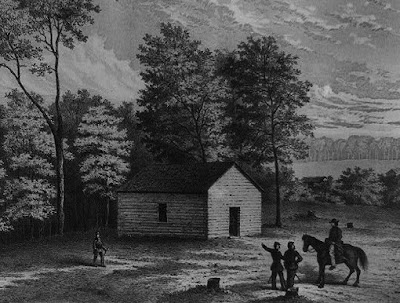
Shiloh Church

Summary historical perspective on the battle

    The intensity of the Battle of Shiloh in southwestern Tennessee on April 6-7, 1862, also known as the Battle of Pittsburg Landing, changed public expectations in both the North and the South that this would be a short-lived war because of the intensity of the battle and the high rate of casualties for both sides:
            Union losses out of 62,000 troops: 13,047
                        Killed 1,754
                        Wounded 8,408
                        Missing or captured 2,885
            Confederate losses out of 45,000 troops: 10,669
                        Killed 1,728
                        Wounded 8,012
                        Missing or captured 959
    In his memoirs in chapter 25 “Remarks on Shiloh” Grant writes “Up to the battle of Shiloh, I, as well as thousands of other citizens, believed that the rebellion against the Government would collapse suddenly and soon, if a decisive victory could be gained over its armies….” But the intensity and cost in man-power changed his perspective:  “I gave up all idea of saving the Union except by complete conquest.”
    Though the Union losses were greater than the Confederate, the Union victory would allow for him to push deeper into Southern territory to divide the Confederacy in two.  Victory came at a high cost.
 
Reflections on the “soldier in the ranks” perspective on dealing with the cost of battle
    In the midst of such pain and suffering what should one do?  The above account which Horatio Hackett recounts shows some dealt with the harshness of their suffering through the lens of faith.  The hymn “When I can Read My Title Clear” by Isaac Watts was first published under the heading "The Hopes of Heaven our Support under Trials on Earth" in his 1707 Hymns and Spiritual Songs:

When I can read my title clear
To mansions in the skies,
I’ll bid farewell to every fear,
And wipe my weeping eyes.
 
Should earth against my soul engage,
And hellish darts be hurled,
Then I can smile at Satan’s rage,
And face a frowning world.
 
Let cares, like a wild deluge come,
And storms of sorrow fall!
May I but safely reach my home,
My God, my heav’n, my All.
 
There shall I bathe my weary soul
In seas of heavn’ly rest,
And not a wave of trouble roll
Across my peaceful breast.
 
    “Clear title” means “undisputed ownership”.  Isaac Watts’ original title -- "The Hopes of Heaven our Support under Trials on Earth" -- gives us insight into his meaning of this song.  In a world of fear and sorrow, Watts challenges us to put our trust in Jesus’ promise in John 14:1-3: “Let not your heart be troubled: ye believe in God, believe also in me.  In my Father's house are many mansions: if it were not so, I would have told you. I go to prepare a place for you. And if I go and prepare a place for you, I will come again, and receive you unto myself; that where I am, there ye may be also” (King James Version wording clearly is the basis for the song).  Through faith in Jesus, Watts says we can put in perspective the troubles of this world as we look to the place of joy Jesus is preparing for those who trust in Him as Savior.
    So there on the Shiloh battlefield where death, pain and sorrow were abundant, for many of the men this well-known hymn became a call to look to Jesus’ promise as a way of dealing with the “storms of sorrow” that night and yet also an offering of praise to Jesus for His willingness to “die a death of agony for me”.
    In the Old Testament, the town of Shiloh ("place of peace") became the place where the Tent of Meeting was located after the land was conquered and the people would come to worship God during the time of Joshua and the days of the Judges (Josh.18:1-10).  The Shiloh Meeting House on the battle site was built in 1853, and Union forces encamped along the ridge the church was built on.  The battlefield took its name from the church.  The church was damaged in the fighting, then used as a hospital after the battle, and finally torn down by Union soldiers for the lumber to build a bridge.

    In Nothing But Victory -- The Army of the Tennessee 1861-1865 by Steven Woodworth (2005) pages189-191 is a detailed description of the night of April 6.  After intense twelve hours of fighting came the darkness with the wounded between the lines "calling for mother, sister, wife, sweetheart, but the most piteous plea was for water". Then came the rain and thunder mixing with the ongoing artillery fire between the lines.  Woodworth cites that on one part of the battlefield was heard the singing of Charles Wesley's "Jesus, Lover of My Soul" hymn among the wounded.  And elsewhere was the singing of the hymn of this account.  I cite this as evidence that the above account recorded by H. Hackett is in fact a description of something that actually happened that night.

Children’s project questions:
            1) Talk about the shift from early war “optimism” that the conflict would be brief and end soon to the “reality” that it was going to be a “long hard road to Richmond”.  Explore why human nature often “presumes” desired outcomes more often than realistically thinking through what might happen and exploring ways to overcome the difficulties to accomplish the goal.
            2) Would there be many who would join in today if someone started singing a Christian song on a battlefield filled with wounded & dying soldiers?  What does that say about our culture today?  Does that make you glad or sad?

Saturday, March 5, 2022

Hard Crackers, Come Again No More! A Song Celebrating a Beloved Civil War Army Ration!

    Yes, the title above is being sarcastic.  John D. Billings shares his memory of a famous Civil War song that captures the “man in the ranks joy” over the army’s provisions (Hard Tack and Coffee.  Soldier’s life in the Civil War 1887).  This song that Billings remembers is a Civil War parody of a popular song from 1854 “Hard Times Come Again No More” by Stephen Foster that
challenged the fortunate to remember the struggles of the less fortunate.  The Civil War song is a satirical mocking of a staple of army rations that went by a variety of names: the hard cracker, hardtack, hard bread, army crackers, worm castles, sheet-iron crackers, tooth dullers.  Billings writes:

    “For some weeks before the battle of Wilson’s Creek, Mo., where the lamented [General Nathaniel] Lyon fell, the First Iowa Regiment had been supplied with a very poor quality of hard bread (they were not then -- 1861 -- called hardtack).  During this period of hardship to the regiment, so the story goes, one of its members was inspired to produce the following touching lamentation:

Let us close our game of poker,
Take our tin cups in our hand,
While we gather round the cook’s tent door,
Where dry mummies of hard crackers
Are given to each man;
O hard crackers, come again no more!
Chorus:  ‘Tis the song and sigh of the hungry,
“Hard crackers, hard crackers, come again no more!
Many days have you lingered upon our stomachs sore,
O hard crackers, come again no more!”

There’s a hungry, thirsty soldier
Who wears his life away,
With torn clothes, whose better days are o’er;
He is sighing now for whiskey,
And, with throat as dry as hay,
Sings, “Hard crackers, come again no more!”  -- Chorus

‘Tis the song that is uttered
In camp by night and day,
‘Tis the wail that is mingled with each snore,
‘Tis the sighing of the soul
For spring chickens far away,
“O hard crackers, come again no more!”  -- Chorus

When General Lyon heard the men singing these stanzas in their tents, he is said to have been moved by them to the extent of ordering the cook to serve up corn-meal mush, for a change, when the song received the following alteration:

But to groans and to murmurs
There has come a sudden hush,
Our frail forms are fainting at the door;
We are starving now on horse-feed
That the cooks call mush,
O hard crackers, come again once more!
Chorus:  It is the dying wail of the starving,
Hard crackers, hard crackers, come again once more;
You were old and very wormy, but we pass your failings o’er,
O hard crackers, come again once more!

The name hardtack seems not to have been in general use among the men of the Western armies.”  (p.118-19)

    In sharing this memory, Billings is reminding us that he and others did their duty even though it meant having to be “creative” with less than ideal food rations as well as with finding humor in what they were dealt.  Now certainly down through the centuries it has always been the habit, and the right, of the ranks to complain about the rations provided.  You have to enjoy the creativity of this song in lamenting what was a part of life for the soldier during the Civil War.

Children’s project:
1) Make some hardtack (there are various recipes on line; this one from the site:  Emerging Civil War – “Civil War Cookin’: Hard Tack Come Again No More”.  No, haven’t personally tried to use this recipe.  Others on line have differing measurements, salt added, and cooking times etc.
    3 cups flour (can use all-purpose, but whole wheat is more authentic)
Water (1 cup)
Add enough water to Flour so the mixture is soft, but not sticky, then knead for 8 minutes to make the dough elastic.  Roll the dough out and cut into 3”x 3” squares ½” thick.  Use a nail or something to prick four holes across in four rows down into the dough, then turn over and do this again -- (this prevents the cracker from “rising” as it bakes).  Bake at 450 degrees for 7 minutes, then reduce oven to 350 and bake for additional 7 – 10 minutes. They will be hard, and get harder as they cool and dry.  Bake them for looks, not for eating as they will be hard.  Don’t put them in a sealed container because they will mold, but let them dry out completely.  Add weevils for additional flavor and realism.  What?!? Just joking.  My family has a couple of hardtack pieces that we use for living history display that were given to us almost 30 years ago.  That should tell you how “durable” hardtack is.

2) Look up the words to the song “Hard Times Come Again No More” and compare them to this Civil War song parody.  (Parody: an imitation of the style of a particular writer, artist, or genre with deliberate exaggeration for comic effect).  Explore how parody works by looking at Foster’s song which calls on the favored in society to see the distressed struggling people around them and realize their plight.  Some say Foster’s song was his way of calling on the privileged to realize the needs of “the less fortunate” around themselves.  Others see his song as expressing his personal feelings as he descended into loss in his own life.  It most likely is a mix of both.  As culture continued to divide and the Civil War came, his song was indeed a challenge needed by society to look compassionately on others in their struggles.  Now obviously the parody Civil War song “Hard Crackers Come Again No More” is making the challenge for the “privileged” well-fed officers to see the plight of the “down-trodden” man-in-the-ranks.  Some eat well in the army, while many others must make do with poor quality rations as they obey the orders of the privileged to march and fight.   The “effectiveness” (= popularity) of the Hard Crackers song is in a great degree based upon the popularity of the Hard Times song in the culture of that time.  Maybe come up with a project where your child does a parody on something that is popular to them.

Sunday, December 24, 2017

I Heard the Bells On Christmas Day -- Christmas and the Civil War

    What value is the "promise of Christmas" amidst the struggles of life?  Is it only for the happy hearts who can blithely sing Christmas songs and madly shop for gifts?  Is the no room for the sad struggling heart?
    The words of Henry Wadsworth Longfellow in his 1863 poem "Christmas Bells" wrestles with the tension between "joy" and "sadness" at Christmas.  Understanding the history of his times and life will expand our appreciation of the familiar Christmas carol "I Heard the Bells on Christmas Day."
    Yes, the upbeat "hope came on Christmas Day" is true.   Jesus, the Son of God was born, and He is the hope of the world.  In Him alone is our hope for forgiveness of sin and the restoration to peace with God the Father.  Through Jesus there is "peace on earth, good will to men"
    But does that mean that all "struggle of faith" is magically eliminated?  No.  The world is often not a happy place full of "good cheer and joy".  It wasn't during the night of Jesus' birth for the Jewish nation living under the tyranny of Roman rule and it wasn't for Henry Longfellow in 1863.  But out of Longfellow's struggle with grief and perplexity over the turmoil of the war came the words for a Christmas carol that many today casually sing as "just another song".  The poem "Christmas Bells" that he wrote in December of 1863 reflects his struggle to put the optimistic "promise of Christmas" into perspective within a life of sadness and struggle and loss.

"Christmas Bells"
(verses 4 & 5 were edited out to create the Christmas Carol "I Heard the Bells on Christmas Day" published in 1872)

1)  I heard the bells on Christmas Day
Their old, familiar carols play
And wild and sweet
The words repeat
Of  peace on Earth, good will to men!

2)  And thought how, as the day had come,
The belfries of all Christendom
Had rolled along
The unbroken song
Of peace on Earth, good will to men!

3)  Till, ringing, singing on its way,
The world revolved from night to day,
A voice, a chime,
A chant sublime
Of peace on Earth, good will to men!

4)  Then from each black, accursed mouth
The cannon thundered from the South,
And with the sound,
The carols drowned
Of peace on Earth, good will to men!

5)  It was as if an earthquake rent
the hearthstones of a continent,
and made forlorn
the households born
Of peace on Earth, good will to men!

6)  And in despair I bowed my head;
"There is no peace on Earth" I said:
"For Hate is strong,
And mocks the song
Of peace on Earth, good will to men!

7)  Then pealed the bells more loud and deep:
"God is not dead; nor doth He sleep!
The Wrong shall fail,
The Right prevail,
With peace on Earth, good will to men!

    In 1861 the Civil War broke out and our nation was divided by anger and war.  Before the war Longfellow was among those calling for the abolition of slavery, being associated with the New England Anti-Slavery Association.  Longfellow's famous poem "Paul Revere's Ride" published in 1860 was written to call for a new revolution to give freedom to all.  That was a righteous and noble hope.  But no one could foresee the tidal wave of conflict and suffering that would be needed to bring about that change in our nation.  What many presumed at first in 1861 would be a short quick revolution was by 1863 still painfully dragging on battle after battle.  The genuine hope for good was facing the reality of a long drawn out cruel war.  This harsh reality challenged even the staunchest desire to see good change take place.
    In 1861 Longfellow also experienced great personal tragedy when his wife, Fanny, died in a tragic accident.  Her dress caught fire as she lite a candle.  She ran into Longfellow's study for help.  He tried extinguishing the flames with a small rug, but failed, so he threw his arms around her to smother the flames.  Though successful in smothering the flames, Fanny died the next day from her injuries (July 10, 1861).  And Longfellow himself suffered burns to his face, arms and hands so badly that he was unable to be at her funeral.
    In his journal for Christmas day 1861 he wrote "How inexpressibly sad are all holidays."  That next July in 1862 he wrote "I can make no record of these days.  Better leave them wrapped in silence.  Perhaps someday God will give me peace."  On Christmas day 1862 he wrote " 'A merry Christmas' say the children, but that is no more for me."  Yes, the bells ring on the Christmas promise of peace & hope, but Longfellow's heart struggles with the harsh realities of life both nationally & personally.
    In March of 1863, Longfellow's oldest son, Charles (born June 9, 1844), left home without his father's permission to join the Union army.  Charles wrote his father "I have tried hard to resist the temptation of going without your leave but I cannot any longer.  I feel it to be my first duty to do what I can for my country and I would willingly lay down my life for it if it would be any good."
    On December 1st, 1863 Longfellow received a telegram saying Charles had been severely wounded during the battle of New Hope Church in Virginia during the Mine Run Campaign.  The bullet had entered his left shoulder, ripped across his back, exiting the right shoulder.  Would Charles live?  And if he did, would he be paralyzed?  For Longfellow, December was a time of traveling to see if his son was still alive, then bringing him back home for a long painful recovery.
    Longfellow does what writers/poets often do:  he processes his emotions through words, exploring a path through the conflicts within his heart.  Look again at the poem.
    The poem starts off in verses 1, 2 & 3 with observing the "typical expectations" of Christmas.  Yes, the message put out is about peace on earth, goodwill to men, recalling the angel's proclamation to the shepherds the night Jesus was born.  There is hope!  Into this troubled world, the One who will resolved the troubles has come!  That's "the unbroken song" everyone knows and many dutifully nod in agreement "ho hum, heard it all before, let's move on".
    Then Longfellow shifts to the political reality of his times, the Civil War which seems to contradict the proclamation given to the shepherds by the angles.  These two verses (#4 and #5 omitted in the 1872 version "I Heard the Bells on Christmas Day") openly wrestle with the conflict of "life's reality" during the Civil War of Longfellow's time vs "the angels' proclamation".  Where is the peace on earth and goodwill to men as the cannons thunder and soldiers die and families are ripped apart with loss and death?  I am sure Longfellow is also wrestling with the sufferings in his private life as well.  Where is the peace on earth & goodwill to men in the loss of my wife, and the suffering of my son?  In his heart he honestly expresses what he feels in verse #6 of his poem:  "in despair I bowed my head: There is no peace on Earth, for hate is strong and mocks the song" that is the message of Christmas.
    These words come across much stronger to me in meaning knowing both the national and personal struggles Longfellow is living with as he writes this poem.  Knowing the history makes the movement into the last verse #7 even more powerful.  Yes indeed, evil and sadness and loss mock the Christmas promise.  Life's realities mocked the promise for the Jewish people living under Rome's crushing rule the night the angels came to the shepherds.  In 1863 national & personal sufferings mocked it to Longfellow.  And even today evil and sadness and loss are still mocking the promise of "Peace on earth, goodwill to men!"  But genuine "Christmas celebration" calls us back to the promise of the angel's proclaimed:   Jesus will be the solution. "God is not dead, nor doth he sleep.  The wrong shall fail, the right prevail, with peace on earth, goodwill to men."
    Longfellow in his poem Christmas Bells is laying out the challenge he is facing.  In the process of writing, he is setting a goal that he sees he needs to strive for;  setting out a path of faith that he needs to travel in his heart.  Did writing the poem resolve all his struggles.  I doubt it.  Broken discouraged  hearts are not so simply fixed.  But knowing the path we should travel, remembering the promise we should cling to in the struggles we feel gives us "a way forward".  We no longer have to linger where we are, bewildered in doubt and confusion.  We once again have a goal we can focus on moving our emotions and faith toward.
    One last thought.  I've heard it said by a friend who has spent years studying & portraying Abraham Lincoln that when someone asked President Lincoln if he thought God was "on our side", meaning on the side of the Union cause, Lincoln replied something like this:  It's not 'is God on our side', but are we on God's side that is important.  Christmas challenges us to that goal.  It's not "will God help me to do what I want" in life, but it's God calling us to accept His goals and hope.  He wishes to redeem us from our sin, but we must accept His terms -- that Jesus Christ is the only way of forgiveness.  Christmas, the celebration of Jesus' birth, is not about "having a good time and getting what I want";  it's about remembering that God offers what I really need at great cost to Himself.  In all the distractions of life, the struggles of life, the conflicts of life, do not walk by the greatest gift ever offered: peace with God through His Son Jesus.  When we accept God's gift of forgiveness through Jesus, we then have the anchor we need to navigate our way through the struggles and conflicts and loss of life to our Heavenly Home across the Jordan.  "Merry Christmas" becomes a reminder that Our Heavenly Father "is not dead, nor doth He sleep, the wrong shall fail, the right prevail, with peace on earth, goodwill to men".