Showing posts with label Gettysburg. Show all posts

Sunday, July 3, 2022

Somebody's Father -- July 3, 1863 Gettysburg

A confederate soldier's sad memory:  C.R. Graham does not give the name of the soldier who shared this memory with him.  It appears in a section titled “Random Tails by Confederates”, so we can assume that it is a memory of a southern soldier who was at the battle of Gettysburg:

    I think that one of the saddest incidents of the war which I witnessed was after the battle of Gettysburg.  Off on the outskirts, seated on the ground, with his back to a tree, was a soldier, dead.  His eyes were riveted on some object held tightly clasped in his hands.  As we drew nearer we saw that it was an ambrotype of two small children.  Man though I was, hardened through those long years to carnage and bloodshed, the sight of that man who looked on his children for the last time in this world, who, away off in a secluded spot had rested himself against a tree, that he might feast his eyes on his little loves, brought tears to my eyes, which I could not restrain had I wanted.  There were six of us in the crowd, and we all found great lumps gathering in our throats, and mist coming before our eyes which almost blinded us.  We stood looking at him for some time.  I was thinking of the wife, and baby I had left at home, and wondering how soon, in the mercy of God, would she be left a widow, and my baby boy fatherless.  We looked at each other and instinctively seemed to understand our thoughts.  Not a word was spoken, but we dug a grave and laid the poor fellow to rest with his children’s picture clasped over his heart.  Over his grave, on the tree against which he was sitting I inscribed the words: “Somebody’s Father, July 3, 1863”  [Under Both Flags. A Panorama of the Great Civil War as Represented in Story, Anecdote, Adventure, and the Romance of Reality   1896 pages 84-85]

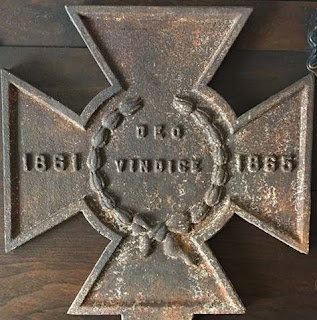
Deo Vindice = God is our vindicator
CS grave marker
Summary facts about Gettysburg:  Casualties at Gettysburg totaled 23,049 for the Union (3,155 dead, 14,529 wounded, 5,365 missing & captured). Confederate casualties were 28,063 (3,903 dead, 18,735 wounded, and 5,425 missing & captured), more than a third of Lee's army.
    The Confederate dead were not buried in the Soldier’s National Cemetery.  Within a few months after the battle most of the Union dead were dug up from their shallow graves and reinterred in the Soldier’s National Cemetery, which was for those who fought to preserve the Union.  But the Confederate dead were left wherever they were buried scattered across the fields and farms of the area.  In the 1870s an effort was made by organizations in the southern states to find and relocate the corpses of the southern soldiers to sites down south.  But it is a known fact that not all of these shallow grave burials were discovered.  And from time to time a grave has been uncovered.  So, we do not know if this man’s body was ever returned home to family.
    In the ‘broad roll of human history’ come moments which remind us that it is those whom God has put in our lives as “family” that are far more important than fame or fortune.  These relationships of love are God’s great gift to us no matter what is rolling along in the big picture of history.

Children’s project discussion questions:
1.  Would you hope your father’s dying thoughts would be on your family, or would you want him to be thinking about how successful he was or how rich he was or how athletic he was?
2.  If you would want him to be thinking of you and your family circle, then are you trying to learn good traits from your parents, or are you too busy with friends your own age to care about building a positive family circle?

Saturday, November 20, 2021

No One Cheered at Lincoln's Dedication Speech -- Gettysburg Address

    So how bad of a failure was Lincoln’s Gettysburg Address on November 19th, 1863? 
    The Democrat “Copperhead” Chicago Times newspaper (1854-1895) posted this editorial on Nov.24th, 1863 about the speech: "The cheek of every American must tingle with shame as he reads the silly, flat and dishwatery utterances of the man who has to be pointed out to intelligent foreigners as the President of the United States."
    C.R. Graham includes in his book, Under Both Flags. A Panorama of the Great Civil War as Represented in Story, Anecdote, Adventure, and the Romance of Reality (1896) p.73-74, an account of the crowd’s acceptance of Lincoln’s speech at the Gettysburg event by W. H. Cunnington, who was a newspaper correspondent up on the stage. Accounts differ as to how well accepted Lincoln’s speech was, and what the exact wording of the speech was etc. Don’t know how long after the war this account was written down by Cunnington. It is interesting that he views the audience being taken by surprise at how short it was and by the non-melodramatic way Lincoln spoke as explanations as to why the crowd did not cheer when Lincoln spoke. Since the previous speech had been two hours long, it is possible that the shortness of Lincoln’s address may indeed have been a reason the crowd was unresponsive. Again, this is one person’s memory of that historic event.
 
Cunnington writes:
    “It was my privilege to be present at the dedication of the Soldier’s National Cemetery at Gettysburg, on the afternoon of November 19, 1863, and to hear the now world-famous address of Abraham Lincoln on that occasion. I can bear witness to the fact that this address, pronounced by Edward Everett to be unequaled in the annals of oratory, fell upon unappreciative ears, was entirely unnoticed, and wholly disappointing to a majority of the hearers. This may have been owing in part to the careless and undemonstrative delivery of the orator, but the fact is that he had concluded his address and resumed his seat before most of the audience realized that he had begun to speak.
    It was my good fortune as a newspaper correspondent to occupy a place directly beside Mr. Lincoln when he delivered this brief oration, and on the other side of the speaker was Hon. W. H. Seward. Other members of the Cabinet had seats on the stand, and I also noticed Governors Curtin, Seymour, Tod, Morton, and Bradford, Hon. Edward Everett, and Colonel John W. Forney.
    At the conclusion of Mr. Everett’s scholarly oration, Mr. Lincoln faced the vast audience. He looked haggard and pale, and wore rather a shabby overcoat, from an inside pocket of which he drew a small roll of manuscript. He read his address in a sort of drawling monotone, the audience remaining perfectly silent. The few pages were soon finished; Mr. Lincoln doubled up the manuscript, thrust it back into his overcoat pocket, and sat down. Not a word, not a cheer, not a shout. The people looked at one another, seeming to say, “Is that all?”  
    The full text of Mr. Lincoln’s address was as follows:
    ‘Fourscore and seven years ago our fathers brought forth on this continent a new nation, conceived in liberty, and dedicated to the proposition that all men are created equal.
    Now we are engaged in a great civil war, testing whether that nation, or any nation so conceived and so dedicated, can longer endure. We are met on a great battlefield of that war. We have come to dedicate a portion of that field as a final resting-place for those who here gave their lives that that nation might live. It is altogether fitting and proper that we should do this.
    But, in a larger sense, we cannot dedicate, we cannot consecrate, we cannot hallow this ground. The brave men, living and dead, who struggled here, have consecrated it, far above our poor power to add or detract. The world will little note nor long remember what we say here, but it can never forget what they did here. It is for us the living, rather, to be dedicated here to the unfinished work which they who fought here have thus far so nobly advanced. It is rather for us to be here dedicated to the great task remaining before us – that from these honored dead we take increased devotion to that cause for which they gave the last full measure of devotion – that we here highly resolve that these dead shall not have died in vain – that this nation, under God, shalt have a new birth of freedom, and that government of the people, by the people, for the people, shall not perish from the earth.’ 
    I am well aware that accounts have differed as to the manner of this address and its reception by the audience. I was an eye-witness and hearer, and my position was immediately beside the speaker, therefore that foregoing account may be relied upon.”

    In the days following the event, Lincoln’s Gettysburg address got both positive and negative reviews by various newspapers. Democrat papers like the Chicago Times paned Lincoln’s speech, after all the people there didn’t cheer, or they laughed at it. Many Republican leaning newspapers were more complementary of his wording and presentation, or at least neutral in their evaluation of it. It should be no surprise that “politics” played into how Lincoln’s words were evaluated back then, just like happens today.  Growing up in the 1950s/60s, my family would go and watch the Memorial Day parade in our small town in upstate New York, and then go to the cemetery for the Memorial Service. Each year from our local high school Senior class a young lady was selected to read the poem “In Flanders’s Fields”, and a young man to read the Gettysburg address. I got to do it my Senior year. That was back when Lincoln was honored and his words were viewed as a positive challenge. Now his statues are being defaced and torn down by ‘woke progressives’. Guess the democrats haven’t changed much in their assessment of Lincoln and his speech.
    Various studies have been done tracing how his Gettysburg address has been interpreted over the years. And there have been changes of interpretation of what he was saying, and differing views of what it should inspire in people who hear it today. Differences of interpretation are legitimate discussions.
    But to interpret his speech as hateful and representing a foul nation that is all just show, with no real equality is a Marxist lie being pushed by those who hate the freedom our nation was founded on: “that all men are created equal, that they are endowed by their Creator with certain unalienable rights, that among these are Life, Liberty and the pursuit of Happiness.–That to secure these rights, governments are instituted among men, deriving their just powers from the consent of the governed.”
    Yes, indeed our nation has had many serious problems over the years. Some have been addressed and other still remain. Equality of opportunity (NOT a guarantee of success or acceptance, but opportunity to work for it) and equality before the law (riches, connections, political power do not give an advantage or give a disadvantage) is the solid foundation that is needed to constantly address differences and conflicts. 
    “Equity” is a “woke progressive” ploy to give the elites power over the masses who submit for “compensation” given to preferred “categories” of people. I posted a satirical blog back in 2013 about what then President Obama’s version of the Gettysburg address might have sounded like had he given it in 1863 instead of Lincoln (What would President Obama’s version of the Gettysburg Address be?). I suggested that Obama would have praised “federalization”. I didn’t know how correct I was in describing the agenda of the “woke progressives”. I choose to stand with Lincoln, imperfect as he was. And I stand with America, imperfect as we are. Judge others individually by the character of their heart, not by their group ethnicity. Reject the Marxist equity path which divides us into group categories to allow the elites to control us. Do not let the men who died at Gettysburg die in vain.
Friday, November 22, 2013

Let's Keep Pursuing Abraham Lincoln's Vision of America

Is Abraham Lincoln's vision of government still worth pursuing?  Or have times and culture changed beyond what he envisioned 150 years ago standing at that National Cemetery dedication in Gettysburg?
Civil War Union Patriotic Envelope Design

"It is for us the living, rather, to be dedicated here to the unfinished work which they who fought here have thus far so nobly advanced. It is rather for us to be here dedicated to the great task remaining before us—that from these honored dead we take increased devotion to that cause for which they gave the last full measure of devotion—that we here highly resolve that these dead shall not have died in vain—that this nation, under God, shall have a new birth of freedom—and that government of the people, by the people, for the people, shall not perish from the earth."

    As a senior in high school in 1971 it was my honor to be chosen to recite Lincoln's Gettysburg address at the Memorial Day Ceremony in my hometown by the local American Legion.  I admit I really didn't understand the creative genius of Lincoln's words.  I was just glad I was able to memorize it and recite it and not make a mistake when called upon to speak to those gathered to remember the soldiers who have served our country over the years.  When I repeated Lincoln's words our nation was struggling to extricate ourselves from the Vietnam War, and come to terms again with 'who we are as a nation'.
    Again in 2013, one hundred and fifty years after President Lincoln first shared his challenge of what our nation was struggling with in the Civil War, it falls to us to continue to strive to preserve our nation. It was not Lincoln who won the war, it was the multitude of soldiers who stepped up and gave their best. Lincoln may have set the vision, but it was the people who brought it into effect.  Even back then there were political thieves and scoundrels at work, just like today. By the grace of God, in spite of the anger and sadness of that civil war, our nation was given a new birth of freedom.  Through great sacrifice and courage those American citizen-soldiers won "Liberty and Union".  But what of the second phrase?  "Now and Forever"?  Let's recommit to working together so that it cannot be said what they preserved. . . we lost through indifference.

    Our current president may be too busy or too grand to "remember" the 150th anniversary of Lincoln's Gettysburg Address. Let's surprise him and the rest of the professional political class of both parties entrenched in Washington DC, and thwart their plans to spend our nation into oblivion and regulate us into helpless quiet sheep that obey their every whim.  Isn't Lincoln's vision of government -- "of the people, by the people, for the people" -- far better than what the political elites envision for us?

Saturday, November 16, 2013

"Remember" -- Honoring Civil War Soldiers by Learning History

What's the value of remembering events like the 150th anniversary of Lincoln's Gettysburg Address?  What's the value in exploring history?
Remember
Drawn by Dawnielle Rowe, age 11
c.1993
    "History" has been debated, edited, summarized, rewritten, exaggerated by the victors, discarded as irrelevant by educators, etc. etc. etc.  In spite of all the limitations involved in understanding history, I still believe exploring history is very valuable in developing character.  I present this picture as evidence that even a child can understand the value of "history".  I recently found it when going through some boxes long packed away.  It was drawn by my daughter when she was 11 years old in 1993.  This picture she drew years ago reflects an attitude she was learning about "those who came before":  respect and honor them.  I still marvel at her integration of the two perspectives of "the THEN of burying the dead" with "the NOW of remembering them".  I wonder how much of an inspiration for her picture was the Civil War reenacting we were doing and how much of it was the fact that in the small church cemetery there in Pennsylvania were a few headstones of soldiers who had been killed in the war and brought back home to be buried.  She has not grown up to be an 'official historian'.  Yet even today as an adult she has an honest respect for the courage and sacrifice of those who have gone before.

    In our "instant" culture we are being lulled into thinking history doesn't really matter anymore.  Some say we have replaced valuing "honor and courage" with "cool & edgy".  That history is still important is shown everyday by how hard progressive elites in our educational system work at editing out old story lines about honor and courage in American History and replacing them with story lines that disparage our nation.  These progressive elites understand that what "perspective" on history is taught to our children will affect their outlook on our nation.  I've heard that it took Hitler about ten years of editing history to convince the German people that killing the Jews was a good idea.  History still matters.  Not just recent history, but history of the generations who struggled in building our great nation.  Should we let Abraham Lincoln's hope that 'those who fought at Gettysburg would always be remembered' be casually thrown away by our children and grandchildren?
    Yes there are events and actions that we cannot be proud of in our national history.  Yes there were thieves and scoundrels who wielded political and economic power that fostered pain and disgrace.  But I still believe that we have been a exceptional nation overall.  I still believe that the courage and dedication of the generations who came before us is worthy of remembering.
    Knowing history does not easily solve today's problems, but maybe it gives us some understanding of what options might be wise to avoid.
    Knowing history does not mean total understanding of how we "got here", but it often provides clues needed to better wrestle with the challenges looming before us.
   Knowing history does humble us a bit, making us pause before we presume that we are unstoppable. 

    "Remember" . . .  Do you think it's worth the effort to pass on to our children and grand children the attitude that its proper to value the courage and sacrifice of those who have gone before?  Or should we just "Forget It"?  Let me know what you think.  Pass along ways you have found helpful in encouraging the next generation to "Remember".

Sunday, November 10, 2013

What Would President Obama's Version of The Gettysburg Address Be?

    Abraham Lincoln and Barack Obama -- Two politicians from Illinois separated by 150 years -- How different would be their "Gettysburg Address"?
    President Abraham Lincoln on Nov.19,1863 gave a short yet profound address at the dedication of the Gettysburg  Soldier's National Cemetery which enshrined his vision for a greater America arising out of the conflict of the Civil War.  What would be President Barack Obama's vision for America if he gave the "Gettysburg Address"?  Given our current president's political track record, I submit the following spin-speech:

    Four score and seven years ago some rich white men of the greedy 1% got the idea that they could make more money if they didn't have to pay taxes to Europe.  They convinced the working class people to go to war and die for their vision of change.  They talked about liberty, but really meant the chance to exploit the workers.  They talked about equality, but kept slaves.
    Their discriminatory system has now broken down and we are a divided people, still asking the working class to die to bring about change.  I stand here at this cemetery dedication, having to deal with the divisions I've inherited from the failed leadership of the past.  It now falls on my shoulders to lead this country forward toward genuine equality.  The Union soldiers who fought here were fortunate to have the full backing of my Federal government.  They would not have won the tepid victory of this past July had it not been for the roads that led them here, had it not been for the tireless devotion of the Federal administrators coordinating the war effort from Washington DC, and it not been for my grand vision of where we must go as a nation.
    Have no doubt that change is coming!  My leadership will bring about setting free all those enslaved in the southern plantation system!  I will give them a new birth of freedom!  The evil serpent of states rights will be crushed under the heel of absolute federal power!!  Those enslaved will be given the freedom to work under the empowering supervision of federal regulations to rebuild those plantations into new and glorious communities where wise compassionate federal supervisors will lead them gently through every stage of their lives -- guiding them away from obesity through federally planned meals, providing family planning through free contraceptives and free abortions, educating them into becoming compliant contented workers supportive of my Federal government!
    Even now under my leadership, the compassionate elites of Washington DC are enabling the working class people already within my sphere of control to grasp the truth that their only hope for happiness comes from total Federal supervision.  And I promise you this day -- at this cemetery dedication service for these unfortunates who had to die to end the dream of the greedy 1% -- I promise you that this nation will become greater than Europe!  I am creating a new and greater Federal government composed of all the people living under federally mandated harmony, supported by the people's wealth distributed through proper federal channels, for the good of all the compliant people supervised by my wise progressive federal regulators.  Yes, the world will quickly forget the dead buried in this cemetery, BUT the world will never forget the wisdom and goodness of MY grand progressive vision!  FORWARD!!

    Times have changed.  President Abraham Lincoln understood truth and justice.  President Barack Obama only understands Chicago politics.

    It's called political satire.  Freedom of speech hasn't been taken away . . . yet.