Showing posts with label Generals & Leaders. Show all posts

Saturday, May 21, 2022

Colonel Elmer Ellsworth -- A Death That Made History -- May 24 1861

  Is Elmer Ephraim Ellsworth a heroic martyr or just another slain tyrant?  Depends on which side you stand with during the early days of 1861.  If you stand with the Union, then he is a heroic martyr who needs to be remembered.  If you stand with the Confederacy, then he is just the first of many tyrants who need to be killed.

Here is a eulogy for him entitled “The Murder of Colonel Ellsworth” printed on May 26, 1861 in the New York City Sunday Mercury Newspaper two days after his death:
We hope, and do not doubt, that every fireman, every patriot, and every American citizen will recollect, and hold in eternal remembrance, the assassination of the young, the gallant, and the glorious Colonel Ellsworth whose fate, at Alexandria on Friday last [May 24], sealed the last seal which consecrates the book of martyrs to the cause of human liberty.  He died at the hands of an assassin – not at the hands of a foeman who met him in the field of war; for, had he died on the field of battle, we might have ascribed his sacrifice to the chances incident to a glorious, or even inglorious, fight.  Young, honorably ambitious, patriotic, and zealous in the cause of his country, he entered the lists of the nation to win a glorious name or a soldier’s grave.  He fell too early and young, but his death shall not go unavenged.  The whole North and North-west will rally to punish the cowards and braggart, who to propagate and advance the cause of human slavery.
Currier and Ives engraving 1861
The murder of Ellsworth will carry fire, faggot, and flame to every region where his assassination shall be applauded by rebels, knaves, and thieves!
Ellsworth!  Brave, determined and gallant!  He led to the field of war our Fire Zouaves, and will they not, and all their sympathizers, rally to avenge the death of their chosen leader and chieftain.
Colonel Ellsworth, though not a resident of the city of New York, and, in some sort, a stranger to our firemen, yet commanded their respect, confidence, and lasting love.  They will not permit his assassination to go unpunished, and woe to be those who hearafter fall into the hands of his enemies.  His death has awakened a feeling, excited loud notes from the tocsin of war, and called into action, which cannot be subdued or silenced until every road of land between the Potomac and the Rio Grande is conquered!

The writer of this eulogy mourns Ellsworth’s death as that of a heroic martyr who gave his life for an honorable cause, and in so doing set an example of courage to be followed by every true patriot – total commitment to human liberty and preserving the union.
Now if you were to ask a young person today “who was Col. Ellsworth, and was he a hero or a villain?”  they would glance up from their smart phone for moment with a total blank look, shrug that they haven’t seen him on YouTube, and then go back to texting their friends that they just got asked a stupid question.  But in early 1861 he became well known because of his death at the Marshall House Inn in Alexandria VA on May 24th.  In fact, “Remember Ellsworth!” became a rallying cry in the North to show support for the Union early in the war.  Poems and songs were written in his memory, and patriotic envelopes showing his picture were very popular.
He was born in Malta, New York (April 11, 1837) and then grew up in nearby Mechanicville.  At age 17 he made his way out west to the state of Illinois where his intense interest in military history and tactics led to his involvement in developing a local Militia company based on the French Zouaves model.  He also clerked and studied law in pursuit of a better livelihood and hopes of gaining approval of beloved young lady’s father so they could marry.  In the summer of 1860 he and his Zouaves toured the North performing precision drills in 20 cities.  This introduced him to Abraham Lincoln who invited him to come to work in Lincoln’s law office in Springfield IL and then help in Lincoln’s presidential campaign.  This connection led to his accompanying President Lincoln to Washington DC.  As political tensions between North and South increased after Lincoln’s election and in response to his call for 75,000 volunteers to put down the rebellion, Ellsworth went back up to New York City and raised the 11th New York Volunteer Regiment which had many firemen in its ranks, hence the name the Fire Zouaves.  The unit then proceeded to Washington DC in May of 1861 where they encamped at Camp Lincoln on the banks of the Potomac River.  

Some interesting context to Ellsworth's actions which led to his death and fame is recorded in the same May 26th edition of the Sunday Mercury in a letter from a soldier serving in the Fire Zouaves printed in “Letters to the Editor” section.  (All throughout the war, this newspaper was known for printing letters sent to it by soldiers.)  The man in the ranks makes these observations on May 18th, (the date he wrote the letter), about the rising political tensions: “Here we still remain, directly opposite our enemies and the enemies of our country, leading and holding the ‘even tenor of our way’.  Why don’t the knights of the red-tape councils (for, you know, red tape is predominant) order us into immediate action?  Here we remain, in dull inactivity, rusting for want of excitement.  The ‘boys’ would rather attack a second Sebastopol than have days and weeks pass away with ‘nothing to do’.  If an order was promulgated to the effect that we were to have a daring brush or engagement with the rebels, it would be hailed as a god-send.  Directly across the river is the rebel rendezvous – Alexandria.  Is it not tantalizing to see the secession flag flying there, and we unable, though anxious, to pull it down?  Between you and me, and the guardhouse, there was a plot that some fifty of us would secretly cross the river to-night, and bear it away in triumph; but the colonel, by some means unknown to us, discovered the plot, and positively refused to countenance it, therefore, we must let the matter drop for the present.”  [His reference to “attack a second Sebastopol” is a reference to the charge of the Light Brigade, and means ‘we’d rather go down in a glorious defeat than waste away here in camp.’]

From the above letter it is obvious that the Confederate flag flying over James Jackson’s hotel, the Marshall House, was viewed by Col. Ellsworth’s men as a secession insult that needed to be torn down. Jackson had raised the large Star & Bars flag in February to show his support of the Confederacy.  It was large enough so it could be seen across the river by people in Washington DC.  
Virginia ratified the ordinance of secession through popular vote on May 23.  The next day, May 24, Lincoln sent about 13,000 Union troops across the Potomac to secure various strategic points in Virginia.  Col Ellsworth and the Fire Zouaves (11th New York) crossed the river into Alexandria, landed at the city’s wharf where they met no resistance since the small Confederate militia force there had evacuated the town by railroad to Manassas.  Ellsworth sent one company to occupy the railroad depot.  He led another small group toward the telegraph office.
Though Ellsworth had evidently prohibited some of his men’s earlier unauthorized plan, it is no surprise at all that when his regiment did cross the Potomac on May 24 under proper military orders that he led a group of them to tear down that insulting secesh flag.  Many view his action as an impetuous decision, since it seems to have been done on the way to occupying the telegraph office, and since he did not bring with him a significant number of soldiers.  So, was it simply an impetuous action with a bad outcome getting used to push the larger political agenda?  I think that his removing the insulting flag was a determined action to confirm to both the local residents of Alexandria as well as to his own men that he did indeed stand with the Union.  He may have moved up his timing of the flag’s removal in his mind’s order of actions to secure the city for Union control, but I doubt it was just an unplanned impulse on his part.  His taking so few men with him may just be an indicator that since he had met no real resistance thus far, he therefore assumed it would be a simple task.  And that he went up and cut the flag down himself instead of sending a detachment to do so also shows his personal desire to stand for the Union.
Ellsworth was shot by Jackson as he came down the stairs.  Jackson was also killed in the struggle by Private Francis Brownell.  In the North “Remember Ellsworth” became a rallying cry to defend the Union and put down the rebellion.  While in the South, Jackson’s death was viewed as that of a patriot killed defying tyrants and defending his home.  Is Elmer Ephraim Ellsworth a heroic martyr or just another slain tyrant?  Depends on which side you stand with during the early days of 1861.
  
Patriotic Envelope US32
"True to the Union" is in the banner the eagle is holding.
This is just one example of the many patriotic covers done to rally support for the Union.

Children Projects:
This could be an interesting discussion about “who your hero is” depends on “which side you support”.  Also, how narratives of deeds and deaths are often used to support "the greater cause".  As well as how “heroes change over time”.  So, help your child develop God honoring values.  That will help them sort through the “narrative of the moment” that they will be bombarded with throughout their lives.

Saturday, April 30, 2022

Hatteras Inlet Assault 1861 Patriotic Envelope

     Taking a casual glance at this patriotic envelope and seeing General Butler along with mention of the Navy and the picture of a Confederate fort being bombarded by naval ships as troops storm it, the first instinct is to think of the capture of New Orleans in April & May 1862 where Benjamin Butler, "The Beast", gained his infamous reputation for draconian control.  But wait, was Commander Stringham the naval hero in the New Orleans assault?  Nope, it was another man, Admiral David Farragut.  So What's going on here?

Our Army & Navy US 23 Patriotic Envelope
(pictured is enlarged to show details; actual envelope size is the normal 5 1/2" by 3 3/8")
    
    Well, on the back side of the envelope is the printer's details:  S.C.Upham, Philadelphia, copyright 1861.  That information sends us on a quest to discover what Union battle involving both army and navy personal this envelope is celebrating since it's now obviously is not the seizure of New Orleans in 1862.
    Upham is celebrating the successful capture of the Confederate coastal forts protecting the Cape Hatteras Inlet in North Carolina (Aug.28-29, 1861).  This battle was part of the Union Atlantic Blockage Campaign to cut off Southern trade and stop their commerce-raiding of Northern shipping.  Despite the Union blockade of Norfolk, VA. the South still had access to trade via the North Carolina sound through the barrier islands coast.  The Hatteras Inlet was the most traveled and the most vulnerable to Union attack because it was deep enough for sizeable warships.
    When North Carolina seceded, they began the construction of Fort Clark and Fort Hatteras at the southern end of Hatteras Island to control access to Pamlico Sound.  Fort Clark faced east out to sea, with Fort Hatteras protecting the inlet the ships would sail through.  Fort Hatteras had only about ten 32-pounder smoothbore mounted guns when the assault came.  Fort Clark only had five.  Compared to the Union ship's guns, these were of limited range for coastal defense.  Nor was there really sufficient manpower at both forts to hold off a determined Union assault.
    The Union plan from Navy Secretary Gideon Welles was to sink old ballast-laden ships in the channels going through the outer banks along the North Carolina coast to block them so the South could no longer sail ships in and out.  Silas H. Stringham, commandant of the Atlantic Blockading Squadron did not believe this approach would work since he believed tidal currents would sweep away the wrecks or rapidly scour out new channels.  For Stringham the southern forts would have to be taken and held by Union forces to effectively shut the channels down.  This would need the cooperation of Army personnel along with the Navy assault.  General John E. Wood at Fort Monroe organized an infantry force of 880 troops to assist Stringham's ships and put Major-General Benjamin F. Butler in charge.
    Some of the Union ships arrived off the Hatteras inlet late Aug.27th and commenced bombarding Fort Clark the next morning on the 28th.  Stringham kept his ships moving in a loop, delivering a broadside against the fort, then moving back out of range to reload.  This tactic prevented the fort artillery from adjusting their aim as they fired against the fleet, and so reduced the traditional advantage of shore-based guns over attacking ships.  Mid-day the infantry troops began to attempt to land.  Only about a third of the Union soldiers were able to land on the beach a few miles east of Fort Clark because increasing winds caused the waves to surge higher and higher making troop transport impossible.  Shortly after noon the Confederate forces in Fort Clark ran out of artillery ammunition, so they spiked the guns and abandoned the fortification, heading for Fort Hatteras.  Colonel Max Weber, commanding the Union troops who had managed to get ashore, realized this and sent his men in to occupy Fort Clark.  The Union troops got their ships to cease the bombardment of the fort by waving the American Flag, signaling that it had fallen to Union control.
    Stringham then had his ships move to begin bombarding Fort Hatteras.  Because the Confederate forces were conserving ammunition, they only returned limited fire.  Stringham thinking it may also have been abandoned, sent a shallow-draft gun boat into the inlet to take possession of the fort.  Now the Confederate forces opened up with a full volley of fire, forcing that Union ship to flee back out to sea while the other Union ships again opened fire.
    With night coming and threatening weather, Stringham ceased bombardment and pulled his ships back out to deeper water until the next morning.  At dawn on the 29th, the Union ships steamed back in and anchored just out of range of the Confederate guns to renew their bombardment of Fort Hatteras.  Union ships were able to prevent Confederate transport shops from bringing in more troops to reinforce the fort garrison.  By 11:00 am the Confederates realized their hope of holding out was fast fading.  As they were preparing to spike the guns and withdraw, a shell hit and ignited the fort's magazine, forcing Commander Samuel Barron to raise a white flag.  Butler insisted on unconditional surrender.  Barron complied and the 700 Confederate troops and officers were taken prisoner.
    The taking of the Hatteras Inlet was a great morale boost for the Union after a summer of failure and defeats like First Bull Run.  It was said that when his staff woke President Abraham Lincoln up in the middle of the night to tell him about this victory, that he danced a jig in his nightshirt.
   Now we can better understand why Upham printed this envelope celebrating the Hatteras Inlet victory.  The picture of the soldiers storming the fortification and the ships bombarding it makes more sense when we understand the historical context.  And we have a better understanding of why Butler and Stringham are the two leaders on this patriotic cover.  Note that the Confederate flag pictured on the fort being attacked is the Stars and Bars first national flag, and not the battle flag which has become the one most people today would recognize as a Confederate flag.  Also note on the envelope picture that the flag pole is being shattered by the attacking Union forces.  This patriotic cover celebrates much needed good news for the Union cause in late 1861.

    I admit that when I bought the original patriotic cover years ago at a military antique show, I bought it for two reasons.  First, because I saw Gen. Butler's picture on it, I just assumed it was celebrating the famous capture of New Orleans.  Secondly, since I had seen very few envelopes celebrating the Navy, I wanted to have one to reproduce for reenactors to use for variety in their letter writing and also in their displays for spectators to see.  Now obviously I was wrong about which battle victory it was celebrating.  But I don't regret buying it and reproducing it, because now I can say it shows an aspect of history that was important in that time.  And I also get to say that doing research is important in learning about history.

Children's Project:   Explore why the Union blockade of Southern ports was a good war strategy for the North and a harmful one for the South.  Although the Hatteras Inlet assault was only one part of the overall strategy, look at a map of the area to see how controlling it would help hurt the Southern shipping.  Also discuss how after a summer which produced little "victory" for the North, an actual victory would be good news to people supporting the Union cause.


Saturday, January 22, 2022

On a Muddy Path You have to Laugh -- Burnside's Mud March January 1863

    General Ambrose Burnside, who replaced George McClellan as commander of the Army of the Potomac in Nov.1862 hoped that his plans in January 1863 to march on Richmond would go better than the disastrous assault on Fredericksburg he had commanded in December 1862 had gone.  This time he planned for his army to outflank Lee’s defensive position at Fredericksburg by crossing the river upstream and drawing Lee’s men out of their defensive positions.  That was the plan. 

           On January 20, 1863 in unseasonably mild weather the Union Army started its march to cross the Rappahannock.  But during the night a violent storm began pouring down rain which continued coming over the next two days.  The torrential downpour turned the dirt roads into a muddy quagmire.  One solider wrote “The whole country was a river of mud, the roads were rivers of deep mire.”  Wagons sank to their wheel hubs in mud.  At times artillery became so hopelessly stuck that even a team of 12 horses and 150 men couldn’t pull one cannon out of the mud.  Soldiers slipped repeatedly, many losing their shoes in the thick mud.  The rain ended on the 22nd, but the unusual above freezing temperatures kept the roads sticky mud paths where horses and mules died of exhaustion.  To help raise his soldier’s spirits Burnside issued a whiskey ration, but instead it led to drunken troops brawling with one another.  Across the river, Confederate pickets watched the struggling Union troops with amusement.  Some put up a large sign on the riverbank that said “Burnside’s Army Stuck in the Mud” and another sign “This way to Richmond”.

    On the fourth day, Burnside cancelled the order for the advance and ordered his troops to return to their encampments.  Many in the ranks were totally demoralized.  A Massachusetts soldier, Charles E. Davis Jr. wrote, “It is not an exaggeration to say, that before or after, there was seen no such state of demoralization as possessed a large part of the Army of the Potomac at the end of this foolish undertaking.”  Lincoln replaced Burnside with Joseph Hooker as commander of the Army of the Potomac on Jan.26th. 

    All this historical background gives an interesting twist to a “revised prayer of the soldier while on the celebrated Burnside Mud March” that John Billings shares in his book of Civil War memories  (Page 72 Hard Tack and Coffee 1887):

"Now I lay me down to sleep
In mud that's many fathoms deep
If I'm not here when you wake, 
Just hunt me up with an oyster rake"

    You have to smile at the humor of whoever came up with this revision of a prayer meant to comfort.  Sometimes things in life are so bad, the only thing left is to find something to laugh over.  Yes, this is not a “significant historical notation”, but Billings gives us insight into one way the men in the ranks struggling through the muddy quagmire got a brief moment of relief.  And evidently one solider remembered it long after and shared it with Billings.  Good night and watch where you sleep.


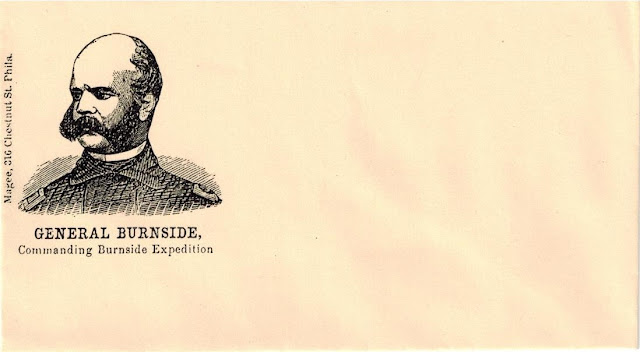
General Burnside Civil War Patriotic Envelope US48
celebrating his attacks on Confederate forces along the North Carolina coast
from February through June 1862.
Wonder how popular this one was among the soldiers after the mud march?

Children's Project:  Explore how both the Confederate signs and the Union revised prayer are both "sarcastic humor" using irony (intended meaning is the opposite of what's expressed).  Explore how what is humorous to one is not so funny to the other (am sure neither the Union soldiers seeing the CS signs nor General Burnside were pleased to be mocked).  This might be an interesting way to discuss different types of humor and the challenges of "cancel culture" with your children.  For example, should they share a joke mocking their teacher with the teacher?  And obviously jokes about you as a parent are always off limits.

Saturday, September 8, 2018

Southern Contraband of War Fleeing North -- Gen. Butler's Account of the Contraband Tag being Applied to Runaway Slaves

Major General Benjamin Butler gives this account of his inspiration to classify escaping southern slaves as "contraband":

    On the day after my arrival at the fort [Fort Monroe}, May 23 [1861], three negroes were reported coming in a boat from Sewall's Point, where the enemy was building a battery.  Thinking that some information as to that work might be got from them, I had them before me.  I learned that they were employed on the battery on the Point, which as yet was a trifling affair.  There were only two guns there, though the work was laid out to be much larger and to be heavily mounted with guns captured from the navy-yard.  The negroes said they belonged to Colonel Mallory, who commanded the Virginia troops around Hampton, and that he was now making preparation to take all his negroes to Florida soon, and that not wanting to go away from home they had escaped to the fort.  I directed that they should be fed and set to work.
    On the next day I was notified by an officer in charge of the picket line next Hampton that an officer bearing a flag of truce desired to be admitted to the fort to see me.  As I did not wish to allow offices of the enemy to come inside the fort just then and see us piling up sandbags to protect the weak points there, I directed the bearer of the flag to be informed that I would be at the picket line in the course of an hour.  Accompanied by two gentlemen of my staff, Major Fay and Captain Haggerty, neither now living, I rode out to the picket line and met the flag of truce there.  It was under charge of Major Carey, who introduced himself, at the same time pleasantly calling to mind that we last met at the Charleston convention.
    Major Carey opened the conversation by saying:  "I have sought to see you for the purpose of ascertaining upon what principles you intend to conduct the war in this neighborhood. . . ."
US57
    "I am informed," said Major Carey, "that three negroes belonging to Colonel Mallory have escaped within your lines.  I am Colonel Mallory's agent and have charge of his property.  What do you mean to do with those Negroes?"
    "I intend to hold them," said I.
    "Do you mean, then, to set aside your constitutional obligations to return them?"
    "I mean to take Virginia at her word, as declared in the ordinance of secession passed yesterday.  I am under no constitutional obligations to a foreign country, which Virginia now claims to be."
    "But you say we cannot secede," he answered, "and so you cannot consistently detain the negroes."
    "But you say you have seceded, so you cannot consistently claim them.  I shall hold these Negroes as contraband of war, since they are engaged in the construction of your battery and are claimed as your property.  The question is simply whether they shall be used for or against the Government of the United States.  Yet, though I greatly need the labor which has providentially come to my hands, if Colonel Mallroy will come into the fort and take the oath of allegiance to the United States, he shall have his Negroes, and I will endeavor to hire them from him."
    "Colonel Mallory is absent," was Major Carey's answer.
    We courteously parted.

Autobiography and Personal Reminiscences of Major General Benj. F. Butler: A Review of
His Legal, Political, and Military Career  (Boston: A.M.Thayer & Co. 1892.  p256-58)

    In the pages which follow this summary of how he came up with the "contraband" tag Gen. Butler gives a rebuttal of those who suggest it really didn't originate with him.
    The Union cover "Secession's Moving Foundation" pictured above reflects the reality that came out of Butler's decision to not return the slaves to their owner.  Many other slaves followed and were taken in by Northern forces.  Their exact status of slave/free would remain undetermined until later in the war after more formal policy was established.  But the artist of this cover catches the fact that things are changing, that Southern culture as it was is being challenged.  
    I don't know if I'd class this cover as an "abolitionist" cover.  Probably I'd see it more along the lines of cheering the fact that the South is being weakened both economically and structurally with each escaping "worker".  By this I mean, if we view patriotic covers as 1860s bumper stickers declaring political opinions of those who use them, then I do not think this covers's use would be limited only to strict abolitionists.