Saturday, October 15, 2022

"God's Love Is Free!" Insight Into the Heart of a Woman Who Desired to Bless Civil War Reenactors

    The following is a transcription of a devotional that my wife, Vicki Rowe gave to a woman’s group about her heart in reenacting the U.S. Christian Commission at Old Mahoning Baptist Church, Home, PA shortly after we had started reenacting -- probably about 1995 or 96.  She is sharing with the women of that church, none of whom were reenactors, what we as a family were doing and why.   I found her hand written notes of her testimony while going through old papers.  Those of you who have been blessed by her at the tent will indeed see that she loved you guys and wanted to bless you in many ways.  (Vicki went home to Heaven on March 3, 2016):

    We all cherish photographs because they remind us of special people or events.  Our heart also carries pictures of God’s faithful training in our lives.  I asked God which snapshot from this past year to share with you.
    Have you ever told God that you wanted to serve Him – that you were willing to do whatever He asked?  When God answered and gave you a job to do, maybe the job was less than fun, maybe even something you were not good at – but He was asking you to depend on Him.  Deep down inside, we all hope God will use our strong points, instead of exposing our weaknesses to other people.
    To be painfully honest, I am afraid of grasshoppers – terrified of bees – dislike making buttonholes – feel sick at the smell of smoke – not good at avoiding stepping in the cow patties -- and my least favorite subject in school was history.  Do you understand my sinking feeling when God chose to give my family a hobby of Civil War reenacting?  When I married my husband 20+ years ago, I had no idea that we would eventually develop a hobby that include so many things I was afraid of.
    I smiled at God’s sense of humor, and decided to keep my promise to serve Him in trying to be God’s hands, feet, and voice to this group of people.  Last year was our first full year, and we chose 6-8 events to be involved in.  We planned various acts of kindness that included baking food to share with the troops, helping cook over the open fire, sewing pouches with buttonholes, crocheting scrubbies, handing out samples of stamps/envelopes, and carrying many bucketfulls of water.  We would come home both sore and tired – but God has been faithful to teach us many lessons.
    This year the Mesopotamia [Ohio] event was one we worked hardest preparing for. Probably about 1500+ reenactors. We decided to take a week’s vacation so we could be there for the full 3 days.  We spent a month doing without sleep so we could get everything done that God had laid on our hearts to do.
    Saturday came – we actually made it there in one piece with projects just finished, wool outfits pressed and on the proper person, and did fairly well in being there on time in the morning.  The kids and I worked on getting ready to carry the boxes in while my husband went to find our unit’s location.  And could you believe it – it started pouring.  Everything was soaked including the sewing projects we brought to share, our clothes, shoes.  You cannot build a fire in pouring rain.  I started telling God how discouraged I was – how I feared that the children would get sick from being cold and soaked.  I felt God had neglected His duty to bless my obedience and smooth the way.  After all, if we are doing God’s work, doesn’t He smooth the way and give good results?
    But as I thought about why we were there – to show acts of kindness to the reenactors in hopes that God will soften their hearts to Him and draw some of them closer to Himself, what better way to show God’s love then to do it when things are difficult.  Jesus did not come to earth, taking on human limitation, to offer Himself as sacrifice for our sins because it was easy to do.  Jesus showed His kindness and love on the cross at Calvary under the harshest of circumstances.
    Maybe God has asked you to serve Him in something that is fun to do – or maybe He has asked you to do a job that leaves you feeling bedraggled.  Either way, He still asks the same question.  “Who is the servant – Me or thee?”  Are we going to allow God to use us even doing things that we are not good at?  He is asking us to depend on Him.
    That weekend at Mesopotamia through the rain and mud we offered God’s love to the reenactors – “God’s love is free! So is this soldier!”  Through the grasshoppers and bees, amidst the cow patties, in spite of the rain we watched God use what little we could do to point reenactors to Him and His free love for them.  Only God knows the results.  Let God use you in all you do, the things you are good at and the things that you struggle to do, to point others to Him.   Pass along the grace God’s given you to others so that they too may find God’s free grace. 

Some of my reflections on her commitment to passing along God’s love to other through reenacting:
    When I first expressed interest in doing Civil War reenacting, Vicki asked if we could do it as a family.  I said yes, the unit is family friendly.  So, she said she wanted to be involved.  Of course, she fed our unit with goodies at the early events we attended.  Then when we learned about the U.S Christian Commission, I remember her saying that we should portray them because it would allow us to offer food and drink to others beyond our unit.  Feed the unit or feed the whole reenactment? OK why not.
    She also sewed things like small pouches & housewives kits, drawstring bags we filled with things like packets of salt & sugar & matches, and handkerchiefs to put out on the gift table at our tent along with the stationery kits & tracts I would put out.
    As we reenacted over the years, she actually came to enjoy history.
    At the event that she cites, I do remember that among the large assortment of cookies and baked goods were six banana boxes full of pumpkin bread loaves.  At that time, we didn’t have a tent, so we used our unit’s storage tent to keep things, and would throughout the day fill up trays with goodies and walk around among the encampment along with lemonade in porcelain pots saying “US Christian Commission. God’s love is free and so is this”.
    So, in the above talk which Vicki is sharing with the ladies at the church about why she is working so hard at a challenging opportunity the Lord has asked her to do -- what is her motivation? It is not fame or fortune.  It is to be a small part in pointing others to Jesus.  It is to bless others in Jesus’ name.  Serving Him is our way of saying “Thank you Jesus for doing on the cross what we could never do ourselves – atone for our sin.” God’s love is free!  God’s love is not for sale!  It is not “church” or “rituals” or “money” or “good deeds” which saves us from judgement for our sins.  It is believing in our hearts that we are forgiven by grace – undeserved love – that Jesus showed on the cross.  Do not be a Pharisees who pridefully thinks that by keeping the laws then God will then owe you forgiveness & heaven.  Come as the thief on the cross who admits "I really do deserve punishment" yet cry out to Jesus for mercy “remember me Lord”.
    Vicki wants to welcome you at the tent in Heaven with a hug and some special delicious goodies saying “God’s love is free! Welcome Home! Come on in!”  Put your faith in Jesus alone.
 
“For by grace you have been saved through faith. And this is not your own doing; it is the gift of God, not a result of works, so that no one may boast.” Ephesians 2:8-9 ESV

God bless,
Glenn Rowe


Saturday, September 17, 2022

They've Come! Louisa M Alcott -- Civil War Hospital Sketches

 What's it like to work among the wounded during the Civil War era?
        Tribulation Periwinkle, a woman who has volunteered to come and help in the medical crisis the war is causing, presents a vivid description of the demands confronting nurses working among the wounded after the battle of Fredericksburg in Hospital Sketches Chapter III – They’ve come! (part 1  pages 31-36).

"THEY'VE come! they've come! hurry up, ladies–you're wanted."
"Who have come? the rebels?"
This sudden summons in the gray dawn was somewhat startling to a three days' nurse like myself, and, as the thundering knock came at our door, I sprang up in my bed, prepared
"To gird my woman's form,
 And on the ramparts die,"
if necessary; but my room-mate took it more coolly, and, as she began a rapid toilet, answered my bewildered question,–
"Bless you, no child; it's the wounded from Fredericksburg; forty ambulances are at the door, and we shall have our hands full in fifteen minutes."
"What shall we have to do?"
"Wash, dress, feed, warm and nurse them for the next three months, I dare say. Eighty beds are ready, and we were getting impatient for the men to come. Now you will begin to see hospital life in earnest, for you won't probably find time to sit down all day, and may think yourself fortunate if you get to bed by midnight. Come to me in the ball-room when you are ready; the worst cases are always carried there, and I shall need your help."
So saying, the energetic little woman twirled her hair into a button at the back of her head, in a "cleared for action" sort of style, and vanished, wrestling her way into a feminine kind of pea-jacket as she went.
I am free to confess that I had a realizing sense of the fact that my hospital bed was not a bed of roses just then, or the prospect before me one of unmingled rapture. My three days' experiences had begun with a death, and, owing to the defalcation of another nurse, a somewhat abrupt plunge into the superintendence of a ward containing forty beds, where I spent my shining hours washing faces, serving rations, giving medicine, and sitting in a very hard chair, with pneumonia on one side, diptheria on the other, five typhoids on the opposite, and a dozen dilapidated patriots, hopping, lying, and lounging about, all staring more or less at the new "nuss," who suffered untold agonies, but concealed them under as matronly an aspect as a spinster could assume, and blundered through her trying labors with a Spartan firmness, which I hope they appreciated, but am afraid they didn't. Having a taste for "ghastliness," I had rather longed for the wounded to arrive, for rheumatism was n't heroic, neither was liver complaint, or measles; even fever had lost its charms since "bathing burning brows" had been used up in romances, real and ideal; but when I peeped into the dusky street lined with what I at first had innocently called market carts, now unloading their sad freight at our door, I recalled sundry reminiscences I had heard from nurses of longer standing, my ardor experienced a  sudden chill, and I indulged in a most unpatriotic wish that I was safe at home again, with a quiet day before me, and no necessity for being hustled up, as if I were a hen and had only to hop off my roost, give my plumage a peck, and be ready for action. A second bang at the door sent this recreant desire to the right about, as a little woolly head popped in, and Joey, (a six years' old contraband,) [“contraband” was a Civil War era term for black slave escapees coming from the South] announced -- 
"Miss Blank is jes' wild fer ye, and says fly round right away. They's comin' in, I tell yer, heaps on 'em–one was took out dead, and I see him,–hi! warn't he a goner!"
With which cheerful intelligence the imp scuttled away, singing like a blackbird, and I followed, feeling that Richard was not himself again, and wouldn't be for a long time to come.
The first thing I met was a regiment of the vilest odors that ever assaulted the human nose, and took it by storm. Cologne, with its seven and seventy evil savors, was a posy-bed to it; and the worst of this affliction was, every one had assured me that it was a chronic weakness of all hospitals, and I must bear it. I did, armed with lavender water, with which I so besprinkled myself and premises, that, like my friend Sairy, I was soon known among my patients as "the nurse with the bottle." Having been run over by three excited surgeons, bumped against by migratory coal-hods, water-pails, and small boys, nearly scalded by an avalanche of newly-filled tea-pots, and hopelessly entangled in a knot of colored sisters coming to wash, I progressed by slow stages upstairs and down, till the main hall was reached, and I paused to take breath and a survey. There they were! "our brave boys," as the papers justly call them, for cowards could hardly have been so riddled with shot and shell, so torn and shattered, nor have borne suffering for which we have no name, with an uncomplaining fortitude, which made one glad to cherish each as a brother. In they came, some on stretchers, some in men's arms, some feebly staggering along propped on rude crutches, and one lay stark and still with covered face, as a comrade gave his name to be recorded before they carried him away to the dead house. All was hurry and confusion; the hall was full of these wrecks of humanity, for the most exhausted could not reach a bed till duly ticketed and registered; the walls were lined with rows of such as could sit, the floor covered with the more disabled, the steps and doorways filled with helpers and lookers on; the sound of many feet and voices made that usually quiet hour as noisy as noon; and, in the midst of it all, the matron's motherly face brought more comfort to many a poor soul, than the cordial draughts she administered, or the cheery words that welcomed all, making of the hospital a home.
The sight of several stretchers, each with its legless, armless, or desperately wounded occupant, entering my ward, admonished me that I was there to work, not to wonder or weep; so I corked up my feelings, and returned to the path of duty, which was rather "a hard road to travel" just then [“hard road to travel” – a phrase used a southern war song “Richmond is a hard road to travel” = won’t be an easy conquest, but a challenge]. The house had been a hotel before hospitals were needed, and many of the doors still bore their old names; some not so inappropriate as might be imagined, for my ward was in truth a ball-room, if gun-shot wounds could christen it. Forty beds were prepared, many already tenanted by tired men who fell down anywhere, and drowsed till the smell of food roused them. Round the great stove was gathered the dreariest group I ever saw–ragged, gaunt and pale, mud to the knees, with bloody bandages untouched since put on days before; many bundled up in blankets, coats being lost or useless; and all wearing that disheartened look which proclaimed defeat, more plainly than any telegram of the Burnside blunder. I pitied them so much, I dared not speak to them, though, remembering all they had been through since the route at Fredericksburg, I yearned to serve the dreariest of them all. Presently, Miss Blank tore me from my refuge behind piles of one-sleeved shirts, odd socks, bandages and lint; put basin, sponge, towels, and a block of brown soap into my hands, with these appalling directions:
"Come, my dear, begin to wash as fast as you can. Tell them to take off socks, coats and shirts, scrub them well, put on clean shirts, and the attendants will finish them off, and lay them in bed."
If she had requested me to shave them all, or dance a hornpipe on the stove funnel, I should have been less staggered; but to scrub some dozen lords of creation at a moment's notice, was really–really–. However, there was no time for nonsense, and, having resolved when I came to do everything I was bid, I drowned my scruples in my wash-bowl, clutched my soap manfully, and, assuming a business-like air, made a dab at the first dirty specimen I saw, bent on performing my task vi et armis [Latin meaning “by force of arms”] if necessary. I chanced to light on a withered old Irishman, wounded in the head, which caused that portion of his frame to be tastefully laid out like a garden, the bandages being the walks, his hair the shrubbery. He was so overpowered by the honor of having a lady wash him, as he expressed it, that he did nothing but roll up his eyes, and bless me, in an irresistible style which was too much for my sense of the ludicrous; so we laughed together, and when I knelt down to take off his shoes, he "flopped" also, and wouldn't hear of my touching "them dirty craters. May your bed above be aisy darlin', for the day's work ye ar doon! –Whoosh! there ye are, and bedad, it's hard tellin' which is the dirtiest, the fut or the shoe." It was; and if he hadn't been to the fore, I should have gone on pulling, under the impression that the "fut" was a boot, for trousers, socks, shoes and legs were a mass of mud. This comical tableau produced a general grin, at which propitious beginning I took heart and scrubbed away like any tidy parent on a Saturday night. Some of them took the performance like sleepy children, leaning their tired heads against me as I worked, others looked grimly scandalized, and several of the roughest colored like bashful girls.

Louisa Alcott does have an interesting way of describing the challenges women faced as they stepped up to help in the hospitals during this national crisis doesn't she?  She was born Nov.29, 1832 in Philadelphia, Pa. died March 6, 1880 in Boston, Mass.  She is known for books such as Little Women (1868) and Little Men (1871).  Her book Little Women was first published in a series of short stories, then eventually complied into one book.
        Due to pressures and family struggles as she grew up, writing became for her a creative and emotional outlet as her family struggled to support themselves.  Her family served as station masters for the underground railroad in the late 1840s.  She was also involved with the woman suffrage movement during her lifetime.
 In December 1862 she volunteered to be a nurse to aid the wounded in the Union Hospital in Georgetown, DC.  The demands of the war led to the acceptance of women serving in the hospitals as nurses (a role previously restricted in the military to male Stewards).  She intended to serve three months, but half way through she contracted typhoid and became deathly ill.  Though she eventually recovered, she would struggle with the after affects of the medicine (which included mercury) used to help her recover.
        Alcott edited and fictionalized letters she had written home about her nursing experience into the story of nurse "Tribulation Periwinkle" which were first published in the Boston anti-slavery paper Commonwealth and then later printed as a book entitle Hospital Sketches in 1863 (republished with additions in 1869) — which brought her recognition for her observations and humor.

        Union casualties at the battle for Fredericksburg, Dec.11-15, 1862:  1,180 killed; 9,028 wounded, 2,145 missing (Combat: The Civil War ed by D. Congdon p.315). Other sources have numbers of around 1,200 killed, around 9,600 wounded, around 2,000 missing or captured.  Exact stats vary with sources.  But clearly there were a great many wounded who were needing medical help from this battle when Alcott came on duty.

        What is in the name "Tribulation Periwinkle"?  I do not claim to have figured out why Alcott chose this name for her fictional character.  I looked for suggestions of reasons on other sites, but really didn't find many ideas.  Some suggested that "Tribulation" was chosen since the nurse was facing many challenges in getting accepted into the role of nursing and then as she did her work in the medical system of that time.  Seems reasonable.  Didn't find much on the last name of "Periwinkle".  When I did research on the word, it's a name for a grouping of flower types, some of which are poisonous.  There seem to be two themes of meaning attached to the flower type from European folklore. One is that periwinkle symbolizes hope/ love/ affection/ protection.  The flower was often given to someone who had suffered loss as an act of comfort.  The second theme is that it is the flower of death, because its vines were woven into headbands placed on dead children in burial or by criminals on their way to execution.  Also periwinkle was a popular folk medicine component in various herbal treatments from the Middle Ages on.  Given the mixed messages themes associated with periwinkle, I can see maybe why Alcott chose the name tag.  She, as a nurse, was both offering hope and comfort in the midst of suffering and death.  Again, I am not claiming this is the correct interpretation of Alcott's reasoning.  I offer this as a suggestion that you might find interesting.

Children’s Project:
        Discuss with them how they would feel to be in a room full of wounded men and be working on cleaning them up from the grim and dirt of battle along with the blood stains of wounds and surgery.  Explain to them how she tried to deal with bad odors of the place through the perfume bottle she carried.  Explore why they think she was willing to endure such tough circumstances to be at this hospital.  Would they be willing to do the same?
        For background on the "contraband" tag see the post on September 2018 "Southern Contraband of the War Fleeing North -- Gen. Butler's Account of the Contraband Tag being Applied to Runaway Slaves".

Saturday, August 20, 2022

Cape Hatteras Under Union Control – A Soldier's Perspective September 1861

    How did the men-in-the-ranks view the victory of taking the Confederate forts protecting the Cape Hatteras inlet in August 1861?  Well, it was a much needed Union victory in the fall of 1861 after a summer of defeats as I shared in the previous blog post about the Hatteras Victory Patriotic Envelope, posted on April 20, 2022. But was it an effective strategy in blockading Southern commerce?  And what was it like for the Union soldiers to be there on duty after the battle garrisoning the captured forts?  The following unnamed soldier’s letter gives some interesting “little details” to help us better appreciate the “big picture” of the Union victory.  Hope you enjoy reading his letter printed in the Sunday Mercury Newspaper Sept.22, 1861 about what’s happening now that the Union controls Cape Hatteras:

Hawkins’ Ninth Regiment N.Y.S.V.
On Board Steam Transport S.R.Spaulding
Cape Hatteras, September 12, 1861
To the Editors of the Sunday Mercury:
I write to you, having an opportunity to send this by the transport which leaves for Fortress Monroe to-day.  We struck tents at Newport News, VA., at 4 o’clock PM, of the 10th inst., but did not get aboard of the steamer until 10PM, when we left under cover of night.  We arrived here yesterday, 12PM, after a pleasant voyage.  The steamer was somewhat crowded, and of course we hadn’t everything we wanted.  We slept on deck, down in the hold, and in fact in every place we could find.  We disembarked at 1 PM, Wednesday, and remained on shore until 6 PM, when we were ordered aboard again for the night.  The same inconvenience we had to experience again.  All the companies, with the exception of our own, are ashore.  We are detained aboard for something; I don’t know what.  To tell the truth, this is the most dreary place I have ever seen.  The soil is all sandy, like Coney Island exactly.  Our colonel [Rush Hawkins] is in possession of Fort Clark, which is at the upper end of the island.  Fort Hatteras, in possession of Col. [Max] Weber, is nearest the landing, and is, I think, the best fort.  I stood upon the ramparts yesterday, and viewed the country all around.  It is a very curious sight.  Shot and shell were strewed all around.  I have got plenty of shell and shot, and will endeavor to send you some.  Fort Hatteras is not a regularly-built fort, like any that are in the Harbor of New York; it is built of sand and sod, and has no barracks.
Our boys have all sorts of trophies taken here.  Some had watches, and others had knives and pistols; and when we arrived, we were received by some of our boys who were dressed up in all sorts of clothes, taken from the “seceshers” -- green, blue, gray, and every color imaginable.  It was rather an amusing sight, and one I won’t soon forget.  Yesterday we met two schooners (prizes) on their way to Philadelphia.  It appears they came in supposing it to be still in possession of the secessionists.  Lieut. Crosby met them, and they asked to be towed in by the Fanny, and the captain of the “secesher” said he was glad to get clear of the “d—d Yankee,” meaning the frigate Cumberland, who tried to deceive them by letting them run the blockade.  Lieut. Crosby afterward said he was a United States officer, and claimed him as his prisoner.  The captain then was so surprised that he went aboard and got drunk, and remained so all day.  The colonel had a beautiful stand of colors captured, and the hoisted them on the fort. We have captured five vessels since our boys have been here, and we expect a number to arrive from the West Indies daily.  The prizes we took yesterday had on board coffee and ammunition.
Our boys lived high at first.  They captured all their provisions.  The people, they say, come from miles around into camp, and sell articles, such as fish, etc.  They are all loyal.  To my utter surprise, we have not seen a contraband since we arrived.  There are none around.  All the people are white.  There is a small church a little way up the main land, where an old minister preaches, and who seems to be their leader.  He comes into camp under a flag of truce, and gets all the inhabitants to swear allegiance to the Union.  About five hundred have already done so.  They say there is no rebels nearer than sixty miles.  This I guess is so, because we have no picket-guard posted, only an interior guard.  We are on the Cape, and nothing can be seen to the North but a wide expanse of water; and it reminds me of the island that Robinson Crusoe lived on; at the back you can see a few houses.  Our men seem to have everything they want; figs are in abundance; a little back in the country, fishing is of the first class, but the water is awful.  We have no well save those that are dug in the sand, and the water is almost unfit to drink.  When a storm is brewing, they say, it carries everything before it, washing clear over the sand.  You may not hear from me for one or two weeks.  I understand we are to have communications with the fortress twice a week, and then of course I will write to you often. R.H.J.

Fort Hatteras under Union control
Picture from Battles and Leaders of the Civil War 1887 page 665

9th Infantry Regiment New York State Volunteers also knows as the Hawkins Zouaves or New York Zouaves. Organized mostly in New York city, mustered into U.S. Services May 4, 1861.  In June they were stationed at Newport News VA.  On August 28-29, 1861 three companies (C, G & H), serving under Major-Gen. Butler, helped in the attack on the confederate forts guarding the Hatteras Inlet.  The rest of the regiment was then sent down to help secure the forts taken, arriving Sept.10 through 12.

Little details make “the big event” more interesting
Reading this man’s letter describing various little things going on around him gives us more insight into the big picture event of the Cape Hatteras Assault.  You have to appreciate his sense of humor.  His humorous description of how the blockade runners were lured into thinking “they had made it safe” by flying of Confederate flag over the fort and the pretending to let them slip by the Union blockading vessels, only to be surprised – “you’re our prisoners”.  Might as well finish off the liquor, it’s just going to be confiscated anyway by these yanks.  And I am sure the coffee was much appreciated by the garrison.
The details about occupying the forts, the mix of good food options to supplement army rations and distasteful water, and the relationship with the people in the area all give more depth of appreciation of the big picture of this Union victory on the North Carolina shores.  I am glad the Sunday Mercury printed up letters like this one during the course of the war.  Its always interesting and enjoyable to get perspectives from the guys doing the work on the ground.

Children projects:
1) Explore why the Confederate blockade runners could be fooled.  (You will have to explain there was no such thing as radio signals or text messaging during the Civil War time period.)  Show how this was part of the early war Anaconda Plan proposed by Gen. Scott.
2) For background on the “contraband” comment, see my post on “Southern Contraband of War Fleeing North” (Sept. 8, 2018) for the origin of this term to describe people of color during the Civil War.
3) Perhaps explore how 'big politics' can differ from 'local politics'.  The state of North Carolina did secede from the Union. But here the local population seems to accept the Union forces.  Explore how secession was more complicated in North Carolina than other southern states.
4) This soldier talks about souvenirs of war that he and others were enjoying collecting.  Does your family have any souvenirs of maybe family history that you prize?  But then the next generations may not value what the previous ones did because the “memories” don’t get passed along.  Time moves on.  I bought a Civil War hat pin years ago that had been made out of an original Union coat button which some sweetheart had worn in honor of her man off to war.  My wife wore it in her hat at the reenactments we went to over the years.  So, it got a second life.  When Vicki died, I gave it to my daughter.  She will give it to my granddaughter who is named after her grandma with the story of the memories of grandma always wearing it in her hat.  But someday it will probably just be lost again.  Talk to your children about why they treasure some things, about family memoires of things you treasure.  It may keep family history alive for another generation.

Saturday, July 30, 2022

Challenges & Joys of an Ohio Soldier Tramping Through Tennessee 1862

  Of course, being out on campaign in the fall of 1862 is fun!  Well, maybe better described as a mix of challenges and surprises.  This letter is from George Washington Fawcett (1837 – 1912).  He had volunteered for three month service in the 19th Ohio when the call first went out from President Lincoln.  Then he reenlisted for three year service in Co.I 1st Ohio Infantry.  His commitment to the Union cause shows up in this letter, written to his friend Clara Strieby living in Kansas.  His unit, involved in the Western Theater campaign, is encamped in Franklin Country TN just north of the Alabama boarder.  Having fought at Shiloh (April 1862) and the Corinth Campaign, they are awaiting further orders.  His letter is an interesting mix of how he is handling challenges such as 'marching into enemy territory' and finding 'creative' ways to get food, along with enjoyable surprises such as getting mail from home and exploring interesting local sights.  He has some interesting insights into the change of attitude about this being a "short war" and about how his attitude toward the secessionists is changing.  Enjoy a bit of “history” from the ranks:

Written to Miss Clara L Streby
Council Grove, Morris County, Kansas
Postmarked Nashville, Tn

Camp Boiling Fork, Franklin county, Tennessee
August 5, 1862
Friend Clara,
Yours of July 11th was received the other day and you may rest assured that it was perused with much interest. For a long while we had been—as it were—shut out from the balance of the world without either a mail, newspaper, or any news whatever save camp rumors which are as a general thing very ridiculous and not much to be depended upon. But the other day a train did finally get through from Nashville and the glad tidings was revealed to us that this railroad was open through from Nashville to Stephenson—a distance of 120 miles. But this was not all the joy. A large mail for Company I produced some smiling countenances and your humble servant was the recipient of no less than four letters and several papers, one of which was from your good self. So you may judge that I felt right good and that night I slept sound and had pleasant dreams of friends in the far distant west & of dear ones at home—a sister whom I so dearly love and who expected or hoped that the war would be over before this, was disappointed in not having me home by the 4th of July. Why Clara, if I get home by the next fourth of July, I shall feel thankful. I do not see as there is any prospect of the war ending yet. Indeed, things look more gloomy to me now than they did 10 months ago. We have gained a great amount of territory, but we have got as much or more than we can hold.
The rebels are now all around us and if they should make a dash into our camp today, I would not be a bit surprised. We are looking for them and more than half of our regiment are now out building fortifications. If they do come, we will give them a warm reception and they will get the best we have got in our cartridge boxes. We are encamped in a very pleasant grove near Boiling Fork—a small creek which supplies our camp with an abundance of the best of water. We are guarding a bridge which we have rebuilt across the creek since we came here. We arrived here on the 8th of July. Came by way of railroad from Huntsville. Our train was the first one on the road for over 5 miles as the rebels destroyed all the bridges on the road last spring when they retreated from Nashville. We have now go the road in running order.
        We are distant from Nashville about 87 miles south and 30 north of Stephenson and about 35 or 40 from Chattanooga. We are only a few miles north of the line between Alabama and Tennessee. There is a range of the Cumberland Mountains here through which the railroad crosses by way of a long tunnel. We are encamped at the foot of the mountain about 2 miles from the tunnel.
When I last wrote you we were at Florence which is over 150 miles from here. We had some hard marches after that beneath the rays of a hot Alabama sun. And you better believe we felt glad when we arrived at Huntsville and were favored with a ride on the cars. The balance of the division were not thus favored as they had to walk through to Stephenson. Since we have been here, we have been rather short of rations for a long while. We were one-fourth rations and some of the time without any at all from Uncle Sam. But we made it a point to visit some of the neighborhood plantations very frequently and the potato patches, hen roosts, orchards and such like had to yield to our wants.
I have been in the service over one year but I have never taken anything of much importance without paying for it—till of late. But lately since the rebs have been playing the mischief so and trying to cut off our supplies, I have just come to the conclusion there is no harm in making the prominent secessionist in the neighborhood respond to our wants. This rather a rich part of the country and there are quite a number of very good plantations near our camp. I have been out several times after provisions. I first go and ask for what I want and if they do not give it, I sometimes take it anyhow. We were out of bread for several days and we were bound to have something to eat or else starve so 8 of our mess went out after potatoes. We found an old planter who gave us enough to fill our haversacks and while 6 of us were in the garden digging, then two others of our mess were skylarking around the premises to see if they could find another patch and they engaged the old planter in conversation while the other two boys filled a 2-bushel bag.
Since our arrival here I have had several tramps up on the mountains and have visited quite a number of very wild and dangerous places. But I am always in my element while clambering over rocks, penetrating caverns, and visiting such wild places. But I must now tell you about what a beautiful cave there is on the mountain side about 1½ miles from our camp. We heard of this cave shortly after our arrival here. Also heard that there was a band of bushwhackers concealed in the cave. So our captain with our entire company went out on a scout to the cave. After a long search, we found it but would not if we had not went and got a negro slave to show us the place. There is no road or even a path leading to it. The entrance of the cave is very small—not more than large enough to crawl in at. We did not see any outward signs of rebels so we had no fears on entering. We left a strong guard on the outside while about 20 of us provided ourselves with hickory torches and entered. After crawling on our hands and knees for several hundred feet, we came out into a large room which was at least 60 feet from floor to ceiling and several hundred feet in length and width. I was perfectly enraptured with awe at its beauty and grandeur. The ceiling and walls resembled the most magnificent fresco painting, which reminded me of the audience room of the M. E. Church in Salem—only it was far more grand. The ceiling was covered with formations which resembled icicles in shape. Those were of various sizes from 3 inches to 3 and 4 feet in length—the points of which are covered with a white substance resembling snow. This reflecting in the torchlight was magnificently grand. We found several springs of the purest crystal water. There were many side caverns that we did not enter but doubtless the cave is miles in extent. I have made two visits to the cave and am now ready for the third visit. I was there one day with our chaplain. He says it exceeds the Mammoth Cath in beauty.
We have captured several bushwhackers since we have been here. One boy belonging to our company was shot at the other day while on picket. I like our present camp very much, it being so near the mountains. The weather as a general thing is very pleasant. There is an abundance of apples & peaches which are now ripe.  The health of our regiment is remarkably good. Two of our company there were wounded at Shiloh have again rejoined us in camp nearly as sound as ever. One of them will be a little lame probably for life yet he is of the right grit and he wants to get a chance at them again. Steph. Talcott has again rejoined us after being home on furlough about 3 months. My right hand man, Joe T., is all right. Him and I have got us a very nice bough house made with a good bed in it and everything fixed to suit our fancy. Call around and see us.
Well, Car, I have not told you half as much as I thought I would when I commenced but I will have to close. We are all enjoying camp life hugely. My health was never better. Soldiering is a luxury while we are laying in camp as we are at present.
So it is the white Injins you are afraid of now? I should judge from what you say that they need civilizing—a portion of them at least. Your letter was full of interest and just such a one as a soldier loves to receive. You need have no fears about not interesting me. I remember our friend Alex Taylor. I trust he is not badly wounded.
The late call for 300,000 more troops [Lincoln’s Proclamation July 1, 1862] will either bring out a good many cowards or else they will be drafted. There is considerable of talk about drafting now about home.  I have not seen or heard from Br. Hale since I wrote you before but I learn that Woods’ Division is on the railroad between us and Nashville. Talcott saw Br. Hudson on the train the other day as the cars passed but he did not get to speak to him. We still have some very spiritual prayer meetings. I could appreciate a good class meeting once more. I trust that my heart will remain fixed and that my faith may never waiver.
Write me soon as you can. I remain as ever your friend truly, — G. W. Fawcett
    Direct On the line of the Nashville and Chattanooga Railroad, Cowan Station, Tennessee
    Stephen sends his respects & says he is a going to emigrate to Kansas after the war is over and Fawcett is a going along.

[This letter transcript is from the WordPress site: Billy Yank & Johnny Reb Letters. Transcribed by Will Griffing, in the Ohio letters section]

Children Projects:
    1) In his letter’s first paragraph explore why his unit might be very glad to get “mail from home”.  Explain to them what “letters” and “newspapers” are.  Maybe show them some of your artifacts if you still have them.  And remind them that this letter they are reading was written in 1862 and has survived over 150 years.  He wrote this letter on Aug. 5th.  The cancelation date on the envelope in Nashville is Aug. 9th.  And it looks like someone wrote on the envelope that the letter was "received" on Aug. 15th.  So it appears that sometimes mail delivery was good and sometimes not so good, which makes sense in a war situation.  Staying connected with loved ones back home was always something the men looked forward to, both to get news from home and as Fawcett shows here to share perspectives from the field about what's going on in his life.  
    2)  Supplementing short rations means taking what's needed:  Explore his attitude change about getting food needed to survive.  They are now in “enemy” territory and sometimes are not getting the supplies needed from the army quartermaster.  Initially Union commanders tried to uphold Lincoln’s policy of not pillaging from the locals as the armies moved through secessionist territory.  The hope was to avoid pushing locals toward loyalty of the Southern cause.  But as the Union troops began pushing into the South in 1862, attitudes began to change as it became evident that Southern loyalty was indeed generally stronger than national loyalty. Attitudes from the men in the ranks on up to higher commanders became “we must conquer” by punishing the disloyal and gaining supplies for our conquest.  Fawcett is reflecting this shift in this letter as he describes the reaction to how his unit is supplementing their shortages of army rations. For a more detailed summary of this shift of attitude check out Nothing But Victory – The Army of the Tennessee by S.E Woodworth p.210-13.
    3)  Trace through the letter his comments that point to a shift in his understanding that this will not be a “short war” as he had once hoped in early 1861.  Remember he had signed up for the first call to action of 3 months.  Now reality is setting in.  Discuss if his attitude is one of defeat or determination.

Sunday, July 3, 2022

Somebody's Father -- July 3, 1863 Gettysburg

A confederate soldier's sad memory:  C.R. Graham does not give the name of the soldier who shared this memory with him.  It appears in a section titled “Random Tails by Confederates”, so we can assume that it is a memory of a southern soldier who was at the battle of Gettysburg:

    I think that one of the saddest incidents of the war which I witnessed was after the battle of Gettysburg.  Off on the outskirts, seated on the ground, with his back to a tree, was a soldier, dead.  His eyes were riveted on some object held tightly clasped in his hands.  As we drew nearer we saw that it was an ambrotype of two small children.  Man though I was, hardened through those long years to carnage and bloodshed, the sight of that man who looked on his children for the last time in this world, who, away off in a secluded spot had rested himself against a tree, that he might feast his eyes on his little loves, brought tears to my eyes, which I could not restrain had I wanted.  There were six of us in the crowd, and we all found great lumps gathering in our throats, and mist coming before our eyes which almost blinded us.  We stood looking at him for some time.  I was thinking of the wife, and baby I had left at home, and wondering how soon, in the mercy of God, would she be left a widow, and my baby boy fatherless.  We looked at each other and instinctively seemed to understand our thoughts.  Not a word was spoken, but we dug a grave and laid the poor fellow to rest with his children’s picture clasped over his heart.  Over his grave, on the tree against which he was sitting I inscribed the words: “Somebody’s Father, July 3, 1863”  [Under Both Flags. A Panorama of the Great Civil War as Represented in Story, Anecdote, Adventure, and the Romance of Reality   1896 pages 84-85]

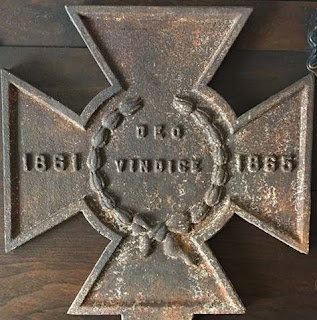
Deo Vindice = God is our vindicator
CS grave marker
Summary facts about Gettysburg:  Casualties at Gettysburg totaled 23,049 for the Union (3,155 dead, 14,529 wounded, 5,365 missing & captured). Confederate casualties were 28,063 (3,903 dead, 18,735 wounded, and 5,425 missing & captured), more than a third of Lee's army.
    The Confederate dead were not buried in the Soldier’s National Cemetery.  Within a few months after the battle most of the Union dead were dug up from their shallow graves and reinterred in the Soldier’s National Cemetery, which was for those who fought to preserve the Union.  But the Confederate dead were left wherever they were buried scattered across the fields and farms of the area.  In the 1870s an effort was made by organizations in the southern states to find and relocate the corpses of the southern soldiers to sites down south.  But it is a known fact that not all of these shallow grave burials were discovered.  And from time to time a grave has been uncovered.  So, we do not know if this man’s body was ever returned home to family.
    In the ‘broad roll of human history’ come moments which remind us that it is those whom God has put in our lives as “family” that are far more important than fame or fortune.  These relationships of love are God’s great gift to us no matter what is rolling along in the big picture of history.

Children’s project discussion questions:
1.  Would you hope your father’s dying thoughts would be on your family, or would you want him to be thinking about how successful he was or how rich he was or how athletic he was?
2.  If you would want him to be thinking of you and your family circle, then are you trying to learn good traits from your parents, or are you too busy with friends your own age to care about building a positive family circle?

Saturday, June 11, 2022

The Army Sutler's Role in the Encampment -- an 1861 Description

  What was a sutler and what his role in Civil War camp life?  Here is an interesting first-person description of how the Army Sutler runs his business printed in the New York City Sunday Mercury Newspaper, September 29, 1861:

  The sutler’s tent is the same in all camps we ever visited.  Be it understood, for the benefit of those who are uniformed, that the sutler is the merchant of the regiment.  He sells lemonade, tobacco (in papers and plugs), cigars (of cabbage, oak leaves, or tobacco), red herrings, cracker, and molasses-cake.  He would sell whiskey if he dared.  His tent is always lumbered up with barrels and boxes, and at the customers’ end of it a board across two pork-barrels does duty for a counter.  Here the men come in crowds every hour in the day, to get some little delicacy (after salt fat pork and no vegetables, with the sun at ninety-eight degrees, even molasses-cake is a delicacy) to eat, or for a glass of cool lemonade to drink and make much of.
As the regiments are mostly supplied with water from muddy springs of their own digging (to prevent poisoning by our amiable Virginia neighbors); and as the sutler generally has the only ice in camp, a glass of even the sutler’s lemonade is a grateful beverage under the torrid circumstances.
The currency used by the sutler is paste-board tickets, representing respectively the value of five cents, ten cents, or twenty-five cents, payable in goods at the sutler’s store.  When a soldier desires to enter into commercial negations with the sutler, and has no money wherewith to achieve that mercantile desideratum, he naturally concludes to anticipate some portion of his pay.  He, therefore, obtains from his captain a printed order on the paymaster for one dollar or more, as the case may be, which is signed by himself, of course, as drawer of the order, and is then countersigned by the captain, as a guaranty that the sum of money called for in the order is actually due the man.  This document is now negotiable, and the sutler will take it and give for its “face,” not in money, but in tickets, which are simply due-bills on himself, which he binds himself to redeem in store goods.
All the goods are sold at his own prices; and as the tickets must eventually all find their way to his establishment, it follows that the office of regimental sutler usually pays better than that of major-general.  When pay-day comes round, the men, having spent all their tickets, have, as a general rule, little interest in the paymaster.  The sutler presents all the orders for pay which are in his possession, and from the paymaster received the gold.  This whole system is very objectionable and the French plan of paying the soldiers every ten days would be an infinite improvement.  As it is, the men do the work and dare the danger, while the sutler pockets the lion’s (or rather the sutler’s) share of the pay.
All sutler’s stores or tents are alike – are always thronged, and always making money.  There is usually a rear entrance for the officers, who are thus admitted behind the counter; and occasionally a sportive major takes a fancy to ride a frolicsome horse in the back door, and a smashing sensation is the result.
Though the sutlers are prohibited from selling spirits to the men, which rule they obey in most regiments, till, as a general thing, an officer need not languish for his liquor.  A colonel can have his cocktail, a major can procure his mint-julep, a captain his “cold without,” a lieutenant his “lemonade with,” and even a sergeant can procure his favorite “smash.”
But the whole sutler arrangement is bad, though it is so intimately connected with the system of army payments that a reform touching only the sutler’s department would be but half skin-deep.

Another description in a different Letter to the Editor by a different soldier tagged as being in the Ninth Regiment N.Y.S.M. at Camp Smith, Darnestown Maryland written Oct.5, 1861 and printed in the Sunday Mercury Oct.13th edition:

    Now for a few words for our sutler.  He is to outsiders a very pleasant man, but he has what the boys say "gone back on us."  His charges are outrageous, and what is still worse, he will not allow any outside peddler to come anyways near camp; so we are thus compelled to patronize him, and he has got us as his mercy.  We are unable to buy any luxuries from the farmers, as he buys up everything to supply the officers' table.  It would do you good to hear the boys grumble when pay-day comes.  As soon as they receive their hard-earned money from Uncle Sam, the sutler stands by the desk, and nine out of ten of the boys turn most of their money over to him to settle their accounts, and then commence grumbling; but there is no use of saying a word, as he will only tell that he don't care for you custom.  But, at the same time, he knows that he has got things most of the boys need, and so they are compelled to patronize him.

Background on the word “sutler”
Sutlers have been accompanying armies here since the colonial times during the French and Indian Wars, and before that in Europe.  Shakespeare has the character Pistol declare in Henry V (written in 1599) “For I shall sutler be, Unto the camp, and profits will accrue”.  Our English “sutler” comes from the Dutch word.  Merriam-Webster gives this background: “The Dutch adopted ‘soeteler’ from a Low German word meaning ‘sloppy worker,’ which itself traces to an even older verb that meant ‘to do sloppy work’ or ‘to dirty.’ Perhaps the snide designation was inspired by the fact that the traditional sutler followed troops and sold them supplies at hugely inflated prices.”
With the outbreak of the Civil War, “opportunities” or “needs” -- depending on how you want to describe it -- greatly increased because of the ever expanding size of the army as the war dragged on.  These were civilian merchants supplying non-military goods, both essentials like food variety and luxuries that were not supplied by the army for the soldiers on duty.  They could be located in a building at an established permanent military post.  Or if following a regiment in the field, they would typically set up a tent or even occasionally sell directly from their wagon if necessary.  The regulations over who could be a sutler and what they could do changed over the course of the war.  Typically, there was to be only one sutler per regiment or post.  And being a sutler meant you had to be in good with those in command of the unit.

Background Info on the New York City Sunday Mercury Newspaper
Started in 1840 the newspaper had achieved notoriety and circulation over the years to 145,000.  But when the war broke out it lost about 90,000 in the southern and western states subscriptions.  To help with the loss of circulation, the paper in April 1861 announced it would begin publishing letters and accounts sent to it from soldiers in the army, with a free copy being sent back to the soldier who contributes.  Over 3000 such contributions were printed during the course of the war, 1861-65.

Observations:
I always find “first person” accounts interesting helps to “step back in time” with greater understanding.  Yet I also realize that different people can have different perceptions of the same event, so not everything they say is automatically “fact”.  Use these accounts to explore an aspect of history not typically described.
These 1861 articles are interesting descriptions of how sutlers operated their business.  You can sense from how the writers words that while sutlers were considered “necessary”, they were not “necessarily appreciated” because of 1) their pricing which took advantage of the soldiers, 2) the often poor quality of what was being sold, and 3) the double standard of service given to the men in the ranks vs. the treatment of the officers.
It is said that many sutlers setup their tents just outside the encampment so they could also service civilians nearby as well as offer “services” that were restricted within the encampment by regulations such as selling whiskey. 
Though the first 1861 letter above mentions that the sutlers used “paste-board tickets”, some would later on issue token coins like the one pictured below stamped with the regiment designation they were serving along with their business name and a trade value (5 cents, 10 cents etc).  From the description of how payment was made by credit from the soldier’s future pay, you can see how many men would be lured into making purchases that might not have been wise even though desirable on the impulse of the moment.

Children projects:  
1) Explore why it might not be wise for a soldier to spend money that he had not yet actually gotten even though his circumstances might pressure him to need/want to make purchases.  How is this like “credit” buying today?  Remember that most of these soldiers had a family at home that they were needing to support with the money they were being paid.
2) How would your child feel about needing to drinking muddy water with no ice on a hot day?  It’s an interesting little historical tidbit that gives insight into the pressure that a soldier back then had to face.  No bottled water.  No ice in the fridge.  Drink it anyway. . .
3) Explore the issue of “rank has its privileges” back in then, and today.  Talk through the writer’s clear condemnation as unfair that officers can buy drinks while the men in the ranks are prohibited from buying.

Saturday, May 21, 2022

Colonel Elmer Ellsworth -- A Death That Made History -- May 24 1861

  Is Elmer Ephraim Ellsworth a heroic martyr or just another slain tyrant?  Depends on which side you stand with during the early days of 1861.  If you stand with the Union, then he is a heroic martyr who needs to be remembered.  If you stand with the Confederacy, then he is just the first of many tyrants who need to be killed.

Here is a eulogy for him entitled “The Murder of Colonel Ellsworth” printed on May 26, 1861 in the New York City Sunday Mercury Newspaper two days after his death:
We hope, and do not doubt, that every fireman, every patriot, and every American citizen will recollect, and hold in eternal remembrance, the assassination of the young, the gallant, and the glorious Colonel Ellsworth whose fate, at Alexandria on Friday last [May 24], sealed the last seal which consecrates the book of martyrs to the cause of human liberty.  He died at the hands of an assassin – not at the hands of a foeman who met him in the field of war; for, had he died on the field of battle, we might have ascribed his sacrifice to the chances incident to a glorious, or even inglorious, fight.  Young, honorably ambitious, patriotic, and zealous in the cause of his country, he entered the lists of the nation to win a glorious name or a soldier’s grave.  He fell too early and young, but his death shall not go unavenged.  The whole North and North-west will rally to punish the cowards and braggart, who to propagate and advance the cause of human slavery.
Currier and Ives engraving 1861
The murder of Ellsworth will carry fire, faggot, and flame to every region where his assassination shall be applauded by rebels, knaves, and thieves!
Ellsworth!  Brave, determined and gallant!  He led to the field of war our Fire Zouaves, and will they not, and all their sympathizers, rally to avenge the death of their chosen leader and chieftain.
Colonel Ellsworth, though not a resident of the city of New York, and, in some sort, a stranger to our firemen, yet commanded their respect, confidence, and lasting love.  They will not permit his assassination to go unpunished, and woe to be those who hearafter fall into the hands of his enemies.  His death has awakened a feeling, excited loud notes from the tocsin of war, and called into action, which cannot be subdued or silenced until every road of land between the Potomac and the Rio Grande is conquered!

The writer of this eulogy mourns Ellsworth’s death as that of a heroic martyr who gave his life for an honorable cause, and in so doing set an example of courage to be followed by every true patriot – total commitment to human liberty and preserving the union.
Now if you were to ask a young person today “who was Col. Ellsworth, and was he a hero or a villain?”  they would glance up from their smart phone for moment with a total blank look, shrug that they haven’t seen him on YouTube, and then go back to texting their friends that they just got asked a stupid question.  But in early 1861 he became well known because of his death at the Marshall House Inn in Alexandria VA on May 24th.  In fact, “Remember Ellsworth!” became a rallying cry in the North to show support for the Union early in the war.  Poems and songs were written in his memory, and patriotic envelopes showing his picture were very popular.
He was born in Malta, New York (April 11, 1837) and then grew up in nearby Mechanicville.  At age 17 he made his way out west to the state of Illinois where his intense interest in military history and tactics led to his involvement in developing a local Militia company based on the French Zouaves model.  He also clerked and studied law in pursuit of a better livelihood and hopes of gaining approval of beloved young lady’s father so they could marry.  In the summer of 1860 he and his Zouaves toured the North performing precision drills in 20 cities.  This introduced him to Abraham Lincoln who invited him to come to work in Lincoln’s law office in Springfield IL and then help in Lincoln’s presidential campaign.  This connection led to his accompanying President Lincoln to Washington DC.  As political tensions between North and South increased after Lincoln’s election and in response to his call for 75,000 volunteers to put down the rebellion, Ellsworth went back up to New York City and raised the 11th New York Volunteer Regiment which had many firemen in its ranks, hence the name the Fire Zouaves.  The unit then proceeded to Washington DC in May of 1861 where they encamped at Camp Lincoln on the banks of the Potomac River.  

Some interesting context to Ellsworth's actions which led to his death and fame is recorded in the same May 26th edition of the Sunday Mercury in a letter from a soldier serving in the Fire Zouaves printed in “Letters to the Editor” section.  (All throughout the war, this newspaper was known for printing letters sent to it by soldiers.)  The man in the ranks makes these observations on May 18th, (the date he wrote the letter), about the rising political tensions: “Here we still remain, directly opposite our enemies and the enemies of our country, leading and holding the ‘even tenor of our way’.  Why don’t the knights of the red-tape councils (for, you know, red tape is predominant) order us into immediate action?  Here we remain, in dull inactivity, rusting for want of excitement.  The ‘boys’ would rather attack a second Sebastopol than have days and weeks pass away with ‘nothing to do’.  If an order was promulgated to the effect that we were to have a daring brush or engagement with the rebels, it would be hailed as a god-send.  Directly across the river is the rebel rendezvous – Alexandria.  Is it not tantalizing to see the secession flag flying there, and we unable, though anxious, to pull it down?  Between you and me, and the guardhouse, there was a plot that some fifty of us would secretly cross the river to-night, and bear it away in triumph; but the colonel, by some means unknown to us, discovered the plot, and positively refused to countenance it, therefore, we must let the matter drop for the present.”  [His reference to “attack a second Sebastopol” is a reference to the charge of the Light Brigade, and means ‘we’d rather go down in a glorious defeat than waste away here in camp.’]

From the above letter it is obvious that the Confederate flag flying over James Jackson’s hotel, the Marshall House, was viewed by Col. Ellsworth’s men as a secession insult that needed to be torn down. Jackson had raised the large Star & Bars flag in February to show his support of the Confederacy.  It was large enough so it could be seen across the river by people in Washington DC.  
Virginia ratified the ordinance of secession through popular vote on May 23.  The next day, May 24, Lincoln sent about 13,000 Union troops across the Potomac to secure various strategic points in Virginia.  Col Ellsworth and the Fire Zouaves (11th New York) crossed the river into Alexandria, landed at the city’s wharf where they met no resistance since the small Confederate militia force there had evacuated the town by railroad to Manassas.  Ellsworth sent one company to occupy the railroad depot.  He led another small group toward the telegraph office.
Though Ellsworth had evidently prohibited some of his men’s earlier unauthorized plan, it is no surprise at all that when his regiment did cross the Potomac on May 24 under proper military orders that he led a group of them to tear down that insulting secesh flag.  Many view his action as an impetuous decision, since it seems to have been done on the way to occupying the telegraph office, and since he did not bring with him a significant number of soldiers.  So, was it simply an impetuous action with a bad outcome getting used to push the larger political agenda?  I think that his removing the insulting flag was a determined action to confirm to both the local residents of Alexandria as well as to his own men that he did indeed stand with the Union.  He may have moved up his timing of the flag’s removal in his mind’s order of actions to secure the city for Union control, but I doubt it was just an unplanned impulse on his part.  His taking so few men with him may just be an indicator that since he had met no real resistance thus far, he therefore assumed it would be a simple task.  And that he went up and cut the flag down himself instead of sending a detachment to do so also shows his personal desire to stand for the Union.
Ellsworth was shot by Jackson as he came down the stairs.  Jackson was also killed in the struggle by Private Francis Brownell.  In the North “Remember Ellsworth” became a rallying cry to defend the Union and put down the rebellion.  While in the South, Jackson’s death was viewed as that of a patriot killed defying tyrants and defending his home.  Is Elmer Ephraim Ellsworth a heroic martyr or just another slain tyrant?  Depends on which side you stand with during the early days of 1861.
  
Patriotic Envelope US32
"True to the Union" is in the banner the eagle is holding.
This is just one example of the many patriotic covers done to rally support for the Union.

Children Projects:
This could be an interesting discussion about “who your hero is” depends on “which side you support”.  Also, how narratives of deeds and deaths are often used to support "the greater cause".  As well as how “heroes change over time”.  So, help your child develop God honoring values.  That will help them sort through the “narrative of the moment” that they will be bombarded with throughout their lives.