Friday, March 25, 2022

Letters Are Important to Civil War Soldiers

 What is the proof that letters were important to Civil War Soldiers?
We often hear that letters were important to soldiers serving on the field. The following excepts are from letters George P. Jarvis wrote to his sister Leonora Jarvis during the war when he served in the 3d Ohio.  The complete transcripts of all eight of his letters are in Billy Yank & Johnny Reb Letters under the Ohio section.  The complete letters are interesting reads.  I am only citing excepts from various letters that illustrate how much he treasured staying in contact with family back home through letters.  I hope you find this first hand evidence of "letters being important" enjoyable and informative.
George P. Jarvis (1842-1920). Raised in in Athens County, Ohio where his father had a mercantile business in the unincorporated town of New England. (No, not the region in the North Eastern US.)  He enlisted for three months in the 3d Ohio, then reenlisted June 1862. Wounded Oct. 1862 in the Battle of Perrysville Kentucky, he returned to his unit in late Dec. 1862 when stationed at Murfreesboro Tennessee.

Letters from home are considered a good source of news; also he mentions that he has enclosed a letter from a confederate soldier that was left behind when then they skedaddled. Letter #1:

Huntsville, Alabama
May 13th 1862
Dear Sister,
Having nothing else to do this morning, I thought I would drop you a few lines. The weather is very hot here now although it is only May and the Devil only knows how hot it will be next month. I think, however, that six or eight months will close this thing up [the war]   . . . I wrote to Charlie Collier some time since but as yet have received no reply. Haven’t had a mail for three weeks and can’t tell what is going on. About all the news we get is from a Nashville paper — a kind of a would-be Secesh if it dared to sort of a paper — and one don’t have much comfort in reading it. . . The enclosed letter is one that I picked up. The writer, it seems, was a member of Hindman’s Legion [CS Arkansas units led by Thomas Hindman that Jarvis’ unit routed] — the same we shelled at Bowling Green. It seems from his letter that they were not whipped, they only ran to prevent such a catastrophe. He is wrong as regards the number killed as there was not a person killed during the whole cannonade. It will give you a pretty good idea of Southern intellect. But I have been stretching this out longer than I at first intended and will have to close. So good bye all with kind regards to everyone. 
I remain as ever your affectionate brother, — Geo. P. Jarvis

    Letters allow “news” to flow both ways. Unfortunately, there is no copy of the captured confederate letter that Jarvis sent home.  But you can see he wants to keep his family informed of what’s going on in his life on the field.  At the same time, he relies on them to keep him updated on news, both family and national.   His letters show there is give and take between him and his family, which is an encouragement to him as he does his duty.


    This plain envelope is what he sent Letter #1 in to his sister.  Note that is it marked "Soldier's Letter" in the upper right corner.  So that is why the "due 3" is written in the lower left below the address. His sister had to pay three cents to redeem the letter.  In the upper left corned it looks like the letter was sent through the Chaplain of the 3d Ohio, who also wrote the tag Soldiers Letter.  Remember, there was no "free mail" for soldiers at this time in history.

Circumstances sometimes make writing a bit difficult Letter #2:

Murfreesboro, Tennessee  September 4th 1862
Dear ones at home,
It has been some time since I wrote home but be assured that it was not a lack of interest on my part that caused the delay, but we have been on the move almost all the time and it has been impossible for me to send a letter even if I had written one. I will give you a brief account of our march and troubles. . . My postage stamps were all stolen from me by some rascal night before last and I would like some more if you can send them just as well as not. I would say something about our movements and force but are not allowed to do so. I will write again soon. Give my love to all.
As ever, your affectionate son & brother, — G. P. Jarvis

    Being on the march can make it difficult to keep them up to date with what he is experiencing.  And that his postage stamps were stolen also doesn’t help.  Remember, postage stamps functioned as small change during the war, so the thief was likely stealing them for the money value.  But For Jarvis the frustration is that it hinders his ability to stay in touch with his family.  For more information on this see my post “Letter Writing and Postage Stamps Importance to the Civil War Soldier” May 9, 2020 in the blog archive, where I discuss the need to use stamps as money because of the coin shortage during the war.

Mail Delivery is not always the best – grumbling about delays Letters #4 & #5:

Corinth, Mississippi
May 18th 1863
Dear ones at home,
Not as yet have I heard from you, but if I don’t get a letter tonight, I shall be disappointed, and I’ll give Uncle Sam’s mail carriers thunder for I think they have had sufficient time to have forwarded a letter to me since I wrote you last. But it will come some time and if it does not come tonight, I shall not despair. Suppose I should be at home soon. Would it not surprise you? . . . Now do not make up your minds to see me for this is only my opinion, but just consider me as absent till my time is out and then if I get home before, why! you will be disappointed, that’s all.

Murfreesboro, Tennessee
June 22d 1863
Dear Ones at P. G. C.
I take upon myself the duty of answering your kind letter of the 4th and 7th ulto. received yesterday. You can’t guess how much pleasure they afforded me, they being the first of a late date I had received from home since I left Murfreesboro to go on that confounded trip into the bowels of “Dixie.” I had you — when I was at Nashville — direct to that place without reference to Company or Regiment from the fact that I did not know what moment I would leave there nor where I would go, and I thought by so doing I could get the letters sooner and it has proved I was right. The letters remaining in the office are advertised each morning and as soon as I saw my name in the advertisements I wrote to the postmaster where to forward them to. Don’t you think I was rather cute?

    Jarvis has some interesting comments in these two letters about delivery issues.  You can’t blame him for grumbling about delays since he really values the letters from home.  Yet circumstances on the field often made mail delivery to the soldiers difficult.  The second letter shows an interesting point that evidently a list was put out to units about letters that the army mail service wasn’t sure where the addresses was located.  Interesting, as I had not heard about this approach to letter delivery, but it does make sense.
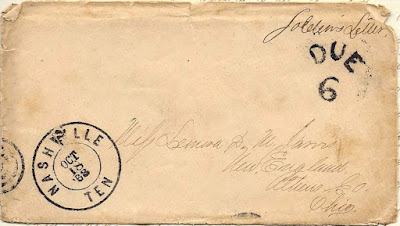
    This plain envelope is from Letter #6 which I have not cited anything from, but I have included the envelope picture here because of the "Due 6" cents stamp on it.  The cost of getting letters home for the soldiers varied at times due to factors such as a long distance or the need to be sent on a ship to get delivered.  I do not know what was the cause of the additional cost in this case.  Again, notice that this time George Jarvis wrote "Soldiers Letter" himself in the upper corner.  The postmark shows the letter clearly went through Nashville, TN to be delivered to Ohio.

Constantly changing circumstances sometimes mean rewriting is necessary Letter #7:

Chattanooga, Tennessee
October 3d 1863
Dear Sister,
Your kind note of 14 Sept. came duly to hand last evening about ten o’clock. You have no idea how glad I was to hear from you for I had not heard a word for nearly a month. I have written just as often as I could send letters and even oftener. Two or three letters I have written and kept a few days and then burned them up because I had no opportunity to send them. And by the time I would get an opportunity, they would be stale and I would write again. I have not written much account of the fight [Battle of Chickamauga] because you will get it in the papers much sooner and more correctly than I could give it to you, and I have not been on the field at all, but have been in the rear all the time where we get nothing but exaggerated reports till we ourselves get a paper containing an account of the battle. And even if I had been there, I could only have described first what came beneath my immediate notice.

    Jarvis takes keeping the family updated seriously, so as things are often changing, he updates letters if he can’t send them out.  And evidently, he doesn’t want his discarded letters to be found and read by someone other than his family.  Yet he is also honest in that he realizes his perspective is often limited and may not be the total truth of what has taken place.
    As I said at the beginning, I've only cited excerpts focused on illustrating his high value of staying connected with family through the letters.  I appreciate his sense of humor and also his humility.  He is sharing what he is experiencing so they can continue to be involved in his life even though separated by hundreds of miles.  Mail Call for him was a good thing to look forward to.  And because his letters have been preserved, we also get to see into his joy of keeping connected with his loved ones back home.

Children Projects:
1)  Do you think Jarvis’ action in letter #7 in getting rid of old letters that he didn’t get sent out and so had to update by rewriting is in part due to his finding that confederate soldier’s letter he mentions in letter #1?  He doesn’t want his feelings, concerns and perspectives being read by someone other than his intended readers, his family.
2)  Explore the issue of stamps being worth money by also reading the blog I mentioned in comments on letter #2.  Today if you took in a stamp to a store would they accept it as change?  No.  Especially the “forever stamp” which has a constantly changing value.
3) Look at the envelope pictures.  They are marked “soldier’s letter”, but they were not "free".  The family had to pay the money due to redeem them at the hometown post office.  And remember “3 cents” back then was of much greater value then 3 cents is today.


Saturday, March 5, 2022

Hard Crackers, Come Again No More! A Song Celebrating a Beloved Civil War Army Ration!

    Yes, the title above is being sarcastic.  John D. Billings shares his memory of a famous Civil War song that captures the “man in the ranks joy” over the army’s provisions (Hard Tack and Coffee.  Soldier’s life in the Civil War 1887).  This song that Billings remembers is a Civil War parody of a popular song from 1854 “Hard Times Come Again No More” by Stephen Foster that
challenged the fortunate to remember the struggles of the less fortunate.  The Civil War song is a satirical mocking of a staple of army rations that went by a variety of names: the hard cracker, hardtack, hard bread, army crackers, worm castles, sheet-iron crackers, tooth dullers.  Billings writes:

    “For some weeks before the battle of Wilson’s Creek, Mo., where the lamented [General Nathaniel] Lyon fell, the First Iowa Regiment had been supplied with a very poor quality of hard bread (they were not then -- 1861 -- called hardtack).  During this period of hardship to the regiment, so the story goes, one of its members was inspired to produce the following touching lamentation:

Let us close our game of poker,
Take our tin cups in our hand,
While we gather round the cook’s tent door,
Where dry mummies of hard crackers
Are given to each man;
O hard crackers, come again no more!
Chorus:  ‘Tis the song and sigh of the hungry,
“Hard crackers, hard crackers, come again no more!
Many days have you lingered upon our stomachs sore,
O hard crackers, come again no more!”

There’s a hungry, thirsty soldier
Who wears his life away,
With torn clothes, whose better days are o’er;
He is sighing now for whiskey,
And, with throat as dry as hay,
Sings, “Hard crackers, come again no more!”  -- Chorus

‘Tis the song that is uttered
In camp by night and day,
‘Tis the wail that is mingled with each snore,
‘Tis the sighing of the soul
For spring chickens far away,
“O hard crackers, come again no more!”  -- Chorus

When General Lyon heard the men singing these stanzas in their tents, he is said to have been moved by them to the extent of ordering the cook to serve up corn-meal mush, for a change, when the song received the following alteration:

But to groans and to murmurs
There has come a sudden hush,
Our frail forms are fainting at the door;
We are starving now on horse-feed
That the cooks call mush,
O hard crackers, come again once more!
Chorus:  It is the dying wail of the starving,
Hard crackers, hard crackers, come again once more;
You were old and very wormy, but we pass your failings o’er,
O hard crackers, come again once more!

The name hardtack seems not to have been in general use among the men of the Western armies.”  (p.118-19)

    In sharing this memory, Billings is reminding us that he and others did their duty even though it meant having to be “creative” with less than ideal food rations as well as with finding humor in what they were dealt.  Now certainly down through the centuries it has always been the habit, and the right, of the ranks to complain about the rations provided.  You have to enjoy the creativity of this song in lamenting what was a part of life for the soldier during the Civil War.

Children’s project:
1) Make some hardtack (there are various recipes on line; this one from the site:  Emerging Civil War – “Civil War Cookin’: Hard Tack Come Again No More”.  No, haven’t personally tried to use this recipe.  Others on line have differing measurements, salt added, and cooking times etc.
    3 cups flour (can use all-purpose, but whole wheat is more authentic)
Water (1 cup)
Add enough water to Flour so the mixture is soft, but not sticky, then knead for 8 minutes to make the dough elastic.  Roll the dough out and cut into 3”x 3” squares ½” thick.  Use a nail or something to prick four holes across in four rows down into the dough, then turn over and do this again -- (this prevents the cracker from “rising” as it bakes).  Bake at 450 degrees for 7 minutes, then reduce oven to 350 and bake for additional 7 – 10 minutes. They will be hard, and get harder as they cool and dry.  Bake them for looks, not for eating as they will be hard.  Don’t put them in a sealed container because they will mold, but let them dry out completely.  Add weevils for additional flavor and realism.  What?!? Just joking.  My family has a couple of hardtack pieces that we use for living history display that were given to us almost 30 years ago.  That should tell you how “durable” hardtack is.

2) Look up the words to the song “Hard Times Come Again No More” and compare them to this Civil War song parody.  (Parody: an imitation of the style of a particular writer, artist, or genre with deliberate exaggeration for comic effect).  Explore how parody works by looking at Foster’s song which calls on the favored in society to see the distressed struggling people around them and realize their plight.  Some say Foster’s song was his way of calling on the privileged to realize the needs of “the less fortunate” around themselves.  Others see his song as expressing his personal feelings as he descended into loss in his own life.  It most likely is a mix of both.  As culture continued to divide and the Civil War came, his song was indeed a challenge needed by society to look compassionately on others in their struggles.  Now obviously the parody Civil War song “Hard Crackers Come Again No More” is making the challenge for the “privileged” well-fed officers to see the plight of the “down-trodden” man-in-the-ranks.  Some eat well in the army, while many others must make do with poor quality rations as they obey the orders of the privileged to march and fight.   The “effectiveness” (= popularity) of the Hard Crackers song is in a great degree based upon the popularity of the Hard Times song in the culture of that time.  Maybe come up with a project where your child does a parody on something that is popular to them.

Friday, February 11, 2022

To My Wife -- A Civil War Poem from a Blessed Soldier far from Home

 At midnight, on my lonely beat,
    When darkness veils the wood and lea,
A vision seems my view to greet,
    Of one at home who prays for me.
Picture from a Civil War envelope

The roses bloom upon her check;
    Her form seems to me like a dream;
And on her face, so fair and meek,
    A host of holy beauties gleam.

For softly shines her flaxen hair;
    A smile is ever on her face;
And the mild, lustrous light of prayer
    Around her sheds a moonlike grace.

She prays for me, that's far away --
    The soldier in his lonely fight;
And asks that God in mercy may
    Shield the loved one and bless the right.

Until, though leagues may lie between,
    The silent incense of her heart
Steals o'er my soul with breath serene,
    And we no longer are apart.

So, guarding thus my lonely beat,
    'Mid darkening wood and dreary lea,
That vision seems my view to great,
    Of her at home who prays for me.

“Written by Joseph McArdle, Company F 163d New York Volunteers.  For some years First Assistant Chief of the Kansas City Fire department, and noted for his bravery and zeal in the discharge of duty.  He died a little over a year ago [Feb.21, 1893] from the effects of pneumonia, contracted while fighting a disastrous fire.  A self-contained and somewhat diffident old solider, he was loved by his comrades, especially by veteran Company A, but few suspected that he possessed any talent in a literary way.  Among his papers, however, was found the following little poem, written in 1864, dedicated to his wife, and containing sentiment worthy to be perpetuated.”  (Page 525 Under Both Flags  A Panorama of the Great Civil War as Represented in Story, Anecdote, Adventure and the Romance of Reality  Edited by C.R. Graham. 1896)

An obituary from Kansas City says that McArdle was born in Ireland in 1837, and came to the U.S. at age 10.  “When, in 1861, the war of the Rebellion broke out, McArdle enlisted in that famous 73d New York, 4th Regiment, Excelsior Brigade, 2d New York F’ire Zouaves.  In the fall of 1864, McArdle went to Kansas City and engaged for a short time in work for the government. But the urgent call for troops by President Lincoln once more appealed to his patriotism, and he re-entered the army, enlisting in the 51st Missouri, and serving as first sergeant. After five months’ service his regiment was mustered out of service, and McArdle went back to Kansas City.”  The obituary goes on to share about his service as their Fire Chief.
So McArdle would have been 27 years old when he wrote the poem about his love for his wife and her love for him that gave him strength as he served his country.  C.R. Graham is right.   Such love, such drawing strength to do the hard and challenging from knowing that you are loved by a wife who lets you go to do your duty while deeply desiring you to safely return is indeed a “sentiment worthy to be perpetuated”.  Consider the wisdom observations from King Solomon:

“He who finds a wife finds a good thing, and has obtained favor from the Lord”
Proverbs 18:22 NASV
“An excellent wife, who can find her?  For her worth is far above jewels.  The heart of her husband trusts in her, and he will have no lack of gain. Charm is deceitful and beauty is vain, but a woman who fears the Lord, she shall be praised.” 
Proverbs 31:10-11,30 NASV

For my tribute to my wife, see my post on Aug.24, 2016:  In Honor of my Beloved Wife Vicki Lynn Rowe.

Children’s Project:  Discuss how McArdle’s love for his wife and his knowing that she cared and prayed for him while he was away in danger serving his country would have been a source of strength for him.  Discuss how a strong marriage between husband and wife can be built by sharing how you and your spouse have deepened your love for each other.


Saturday, January 22, 2022

On a Muddy Path You have to Laugh -- Burnside's Mud March January 1863

    General Ambrose Burnside, who replaced George McClellan as commander of the Army of the Potomac in Nov.1862 hoped that his plans in January 1863 to march on Richmond would go better than the disastrous assault on Fredericksburg he had commanded in December 1862 had gone.  This time he planned for his army to outflank Lee’s defensive position at Fredericksburg by crossing the river upstream and drawing Lee’s men out of their defensive positions.  That was the plan. 

           On January 20, 1863 in unseasonably mild weather the Union Army started its march to cross the Rappahannock.  But during the night a violent storm began pouring down rain which continued coming over the next two days.  The torrential downpour turned the dirt roads into a muddy quagmire.  One solider wrote “The whole country was a river of mud, the roads were rivers of deep mire.”  Wagons sank to their wheel hubs in mud.  At times artillery became so hopelessly stuck that even a team of 12 horses and 150 men couldn’t pull one cannon out of the mud.  Soldiers slipped repeatedly, many losing their shoes in the thick mud.  The rain ended on the 22nd, but the unusual above freezing temperatures kept the roads sticky mud paths where horses and mules died of exhaustion.  To help raise his soldier’s spirits Burnside issued a whiskey ration, but instead it led to drunken troops brawling with one another.  Across the river, Confederate pickets watched the struggling Union troops with amusement.  Some put up a large sign on the riverbank that said “Burnside’s Army Stuck in the Mud” and another sign “This way to Richmond”.

    On the fourth day, Burnside cancelled the order for the advance and ordered his troops to return to their encampments.  Many in the ranks were totally demoralized.  A Massachusetts soldier, Charles E. Davis Jr. wrote, “It is not an exaggeration to say, that before or after, there was seen no such state of demoralization as possessed a large part of the Army of the Potomac at the end of this foolish undertaking.”  Lincoln replaced Burnside with Joseph Hooker as commander of the Army of the Potomac on Jan.26th. 

    All this historical background gives an interesting twist to a “revised prayer of the soldier while on the celebrated Burnside Mud March” that John Billings shares in his book of Civil War memories  (Page 72 Hard Tack and Coffee 1887):

"Now I lay me down to sleep
In mud that's many fathoms deep
If I'm not here when you wake, 
Just hunt me up with an oyster rake"

    You have to smile at the humor of whoever came up with this revision of a prayer meant to comfort.  Sometimes things in life are so bad, the only thing left is to find something to laugh over.  Yes, this is not a “significant historical notation”, but Billings gives us insight into one way the men in the ranks struggling through the muddy quagmire got a brief moment of relief.  And evidently one solider remembered it long after and shared it with Billings.  Good night and watch where you sleep.


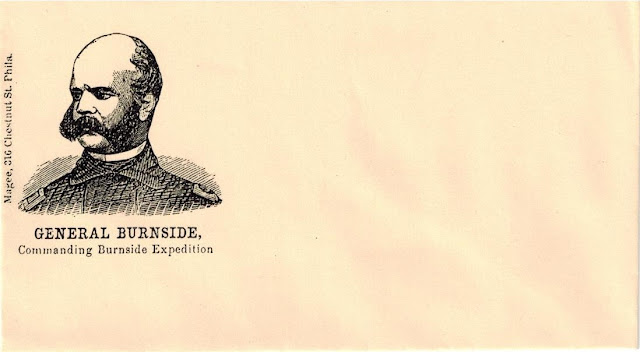
General Burnside Civil War Patriotic Envelope US48
celebrating his attacks on Confederate forces along the North Carolina coast
from February through June 1862.
Wonder how popular this one was among the soldiers after the mud march?

Children's Project:  Explore how both the Confederate signs and the Union revised prayer are both "sarcastic humor" using irony (intended meaning is the opposite of what's expressed).  Explore how what is humorous to one is not so funny to the other (am sure neither the Union soldiers seeing the CS signs nor General Burnside were pleased to be mocked).  This might be an interesting way to discuss different types of humor and the challenges of "cancel culture" with your children.  For example, should they share a joke mocking their teacher with the teacher?  And obviously jokes about you as a parent are always off limits.

Saturday, November 20, 2021

No One Cheered at Lincoln's Dedication Speech -- Gettysburg Address

    So how bad of a failure was Lincoln’s Gettysburg Address on November 19th, 1863? 
    The Democrat “Copperhead” Chicago Times newspaper (1854-1895) posted this editorial on Nov.24th, 1863 about the speech: "The cheek of every American must tingle with shame as he reads the silly, flat and dishwatery utterances of the man who has to be pointed out to intelligent foreigners as the President of the United States."
    C.R. Graham includes in his book, Under Both Flags. A Panorama of the Great Civil War as Represented in Story, Anecdote, Adventure, and the Romance of Reality (1896) p.73-74, an account of the crowd’s acceptance of Lincoln’s speech at the Gettysburg event by W. H. Cunnington, who was a newspaper correspondent up on the stage. Accounts differ as to how well accepted Lincoln’s speech was, and what the exact wording of the speech was etc. Don’t know how long after the war this account was written down by Cunnington. It is interesting that he views the audience being taken by surprise at how short it was and by the non-melodramatic way Lincoln spoke as explanations as to why the crowd did not cheer when Lincoln spoke. Since the previous speech had been two hours long, it is possible that the shortness of Lincoln’s address may indeed have been a reason the crowd was unresponsive. Again, this is one person’s memory of that historic event.
 
Cunnington writes:
    “It was my privilege to be present at the dedication of the Soldier’s National Cemetery at Gettysburg, on the afternoon of November 19, 1863, and to hear the now world-famous address of Abraham Lincoln on that occasion. I can bear witness to the fact that this address, pronounced by Edward Everett to be unequaled in the annals of oratory, fell upon unappreciative ears, was entirely unnoticed, and wholly disappointing to a majority of the hearers. This may have been owing in part to the careless and undemonstrative delivery of the orator, but the fact is that he had concluded his address and resumed his seat before most of the audience realized that he had begun to speak.
    It was my good fortune as a newspaper correspondent to occupy a place directly beside Mr. Lincoln when he delivered this brief oration, and on the other side of the speaker was Hon. W. H. Seward. Other members of the Cabinet had seats on the stand, and I also noticed Governors Curtin, Seymour, Tod, Morton, and Bradford, Hon. Edward Everett, and Colonel John W. Forney.
    At the conclusion of Mr. Everett’s scholarly oration, Mr. Lincoln faced the vast audience. He looked haggard and pale, and wore rather a shabby overcoat, from an inside pocket of which he drew a small roll of manuscript. He read his address in a sort of drawling monotone, the audience remaining perfectly silent. The few pages were soon finished; Mr. Lincoln doubled up the manuscript, thrust it back into his overcoat pocket, and sat down. Not a word, not a cheer, not a shout. The people looked at one another, seeming to say, “Is that all?”  
    The full text of Mr. Lincoln’s address was as follows:
    ‘Fourscore and seven years ago our fathers brought forth on this continent a new nation, conceived in liberty, and dedicated to the proposition that all men are created equal.
    Now we are engaged in a great civil war, testing whether that nation, or any nation so conceived and so dedicated, can longer endure. We are met on a great battlefield of that war. We have come to dedicate a portion of that field as a final resting-place for those who here gave their lives that that nation might live. It is altogether fitting and proper that we should do this.
    But, in a larger sense, we cannot dedicate, we cannot consecrate, we cannot hallow this ground. The brave men, living and dead, who struggled here, have consecrated it, far above our poor power to add or detract. The world will little note nor long remember what we say here, but it can never forget what they did here. It is for us the living, rather, to be dedicated here to the unfinished work which they who fought here have thus far so nobly advanced. It is rather for us to be here dedicated to the great task remaining before us – that from these honored dead we take increased devotion to that cause for which they gave the last full measure of devotion – that we here highly resolve that these dead shall not have died in vain – that this nation, under God, shalt have a new birth of freedom, and that government of the people, by the people, for the people, shall not perish from the earth.’ 
    I am well aware that accounts have differed as to the manner of this address and its reception by the audience. I was an eye-witness and hearer, and my position was immediately beside the speaker, therefore that foregoing account may be relied upon.”

    In the days following the event, Lincoln’s Gettysburg address got both positive and negative reviews by various newspapers. Democrat papers like the Chicago Times paned Lincoln’s speech, after all the people there didn’t cheer, or they laughed at it. Many Republican leaning newspapers were more complementary of his wording and presentation, or at least neutral in their evaluation of it. It should be no surprise that “politics” played into how Lincoln’s words were evaluated back then, just like happens today.  Growing up in the 1950s/60s, my family would go and watch the Memorial Day parade in our small town in upstate New York, and then go to the cemetery for the Memorial Service. Each year from our local high school Senior class a young lady was selected to read the poem “In Flanders’s Fields”, and a young man to read the Gettysburg address. I got to do it my Senior year. That was back when Lincoln was honored and his words were viewed as a positive challenge. Now his statues are being defaced and torn down by ‘woke progressives’. Guess the democrats haven’t changed much in their assessment of Lincoln and his speech.
    Various studies have been done tracing how his Gettysburg address has been interpreted over the years. And there have been changes of interpretation of what he was saying, and differing views of what it should inspire in people who hear it today. Differences of interpretation are legitimate discussions.
    But to interpret his speech as hateful and representing a foul nation that is all just show, with no real equality is a Marxist lie being pushed by those who hate the freedom our nation was founded on: “that all men are created equal, that they are endowed by their Creator with certain unalienable rights, that among these are Life, Liberty and the pursuit of Happiness.–That to secure these rights, governments are instituted among men, deriving their just powers from the consent of the governed.”
    Yes, indeed our nation has had many serious problems over the years. Some have been addressed and other still remain. Equality of opportunity (NOT a guarantee of success or acceptance, but opportunity to work for it) and equality before the law (riches, connections, political power do not give an advantage or give a disadvantage) is the solid foundation that is needed to constantly address differences and conflicts. 
    “Equity” is a “woke progressive” ploy to give the elites power over the masses who submit for “compensation” given to preferred “categories” of people. I posted a satirical blog back in 2013 about what then President Obama’s version of the Gettysburg address might have sounded like had he given it in 1863 instead of Lincoln (What would President Obama’s version of the Gettysburg Address be?). I suggested that Obama would have praised “federalization”. I didn’t know how correct I was in describing the agenda of the “woke progressives”. I choose to stand with Lincoln, imperfect as he was. And I stand with America, imperfect as we are. Judge others individually by the character of their heart, not by their group ethnicity. Reject the Marxist equity path which divides us into group categories to allow the elites to control us. Do not let the men who died at Gettysburg die in vain.

Monday, May 31, 2021

Civil War Veteran's Memorial Day Poem

Like stars that sink into the west,
So one by one we seek our rest;
The column’s brave and steady tread
With banners streaming overhead,
Will still keep step, as in the past,
Until the rear guard comes at last.
Ah, yes, like stars we take our flight,
And whisper, one by one, “Good night.”
Yet in the light of God’s bright day,
Triumphant, each again will say,
"Hail, comrade, here has life begun,
The battle’s fought, the victory’s won!”

by George M. Vickers

p.127 Under Both Flags  A Panorama of the Great Civil War as Represented in Story, Anecdote, Adventure and the Romance of Reality  Edited by C.R. Graham. 1896


    Graham cites three other poems by George M. Vickers in his book. On page 456 Graham gives a brief biography of George Vickers. “The author was a private soldier in the Second Regiment, Pennsylvania Reserve Corps, when commanded by Colonel, afterwards General, McCandless, and in more than one desperate battle witnessed [McCandless’s] heroism.” From the sentiment of this poem, it is definitely written post-war, as the veterans are dying off one by one. 
    Memorial Day observed on the last Monday of May, remembers and honors the men and women who died while serving in the U.S. military. Originally known as Decoration Day, it originated in the years following the Civil War with the great loss of life and the establishment of national cemeteries. By the late 1860s many towns across the US began to hold springtime tributes to their lost soldiers like this. There is much dispute as to the “origin” of this holiday. What seems most probable is that it arose as “tradition” in many towns across the US in both the north and the south in the years following the end of the war and gradually became part of the spring time tradition that finally became officially nationalized as an official federal holiday in 1971. It arose out of the grief over the loss of husbands/sons/fathers/brothers in the war as a means to find some relief in remembering and honoring them.
    On May 5, 1868, General John A. Logan, national commander of the Grand Army of the Republic, an organization for Northern Civil War veterans, called for a nationwide day of remembrance he called Decoration Day. “The 30th of May, 1868, is designated for the purpose of strewing with flowers, or otherwise decorating the graves of comrades who died in defense of their country during the late rebellion, and whose bodies now lie in almost every city, village and hamlet churchyard in the land.” The date was chosen because it was not the anniversary of any particular battle.
    On the first Decoration Day at Arlington National Cemetery, General James Garfield made a speech to 5,000 who attended and who decorated the graves of the 20,000 Civil War soldiers buried there. Many Northern states held similar commemorative events, with the tradition being repeated in subsequent years. By 1890 each one had made Decoration Day an official state holiday. Southern states, on the other hand, continued to honor their dead on other days during the spring until after World War I.


Children’s Project:
Have your child draw a picture showing what Memorial Day means to them.
Or
Ask your child to compose their own poem about Memorial Day

Saturday, May 9, 2020

Letter Writing and Postage Stamps Importance to the Civil War Soldier

     John D. Billings' recollections of his time served in the Army of the Potomac have many interesting insights into life in the army during the Civil War.  In 1887 he published them in his book Hard Tack & Coffee -- Soldier's Life in the Civil War.  I hope you will find Billings' brief description of letter writing and dealing with postage stamps in the chapter "Life in Tents" as interesting as I have.  [page 62-63].

Letter writing was important
"The manner in which the time was spent in these tents [Sibley style] and, for that matter, in all tents varied with the disposition of the inmates.  It was not practicable for men of kindred tastes to band themselves under the same canvas, and so just as they differed in their avocations as citizens, they differed in their social life, and many kinds of pastimes went on simultaneously.  Of course, all wrote letters more or less, but there were a few men who seemed to spend the most of their spare time in this occupation.  Especially was this so in the earlier part of a man's war experience.  The side or end strip of a hardtack box on the knees, constituted the writing-desk on which this operation was performed." 
                                                  
     I've always appreciated the fact that the many letters written during that time have given us greater insight into "what was going on" than the historical headlines about "date and location and armies fought here" could ever do alone.  Sadly our modern means of communications (which are very helpful and enjoyable) will not do the same for future generations looking back on us.  Oh well, life moves on.  For reenactors who wish to portray letter writing at an event, using a wood board as a writing desk might communicate to spectators better the creativity of the soldier-in-the-ranks  overcoming obstacles.  "Let the officers have their fancy writing desks.  We men in the ranks can get the job done even without the advantages of privilege."  The picture here is from the book.  I have seen it before but didn't know where it originally came from.

Postage Stamps were a necessary Challenge
     Then Billings gives insight into why and how postage stamps became important to the soldier, as well as the challenges of keeping the stamps usable:

"It will be remembered that in the early months of the war silver money disappeared, as it commanded a premium, so that, change being scarce, postage stamps were used instead.  This was before scrip was issued by the government to take the place of silver; and although the use of stamps as change was not authorized by the government, yet everybody took them, and the soldiers in particular just about to leave for war carried large quantities away with them -- not all in the best of condition.  This could hardly be expected when they had been through so many hands.  They were passed about in little envelopes, containing twenty-five and fifty cents in value.
Many an old soldier can recall his disgust on finding what a mess his stamps were in either from rain, perspiration, or compression, as he attempted, after a hot march, to get one for a letter.  If he could split off one from a welded mass of perhaps a hundred or more, he counted himself fortunate.  Of course they could be soaked out after a while, but he would need to dry them on a griddle afterwards, they were so sticky."

     One time a few years ago I had a reenactor ask me for an assortment of my reproduction stamps so that he and his fellow comrades could use them as "money" as they played card games at events as the spectators walked by.  In spite of my not wanting to encourage gambling (after all, I do portray the U. S. Christian Commission), I did share some with him because I agreed that it would allow them to portray more accurately to the spectators what the soldiers did back then.
      Billings' description about the stamps getting wet and stuck together is an interesting insight into the many challenges soldiers faced as they lived on the march. When the war broke out the uncertainty over what was going on and people's distrust over the value of the Greenback paper money being issued led to the hoarding of coins made of copper & silver & gold.  But people still needed to give or get back small change in making purchases such as a 3 cent loaf of bread or a 5 cent quart of milk.  During the first few years of the war stamps became by common acceptance and out of necessity "money".  In July 1862 Congress attempted to address the coin shortage by passing a law which allowed postage stamps to satisfy debts owed to the government of up to $5.  People incorrectly presumed that this officially approved stamps as usable for any type of debt or purchase.  In 1862 John Gault came up with the creative encased postage stamp coin solution.  Using button making machines he enclosed postage stamps in silver or brass buttons with a thin mica layer on one side which allowed you to see the stamp's denomination -- this helped preserve the actual stamp better.  He would later add on the back of the encasement button advertisements for various company about their products or services.  His invention was short lived as in 1863 the U.S government issued official script factional currency to over come the coin shortage.  Also during this time various vendors issued "private issue tokens" that they gave out as change when sales were made.
     All this shows the creativity of the people back then as they faced the challenges arising from society being torn apart.  I've often marveled at the fact that postage stamps back then could be cut in half and still used to mail out letters.  For example, you could take a 2 cent Black Jack, and cut one stamp in half, put it on the envelope next to a complete 2 cent stamp and that would total up to the 3 cents needed to mail the letter.  Can you imagine trying to do that today?  The US Postal Service would probably call the police and have you arrested!  Times have certainly changed as the bureaucrats have gotten greater power to control us with "the official regulations and procedures".
     When we forget history, we lose examples of how people before us have risen to the challenge of "changing times".  We should never be herded into the socialist mentality that "the government" or "the experts" will solve what's wrong.  We as individuals need to always be experimenting with options to overcome the difficulties.  It may be having to use a board for a desk or having to soak apart stamps and then dry them on a griddle.  Creativity needs to come from each of us.  That makes us better and stronger, and will also make for good stories later on we can tell around the campfire.